
|
Checking for Corrosive Primers |
Post Reply 
|
Page 12> |
| Author | |
britrifles 
Senior Member 

Joined: February 03 2018 Location: Georgia, USA Status: Offline Points: 8404 |
 Post Options Post Options
 Thanks(0) Thanks(0)
 Quote Reply Quote Reply
 Topic: Checking for Corrosive Primers Topic: Checking for Corrosive PrimersPosted: January 23 2026 at 6:22am |
|
The question of shooting corrosive surplus ammo comes up from time to time. Many think all Berdan primed .303 Mk 7 ammunition is corrosive, but that is not the case.
The golden rule of course is to assume the primers are corrosive and clean the bore, chamber and bolt head the same day you shot the ammo, preferably immediately after shooting. In humid conditions, rust will form very quickly. There are several methods to determine if the primers are in fact corrosive. The one I used is to pull the bullet from the cartridge, dump the powder, chamber the empty case in the rifle with the muzzle resting on a clean sheet of steel (not stainless steel) and snap the primer. I sanded clean a piece of scrap sheet steel and divided it into quarters with an ink marker. The “suspect” Berdan primed case is in the lower left, 1951 Dominion (DAC) Mk 7z. Upper left is a PPU case primed with a WLR primer. Lower right is a 1943 Defence Industries (DI) Boxer primed Mk 7. Upper right is unused as a control. 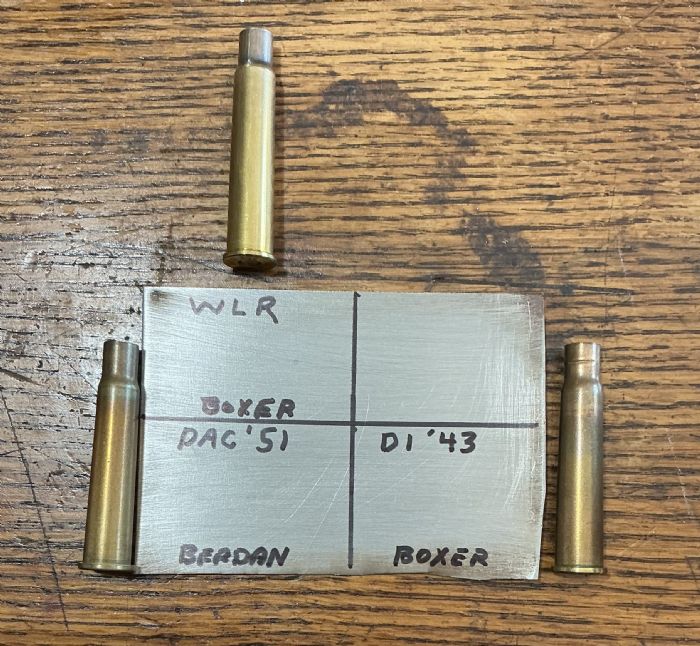 This photo after snapping the primers in the rifle held vertically with the muzzle resting on the sheet steel. It appears that the Berdan primer put more deposits on the sheet than the other two primers, it may be a hotter primer, sounded louder than the other two. 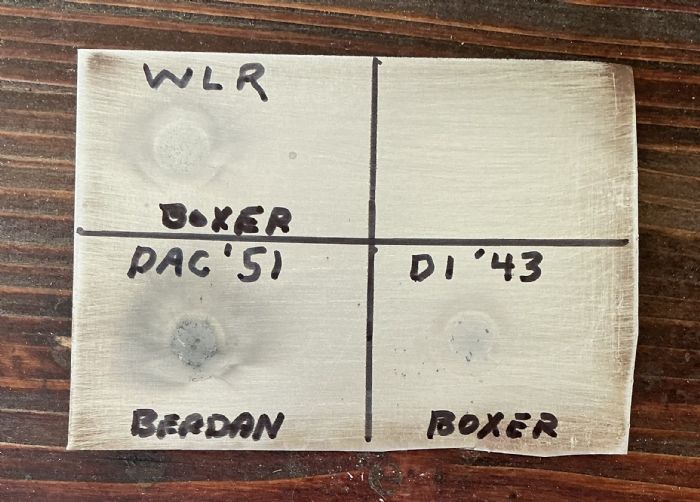 I placed the test sheet into a humidor, as it’s been quite dry in the house (about 35% RH). To boost the humidity in the humidor, I sprayed the inside with a water mist, some of it landed on the sheet steel. The next day, light surface rust appeared on the sheet the next day, in both the WLR Boxer primer and Dominion Berdan primer quadrants, but I believe this is unrelated to the primer fouling. After 5 days in the humidor at 65 to 68 % Relative Humidity, 68 deg F, there was no change to the sample where the primer fouling was deposited. Conclusion: Those Dominion Arsenal 1951 Berdan Primers are non-corrosive. 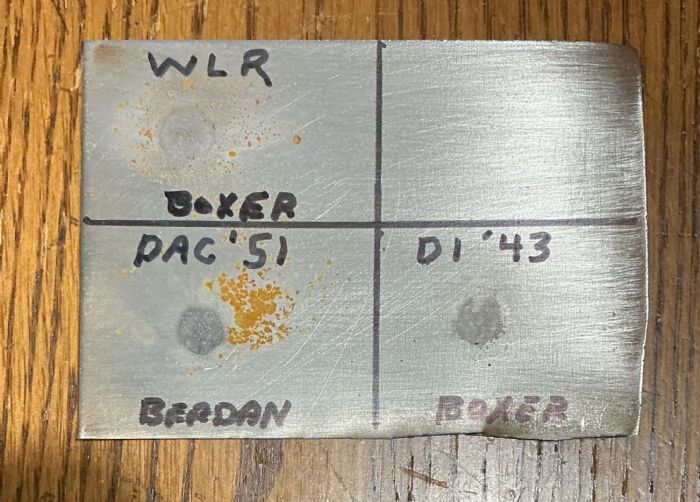 I will see if I can dig up a known corrosively primed case and try this again. But at 65% humidity, if these were chlorate primers, there should have been a very dark ugly looking area with pitting forming where the primer fouling was deposited after just a day or two. |
|
 |
|
|
paddyofurniture
Senior Member

Joined: December 26 2011 Location: NC Status: Offline Points: 7942 |
Post Options
Thanks(0)
Quote Reply
Posted: January 23 2026 at 7:28am |
|
Good to know.
Thanks |
|
|
|
|
Bear43
Special Member 

Donating Member Joined: August 11 2010 Location: Doland, SD Status: Offline Points: 3500 |
Post Options
Thanks(0)
Quote Reply
Posted: January 23 2026 at 7:43am |
|
That's interesting. Looking forward to seeing you do another with known corrosive just to see how it looks in the end.
|
|
|
|
|
britrifles
Senior Member
Joined: February 03 2018 Location: Georgia, USA Status: Offline Points: 8404 |
Post Options
Thanks(0)
Quote Reply
Posted: January 23 2026 at 12:08pm |
|
I forgot to mention what I found pulling down the 1943 DI Mk 7z and 1951 DAC Mk 7.
Both cartridges had smokeless stick granulation powder that appeared identical in dimensions of the sticks and the colour to 1960’s 3031 powder I have in my cabinet. The sticks measured 0.030” in diameter and 0.084” long, which corresponds to IMR 3031 per this 1960’s article in the NRA Illustrated Reloading Handbook (below). 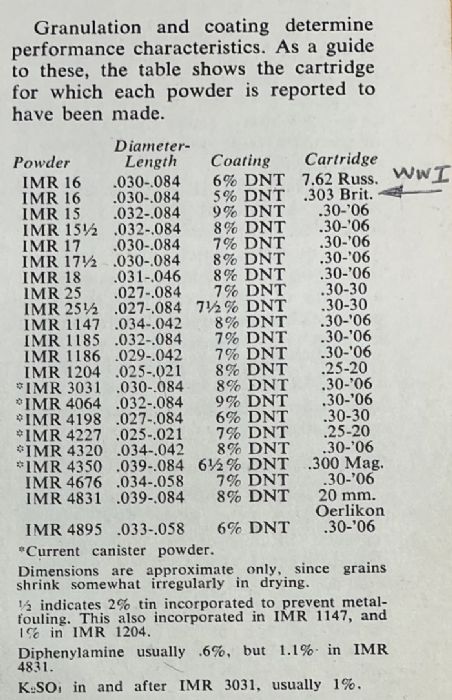 Per this Handbook, IMR 3031 dates back to 1934. It is a “canister” powder sold commercially so might be slightly different from the “bulk” powders produced for mass loading of military cartridges. The bulk powders do have variation from lot to lot and the ammunition manufacturers do their own tests to determine the charge weight to meet the military specification for muzzle velocity. Whereas the Canister powders must be carefully blended to give very similar burn rates and charge weights for the same velocity from lot to lot for obvious reasons. I read somewhere that IMR 3031 replaced IMR 16, used to load .303 British cartridges in WWI and was so named “3031” after the .303 Cartridge with 1% K2SO (potassium sulphate, a muzzle flash inhibitor). The NRA handbook does say IMR 16 was used to load .303 cartridges in WWI and probably the first use of IMR powders in the .303. I need to try 3031 again, perhaps with some pulled Mk 7 bullets. |
|
|
|
|
Zed
Special Member

Donating Member Joined: May 01 2012 Location: France Status: Offline Points: 6460 |
Post Options
Thanks(0)
Quote Reply
Posted: January 23 2026 at 12:54pm |
|
That's interesting.
I have some WW2 .303 rounds. I have pulled a few bullet's because of some corrosion on the those cases. It is a stick powder. I will check the head stamp tomorrow, but I think most are 1944 and 43. A couple of the rounds had humidity in the powder stick. These rounds are from the lot I got with the Resistance No4. Although I also have a box of 200 rounds from the same period in what looks like good shootable condition. So I should pull a couple of those to inspect as well.
|
|
|
It's nice to be important, but it's more important to be nice!
|
|
|
|
|
britrifles
Senior Member
Joined: February 03 2018 Location: Georgia, USA Status: Offline Points: 8404 |
Post Options
Thanks(1)
Quote Reply
Posted: January 23 2026 at 1:12pm |
|
Shaun, if the powder appears to clump or turn a bit reddish, it’s severely deteriorated from long term storage in hot conditions. Some of these powders are prone to this and potentially can spontaneously ignite in a closed can (not usually in a cartridge though).
|
|
|
|
|
Shamu
Admin Group

Logo Designer / Donating Member Joined: April 25 2007 Location: MD, USA. Status: Offline Points: 20510 |
Post Options
Thanks(0)
Quote Reply
Posted: January 23 2026 at 1:50pm |
|
Yes IMR3031 is basically as close as makes no difference to IMR16. Its kind of an open secret that when they switched to the granulated powders from the cordite strands the primers also became non corrosive. I think the best definition would be any "British-Made Mk7 ball with cordite propellant will be corrosive". This kind of tallies with my South African ammo experiences. The .303 head-stamped stuff IS corrosive & cordite filled. The newer R1M3Z with the stick powder (unknown) is definitely not.
|
|
|
Don't shoot till you see the whites of their thighs. (Unofficial motto of the Royal Air Force)
|
|
|
|
|
Canuck
Special Member

Donating Member Joined: January 17 2012 Location: Cochrane, AB Status: Offline Points: 4021 |
Post Options
Thanks(0)
Quote Reply
Posted: January 23 2026 at 2:05pm |
|
Neat experiment!
|
|
|
Castles made of sand slip into the sea.....eventually
|
|
|
|
|
britrifles
Senior Member
Joined: February 03 2018 Location: Georgia, USA Status: Offline Points: 8404 |
Post Options
Thanks(0)
Quote Reply
Posted: January 23 2026 at 2:18pm |
|
Somewhere in my Dad’s stash of .303 ammo I now have is some Berdan primed Canadian Mk VII (cordite) with Cupro Nickel bullets, I think 1942 or 1944. They are incredibly accurate, I shot some of it years ago. I cleaned afterwards assuming they were corrosively primed. I’ll pull one of those bullets and do the corrosive primer test on the upper right quadrant of the test piece that hasn’t been used yet.
|
|
|
|
|
britrifles
Senior Member
Joined: February 03 2018 Location: Georgia, USA Status: Offline Points: 8404 |
Post Options
Thanks(0)
Quote Reply
Posted: January 24 2026 at 5:47am |
|
Went thru one of the .303 ammo boxes I have and found a few loads that might have corrosive primers:
1943 and 1949 WRA Mk VIIz Boxer Primed 1945 DAC Mk VII Berdan Primed The WRA rounds are loaded with NC powder, but the US was using corrosive large rifle primers in WWII for their own ammunition production and did not make the change over to non-corrosive until 1951. The Dominion rounds are cordite loaded, so possibly have chlorate primers. Will do the test again and see what happens. This time will pour some boiling water down the bore before cleaning with Hoppes 9, just in case they are corrosive. |
|
|
|
|
britrifles
Senior Member
Joined: February 03 2018 Location: Georgia, USA Status: Offline Points: 8404 |
Post Options
Thanks(0)
Quote Reply
Posted: January 24 2026 at 9:23am |
|
I pulled down the two WRA ‘49 and ‘45 DAC rounds, snapped the primers with the muzzle resting on the steel test sheet. The DAC Berdan primer did not leave any primer residue, a few small specs. The WRA Boxer primer left a similar gray stain as the others I tested last week. Test sample is back in the humidor and will see what happens.
The WRA looked to have the same powder as the Dominion and DI Mk 7z loads. Same size of sticks, 0.030 x 0.084 inches, same colour, most likely IMR 3031. Powder still looks good. Primers ignited fine too. I think the WRA bullet is a solid lead core, it’s a fair bit shorter than the DAC bullet. The Dominion Mk 7 bullet measured 0.3124, might explain why this ammo shoots so well, 1 to 1.5 MOA out of my Fulton No. 4. Only have about 25 rounds of it left. 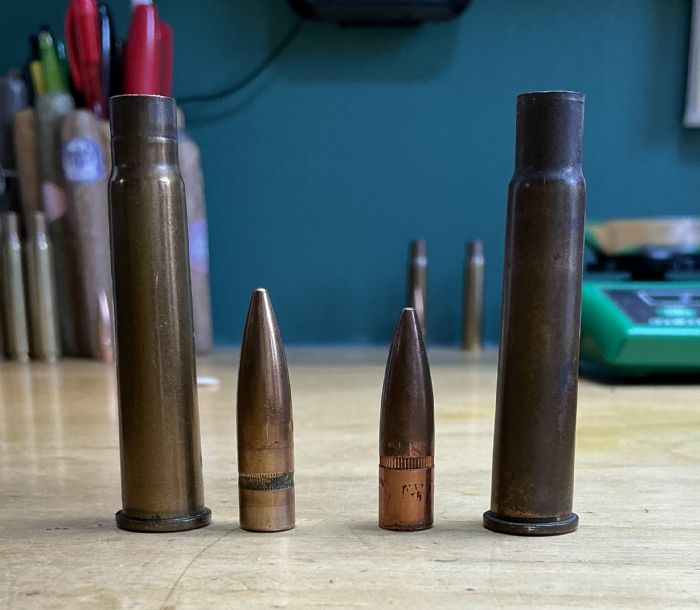 |
|
|
|
|
britrifles
Senior Member
Joined: February 03 2018 Location: Georgia, USA Status: Offline Points: 8404 |
Post Options
Thanks(0)
Quote Reply
Posted: January 25 2026 at 5:14am |
|
After 20 hours in the humidor (66 deg, 65% RH) the WRA ‘49 Boxer primer is showing significant corrosion of the steel sheet. No change in the Dominion’45 Berdan primer.
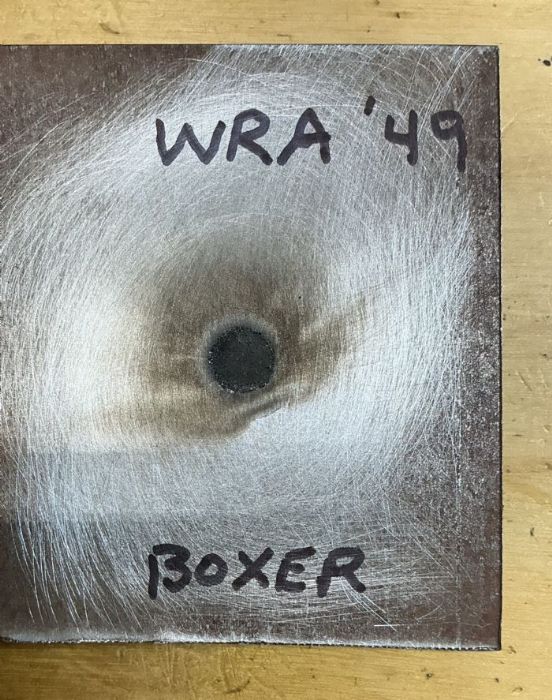 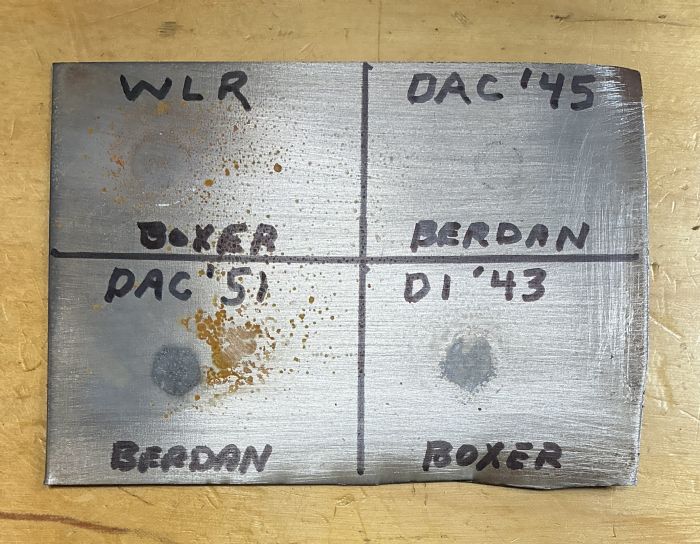 Looking closely at the DAC ‘51 Berdan sample, there may be some light pitting showing. It’s been in the Humidor for a week now. But the WRA ‘49 is much worse after less than 24 hours, very dark and surrounded by light rust forming. At some point, I’ll clean these to remove the fouling (with Hoppes 9) and see if there is any pitting. The WRA ‘49 is on the back side of the sheet, was an afterthought. |
|
|
|
|
Zed
Special Member
Donating Member Joined: May 01 2012 Location: France Status: Offline Points: 6460 |
Post Options
Thanks(0)
Quote Reply
Posted: January 25 2026 at 8:51am |
|
Geoff, with regard to the powder that I removed.
I put all of it, dry and humid, on a concrete slab in the garden, and burnt it! Although I did take a few photos of it at that time. I appreciate the information regarding it's potential to self ignite, that's definitely worth knowing. But rest assured that I always destroy old powder almost immediately after removal. I've found that pushing the bullet in slightly to release the crimp, makes them easier to pull out.
|
|
|
It's nice to be important, but it's more important to be nice!
|
|
|
|
|
britrifles
Senior Member
Joined: February 03 2018 Location: Georgia, USA Status: Offline Points: 8404 |
Post Options
Thanks(0)
Quote Reply
Posted: January 25 2026 at 9:58am |
|
I dodged a disaster a few years back. An old can of powder that was Dad’s had rapidly experienced deterioration. All the stabilizer (diphenhydramine) was consumed and the acids were releasing, the steel can was rusted right thru (that’s how I noticed it). In enclosed spaces, the heat generated can’t release fast enough and the powder can spontaneously ignite. I decided to burn up all of Dad’s remaining powder, except for a few cans of what I can use up and I check those periodically.
You can tell when this process starts by the smell of the powder, and it turns to a reddish brown dust. Opening a can will also emit red-brown fumes/dust. No joke, this is very serious. Storing powder is hot environments speeds up the deterioration. |
|
|
|
|
Canuck
Special Member
Donating Member Joined: January 17 2012 Location: Cochrane, AB Status: Offline Points: 4021 |
Post Options
Thanks(0)
Quote Reply
Posted: January 25 2026 at 11:19am |
|
Thanks for that very important tip!
|
|
|
Castles made of sand slip into the sea.....eventually
|
|
|
|
|
britrifles
Senior Member
Joined: February 03 2018 Location: Georgia, USA Status: Offline Points: 8404 |
Post Options
Thanks(0)
Quote Reply
Posted: January 25 2026 at 12:37pm |
|
I also found some old .30-06 ball cartridges with pinhole corrosion thru the case from deteriorated powder.
|
|
|
|
|
Post Reply
|
Page 12> |
| Tweet |
| Forum Jump | Forum Permissions You cannot post new topics in this forum You cannot reply to topics in this forum You cannot delete your posts in this forum You cannot edit your posts in this forum You cannot create polls in this forum You cannot vote in polls in this forum |


 Topic Options