
|
Case stretch |
Post Reply 
|
| Author | |
Krisincolfax 
Groupie 
Joined: December 01 2023 Location: Washington St. Status: Offline Points: 36 |
 Post Options Post Options
 Thanks(0) Thanks(0)
 Quote Reply Quote Reply
 Topic: Case stretch Topic: Case stretchPosted: December 03 2023 at 2:38pm |
|
Here is a photo of a fired and a full length resize case
( fired in a No4 Mk1 ) I understand that LE's have a generous throat , does the fired case seem to be extreme ? Post script I don't remember why I had the bullets in the picture as it was taken a while back 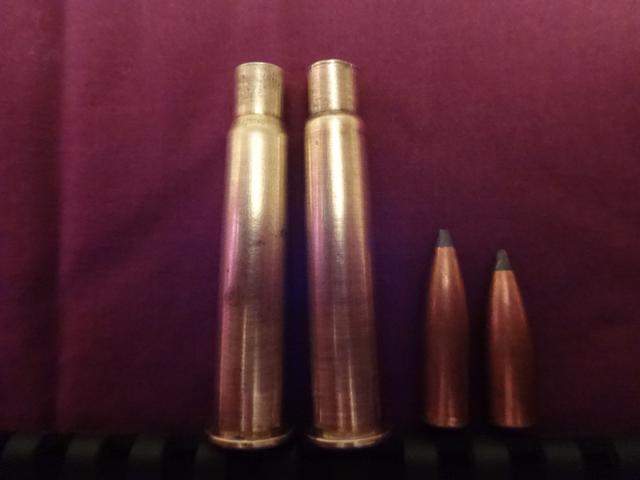 |
|
 |
|
|
Shamu
Admin Group 

Logo Designer / Donating Member Joined: April 25 2007 Location: MD, USA. Status: Offline Points: 20510 |
Post Options
Thanks(0)
Quote Reply
Posted: December 07 2023 at 6:21pm |
|
The fired cases look pretty much "normal" to me. "Long throat", doesn't really come into it. That applies more to bullet seating depth. I've found that the best seating depth is one caliber of width as a MINIMUM seating depth in the case. It probably going to jump to the lands whatever you do, but by giving some depth inside the case neck at least gets it "started off right" This is where bullet profile comes into play. Compare these bullets all seated to the same OAL. Look at the variation of case neck engagement!  I assume the F/L sized is the one to the right as viewed? Look at the amount the resized brass has been "Set Back" That's not going to harm your shooting, but it is going to shorten your case life. You might want to google "Partial Full-Length resizing" & check it out. |
|
|
Don't shoot till you see the whites of their thighs. (Unofficial motto of the Royal Air Force)
|
|
|
|
|
Krisincolfax
Groupie
Joined: December 01 2023 Location: Washington St. Status: Offline Points: 36 |
Post Options
Thanks(0)
Quote Reply
Posted: December 07 2023 at 7:20pm |
|
Full length resize on the left / fired case on the right as pictured and and most likely a Sierra 180
grain left and a 150 on the right |
|
|
|
|
britrifles
Senior Member 

Joined: February 03 2018 Location: Georgia, USA Status: Online Points: 8404 |
Post Options
Thanks(0)
Quote Reply
Posted: December 08 2023 at 4:09am |
|
To get any reasonable case life, you have to get the case to “headspace” on the chamber shoulder, not on the rim. That holds the case head back against the bolt face and minimizes case web stretching. You do this by neck sizing only, or “partial length” sizing that pushes the shoulder back by .002 inches at most.
You can see that the shoulder is blown forward on the fired case. As Shamu said, the throat has nothing to do with this, it is the chamber dimensions, particularly the depth to the shoulder from the back face of the barrel. These chambers are all reamed “long” to accommodate a certain amount of dirt from the battlefield. The answer is not to throw dirt in the chamber, but to neck size the brass. After 12 to 15 neck sizing cycles, you will begin to feel some resistance in fully locking the bolt. At that point, the firing and reloading cycles have stretched the brass enough that its headspace to the shoulder is longer than the chamber and locking the bolt has to squeeze the case down. The answer here is to partial length resize. Back out the die such that the shoulder is just barely bumped back, I go for a 0.001 - 0.002 inch setback. That will get you another 10 to 12 neck size reloads. Use a Lee Collet neck sizer if you have one. If the rifle headspace is on the tight side, that is just over 0.064 inches, you will get 40 plus reloads from your brass until you begin to get case web thinning and the first signs of circumferential cracks, about 1/2 inch above the case head. None of this really matters unless you are a reloader who shoots a lot and would otherwise quickly run out of brass. |
|
|
|
|
Post Reply
|
|
| Tweet |
| Forum Jump | Forum Permissions You cannot post new topics in this forum You cannot reply to topics in this forum You cannot delete your posts in this forum You cannot edit your posts in this forum You cannot create polls in this forum You cannot vote in polls in this forum |


 Topic Options