
|
No. 4 Positive Compensation at 800 Yds |
Post Reply 
|
| Author | ||
britrifles 
Senior Member 

Joined: February 03 2018 Location: Georgia, USA Status: Online Points: 8404 |
 Post Options Post Options
 Thanks(1) Thanks(1)
 Quote Reply Quote Reply
 Topic: No. 4 Positive Compensation at 800 Yds Topic: No. 4 Positive Compensation at 800 YdsPosted: January 20 2025 at 4:32am |
|
|
Some have you have been following my posts on the .303 Reloading Forum where I’m showing test results of bullet elevation point of impact vs muzzle velocity. This was with my No. 4 T at 600 yards. There was a strong trend of bullet elevation POI increasing with velocity. And it’s causing me to loose points in the sniper matches because of the muzzle velocity variations of 30 to 50 fps, and sometimes more.
I took a look thru my score data book on shooting my No. 4 DCRA 7.62 at 800 yards and did some of the same plots. These are all shot prone in the sling with aperture sights with my Long Range Match Load: Lapua Case BR-2 Primer 44.0 gr Varget 168 Tipped MatchKing 2.95” COAL These are two different 12 shot groups, one at 45 deg F and the other at 86 deg F. It’s not surprising that the muzzle velocity is about 30 fps slower on the colder day (a 40 degree difference). But, what you see here is something that EGB Reynolds describes as “Positive Compensation”. This is what made the 7.62 favored for long range shooting, particularly in how it was bedded. Note that elevation does not change with muzzle velocity, it remains rather flat through a 80 fps range in muzzle velocity. This is because fast bullets leave the muzzle at a lower angle of departure than slow bullets. So here you have it, proof that the No. 4 exhibits positive compensation. I wish my T did this. The question i need to find out is why not? For reference, the 3 MOA horizontal grid line corresponds to the vertical center of the bull.  |
||
 |
||
|
britrifles
Senior Member
Joined: February 03 2018 Location: Georgia, USA Status: Online Points: 8404 |
Post Options
Thanks(0)
Quote Reply
Posted: January 21 2025 at 3:49am |
|
|
I’ve cleaned up the plots on the Shot Elevation Point of Impact (POI) vs Muzzle Velocity from the first post and added a chart showing the 1000 yard results. As expected, the 1000 yard target shows a slight upward trend of increasing elevation with increasing Velocity. This is not surprising as 1000 yds is beyond the “compensating range” of 800 yards.
I’ve rescaled the vertical axis so zero aligns with the center of the bull. Shots shown with positive elevation are hits above the target center, shots shown with negative elevation are hits below the target center. Overlaid on the plot are the heights of the various score rings, X thru 8 ring for the US NRA Long Range Target that these were shot on. For those interested in Historical Match shooting when these rifles were used at Bisley, Connaught (near Ottawa, Canada) and other Commonwealth Nations for Service Rifle (b) competition, the horizontal yellow/gold line corresponds with the Bisley Target Bull of 30 inches (3 MOA at 1000 yds). At 800 Yards (36 shots): 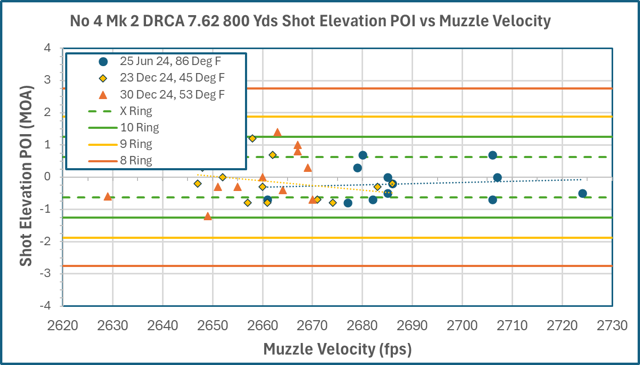 At 1000 Yards (24 shots): 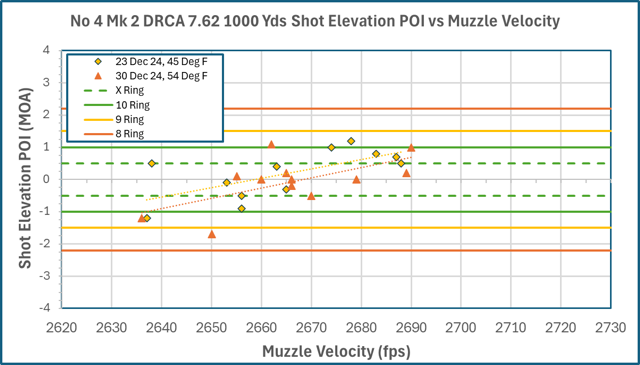 I plan to continue recording data and add to these plots, but I’m not expecting any change to the general trend here. While my .308/7.62 handloads generally show velocity extreme spreads of 30 to 50 fps, this is not of concern for long range shooting with this rifle because of the compensating nature of the barrel and action. |
||
|
||
|
Zed
Special Member 

Donating Member Joined: May 01 2012 Location: France Status: Offline Points: 6460 |
Post Options
Thanks(0)
Quote Reply
Posted: January 27 2025 at 4:06am |
|
|
A very interesting post Geoff.
Thank you for taking the time to share your experience. Impressive results I might add! |
||
|
It's nice to be important, but it's more important to be nice!
|
||
|
||
|
Rossfield
Groupie 
Joined: June 08 2024 Location: Nova Albion Status: Offline Points: 37 |
Post Options
Thanks(0)
Quote Reply
Posted: March 30 2025 at 5:56pm |
|
The only reason I could think of might be that the rather massive No.32 scope mount when well reefed down is adding some rigidity to your receiver such that it does not flex as much as a regular No.4? Or could it be that part of the accuracy which caused the rifle to be selected for TR status in the first place was some vagary of metal alloy and or heat treatment or machining, which conferred some amount of additional rigidity to the action which manifested as increased accuracy at the ranges at which those rifles were tested, but was deleterious to the compensation effect at much longer ranges? |
||
|
||
|
britrifles
Senior Member
Joined: February 03 2018 Location: Georgia, USA Status: Online Points: 8404 |
Post Options
Thanks(0)
Quote Reply
Posted: March 31 2025 at 4:18am |
|
|
Rossfield, I did a compensation test with and without the scope on the No. 4 T, the results are posted in the .303 Reloading Forum under “Effect of Primer Selection on Muzzle Velocity”, page 3.
The scope does indeed affect muzzle jump. Without the scope, the rifle showed “negative compensation”, with the scope it showed no compensation. This makes it a good rifle for short range shooting out to 300 yards. Although since these tests, I’ve installed a new barrel which has significantly reduced velocity spreads, so 600 yd accuracy is now quite good, despite the neutral compensation. I believe the reason is how the forend is bedded on my T. The barrel bearing is located about mid way between the sling swivel band and the chamber reinforce. Whereas the DCRA 7.62 has the barrel bearing at the sling swivel band. |
||
|
||
|
Rossfield
Groupie
Joined: June 08 2024 Location: Nova Albion Status: Offline Points: 37 |
Post Options
Thanks(0)
Quote Reply
Posted: March 31 2025 at 7:47am |
|
|
That does seem an unusual place for a barrel bearing on a .303 No.4. How is that achieved? The approved bearing for the No.4(T) was the reinforce (below the chamber) and the muzzle bearing was it not?
|
||
|
||
|
Shamu
Admin Group

Logo Designer / Donating Member Joined: April 25 2007 Location: MD, USA. Status: Offline Points: 20510 |
Post Options
Thanks(0)
Quote Reply
Posted: March 31 2025 at 10:37am |
|
|
Its called "Center Bedding". It was very popular once as a "fix" for "problem barrels that wouldn't respond to conventional fore & aft bedding. |
||
|
Don't shoot till you see the whites of their thighs. (Unofficial motto of the Royal Air Force)
|
||
|
||
|
britrifles
Senior Member
Joined: February 03 2018 Location: Georgia, USA Status: Online Points: 8404 |
Post Options
Thanks(0)
Quote Reply
Posted: March 31 2025 at 3:57pm |
|
Yes, but the UK NRA and Canadian DCRA did a lot of experimenting and development to improve the No. 4 for Service Rifle SR(b) and later Target Rifle class competitive shooting. There were three common locations within the forend that were used, I have one example of each of them. The primary reason to move the barrel bearing back from the muzzle and free float the barrel forward of the bearing was to reduce the influence of the forend changing the POI at the target as the forend picked up moisture and heat from firing and the sun. The standard muzzle bearing is notorious for changing zeros at the target if it started to rain, or the rifle was laid down on one side, particularly on wet grass, and the sun came out. While these POI shifts would not be significant to service use, they were enough to cost a competitor precious points on the target. A bull would become an inner, or worse, until you found the new group center. In its final form (late 1960’s thru early 1970’s), best accuracy came from setting a wood, or composite, barrel bearing at the middle sling swivel band location in the forend. I’ve gradually figured out how the different barrel bearing locations affected compensation and accuracy. This location seems to have given very good long range accuracy and was used in the 1967 Palma long range matches. |
||
|
||
|
Shamu
Admin Group
Logo Designer / Donating Member Joined: April 25 2007 Location: MD, USA. Status: Offline Points: 20510 |
Post Options
Thanks(1)
Quote Reply
Posted: March 31 2025 at 5:51pm |
|
|
Yes. competition shooters frequently had "Rowlocks Rifle Supports" for when laying the rifle down. It was basically a rowlock from a dingy with a point ground into the pivot. you pounded it into the ground & the rifle rested on it clear of the grass. Nowadays there are little stubby bipod stands doing the same thing.
|
||
|
Don't shoot till you see the whites of their thighs. (Unofficial motto of the Royal Air Force)
|
||
|
||
|
britrifles
Senior Member
Joined: February 03 2018 Location: Georgia, USA Status: Online Points: 8404 |
Post Options
Thanks(0)
Quote Reply
Posted: March 31 2025 at 5:54pm |
|
|
I’ve got a few of those supports, I think they were in the Parker Hale catalog. A light cast alloy.
|
||
|
||
|
Shamu
Admin Group
Logo Designer / Donating Member Joined: April 25 2007 Location: MD, USA. Status: Offline Points: 20510 |
Post Options
Thanks(0)
Quote Reply
Posted: April 01 2025 at 12:51pm |
|
|
Yep, that's them
|
||
|
Don't shoot till you see the whites of their thighs. (Unofficial motto of the Royal Air Force)
|
||
|
||
|
Rossfield
Groupie
Joined: June 08 2024 Location: Nova Albion Status: Offline Points: 37 |
Post Options
Thanks(0)
Quote Reply
Posted: April 01 2025 at 11:22pm |
|
I'm familiar with the concept; it was seen on DCRA conversions sometimes. For a No.4(T) at this distance of time I guess it would preferable to replacing the forend. A No.4(T) that won't shoot well with a proper standard bearing at reinforce and muzzle is an odd thing alright.
Hence the popularity of those Long Branch rock maple forends for range use. Bisonite was a popular bedding material I understand.
|
||
|
||
|
Post Reply
|
|
| Tweet |
| Forum Jump | Forum Permissions You cannot post new topics in this forum You cannot reply to topics in this forum You cannot delete your posts in this forum You cannot edit your posts in this forum You cannot create polls in this forum You cannot vote in polls in this forum |


 Topic Options
 britrifles wrote: