
|
Magnum 150gr Factory Amunition |
Post Reply 
|
| Author | |
303Guy 
Senior Member 
Joined: July 10 2012 Location: Auckland Status: Offline Points: 495 |
 Post Options Post Options
 Thanks(0) Thanks(0)
 Quote Reply Quote Reply
 Topic: Magnum 150gr Factory Amunition Topic: Magnum 150gr Factory AmunitionPosted: September 11 2013 at 6:52pm |
|
I just heard about this Light Magnum ammo from Hornady with a velovity of 2830 fps without higher pressure. Holy cow! It was called 'Light magnum'. Apparently Vihtavouri high energy powders were used. It's been said that these velocities cannot be achieved by hand loaders because of the speciality powders or something. Yet Lapua lists a load at 2949 fps with a 150gr bullet! Holy cow! That's with N133. Now don't get me wrong, I'm trying to revolutionize the 303 Brit. I like my 180gr bullets at 2400 fps but I am interested in lowing the pressure and if I could nudge the velocity up a little at the same time it would be good but it if ain't broke .... Point is, it would be nice to use such a super performing powder at the 'normal' 303 velocities at supposedly way lower pressure.
BL-C(2) is a powder that is listed as producing higher velocity at lower pressure in the Brit but that same powder is pretty average in the 308 (BL-C(2) is the original 7.62 NATO powder or so I have read). This leads me to question published load data, in particular the pressures indicated. Looking at pressures with different powders and bullet weights across different cartridges. Thing is there is no real pattern and some pressures don't make sense. I wonder whether there may be typo's in which CUP and PSI have been switched. Anyway, I thought is was interesting to read about.
|
|
|
303Guy
|
|
 |
|
|
Shamu
Admin Group 

Logo Designer / Donating Member Joined: April 25 2007 Location: MD, USA. Status: Offline Points: 20510 |
Post Options
Thanks(0)
Quote Reply
Posted: September 11 2013 at 10:28pm |
|
I've been loading the .303 with H335 powder, mainly because its all I could find locally. It is supposedly very similar to Ball-C(2) & it does list lower pressures for the same velocities as powders like 3031.
It definitely uses less volume for the same velocity as measured, but I don't know if I'd extrapolate that to getting higher velocities with standard pressures as most modern powders are progressive burning. The light magnums have been around a while & early tests with a light magnum .308 load in FAL rifles was not promising to the point its advised against using it for them.
|
|
|
Don't shoot till you see the whites of their thighs. (Unofficial motto of the Royal Air Force)
|
|
|
|
|
Zed
Special Member

Donating Member Joined: May 01 2012 Location: France Status: Offline Points: 6460 |
Post Options
Thanks(0)
Quote Reply
Posted: September 12 2013 at 3:45am |
|
From a personal point of view, I would not chance guestimating pressure with trial loads. Leave it to the professionals who have the equipment to actually measure the pressure accurately. I do not see the point in practicing something you can only do wrong once!

|
|
|
It's nice to be important, but it's more important to be nice!
|
|
|
|
|
303Guy
Senior Member
Joined: July 10 2012 Location: Auckland Status: Offline Points: 495 |
Post Options
Thanks(0)
Quote Reply
Posted: September 12 2013 at 8:55am |
I wouldn't even chance a listed load with high velocity that doesn't show pressures. Ball powders can behave in strange ways with pressure rise becoming dramatic as the load is increased. One can see this from velocity measurements. One ball powder I tried had an exponential velocity/powder charge curve. I gave that powder away. BL-C(2) is likely to do that too. Notice the max load listed has way lower pressure than usual? That'll be because pressures spike at higher than listed max load. But still, at the max load and the start load the pressures are way lower than usual. H335 seems to be a good performer with moderate pressures. Was BL-C(2) the original 7.62 NATO powder or was it W748? I'm thinking it was W748 - not the other like I first said. I got some W748 for use with lower pressure and velocity loads with the idea of a slower initial pressure rise, important for preserving the bullet bases of soft-ish plain base cast bullets. I found that my favourite powder - AR2209/H4350 - was peening the bullet bases and damaging the trailing edge in the process. W748 solved that problem but doesn't fill the case enough. So I got some W780 which is even slower than 2209. Talking about magnum loads, I've mentioned before how my 14½" barrelled rifle delivers 2000 fps with 194gr bullets (paper patched) using AR2209. It's the paper patch the does it. Pressure is about medium. Accuracy was not so good no doubt due to bullet base damage. At that speed they're hard to capture in 'readable' condition. |
|
|
303Guy
|
|
|
|
|
Zed
Special Member
Donating Member Joined: May 01 2012 Location: France Status: Offline Points: 6460 |
Post Options
Thanks(0)
Quote Reply
Posted: September 13 2013 at 5:02am |
|
303Guy, you say "pressure is about medium" with your 194gr bullets; but how do you know what the pressure is? How do you measure it?
|
|
|
It's nice to be important, but it's more important to be nice!
|
|
|
|
|
LE Owner
Senior Member
Joined: December 04 2009 Status: Offline Points: 1047 |
Post Options
Thanks(0)
Quote Reply
Posted: September 13 2013 at 5:44am |
|
The Light Magnum cartridges required specialized machinery to charge the case and seat the bullet on a compressed blended charge. Not something you can expect to do safely at home.
IMR 4007 Powder is a "Super Short Cut" extruded single base that was formulated for good velocity at low pressures. Hodgdon load data for this powder duplicates the MkVII loads with pressures of less than 40,000 CUP. Have yet to find this powder locally, and have heard little of it since it first came out. Kanamco, sucessors to Kynoch , use blended powders to duplicate Cordite loads for older British African big game cartridges and the .303. Pressures are low for velocity achieved.
|
|
|
|
|
303Guy
Senior Member
Joined: July 10 2012 Location: Auckland Status: Offline Points: 495 |
Post Options
Thanks(0)
Quote Reply
Posted: September 13 2013 at 12:59pm |
Primer flattening. Comparing to other loads, the main one being a medium, jacketed loading table load. This load shows less flattening. I create these blown up images so I can measure them and work out the percentage flattening. It only works with primers that are well rounded to start with. My new ones are too flat to show any changes. This one shows 78% flattening while a the same powder charge under a heavier bullet shows 82% flattening. That's 5% more flattening with a 6% heavier bullet. It's a comparison indicator and no more. I've done this for loads right down to hardly noticeable difference with a plain primer. The comparison load produces around 39500 CUP and shows 86% flattening against the one below with 82% flattening. 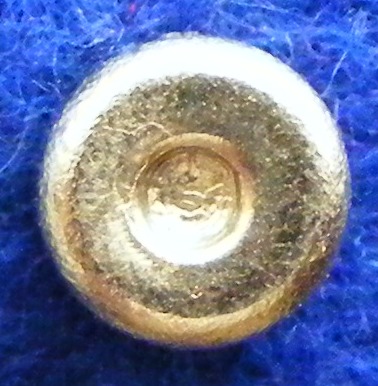 These are the mid range loads I compared against - 46gr AR2208/H4350 under 180gr bullets. 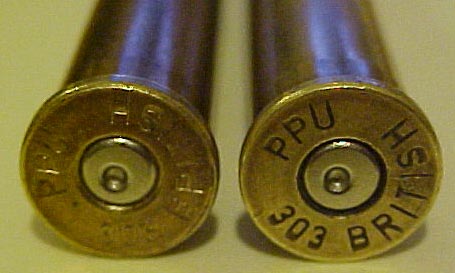 |
|
|
303Guy
|
|
|
|
|
Post Reply
|
|
| Tweet |
| Forum Jump | Forum Permissions You cannot post new topics in this forum You cannot reply to topics in this forum You cannot delete your posts in this forum You cannot edit your posts in this forum You cannot create polls in this forum You cannot vote in polls in this forum |


 Topic Options
 Zed wrote: