
|
Optimal Charge Weight Test |
Post Reply 
|
| Author | |
britrifles 
Senior Member 

Joined: February 03 2018 Location: Georgia, USA Status: Offline Points: 8404 |
 Post Options Post Options
 Thanks(0) Thanks(0)
 Quote Reply Quote Reply
 Topic: Optimal Charge Weight Test Topic: Optimal Charge Weight TestPosted: January 07 2024 at 9:47am |
|
Reloading Sunday.
I’ve got my loads done for running the “Optimal Charge Weight” (OCW) ladder test on the No. 4 T.
The objective is to find the optimal load for the 600 yard stage of the CMP Vintage Sniper Match. So, I will run this test at 600 yds. Not sure yet if I will shoot off the bench or as the matches are shot, prone with front sandbag rest. For those unfamiliar with this test, the method is to load three rounds of each charge weight in increasing weights and shoot these in a “round robin” style. That is ordering the shots such that each successive shot is of a higher charge than the last and repeat this three times, all shots on the same target. Then the MPI is plotted for each three shot group of each load. You are looking for a load where the adjacent lower and higher charge weight gives nearly the same vertical MPI indicating this load is at a barrel vibration node. I’ve selected ten different charge weights of Varget, from 39.4 grains to 42.1 grains in increments of 0.3 grains. These are ordered in the cartridge box such that I begin at 39.4 for shot one and end with 42.1 grains for shot 10. Then repeat the ten shot strings two more times.  All charges must be weighed for this test. One thing I discovered is that the “clicks” on my Harrell’s measure track very well in one tenth grain steps. Now to wait for a calm day to run the test… |
|
 |
|
|
paddyofurniture
Senior Member

Joined: December 26 2011 Location: NC Status: Offline Points: 7942 |
Post Options
Thanks(0)
Quote Reply
Posted: January 07 2024 at 10:29am |
|
Very cool.
|
|
|
Always looking for military manuals, Dodge M37 items,books on Berlin Germany, old atlases ( before 1946) , military maps of Scotland. English and Canadian gun parts.
|
|
|
|
|
mattri
Groupie 
Joined: December 25 2023 Location: iowa Status: Offline Points: 61 |
Post Options
Thanks(0)
Quote Reply
Posted: January 07 2024 at 2:41pm |
|
Interesting, looking forward to seeing the results.
|
|
|
|
|
Mayhem
Senior Member

Joined: February 06 2016 Location: Australia Status: Offline Points: 335 |
Post Options
Thanks(0)
Quote Reply
Posted: January 07 2024 at 7:11pm |
|
Ditto
|
|
|
.303 - Helping Englishmen express their feelings since 1889
|
|
|
|
|
britrifles
Senior Member
Joined: February 03 2018 Location: Georgia, USA Status: Offline Points: 8404 |
Post Options
Thanks(1)
Quote Reply
Posted: February 02 2024 at 6:40pm |
|
Finally had good weather today to run the optimal charge weight ladder test with the No. 4 (T).
Basic load data: PPU Case Neck Sized 3 times WLR Primer Varget 39.4 gr to 42.1 gr in 0.3 grain increments, all charges weighed and tricked 174 gr Sierra MatchKing 3.07 in. OAL 10 different powder charges, three rounds for each different weight. 30 rounds fired in a round robin style where one shot of each load is fired in increasing charge weight and repeated two more times. Typically this is done without making any changes to the sight settings, although after shot #13, I added one minute left windage. No changes made to the scope elevation setting. This was shot at 600 yards on the US NRA Mid Range MR Target off the bench.  I plotted each three shot group for each of the ten different loads on a single target diagram, then calculated the MPI for each of the 10 loads. The 10 MPI values were then plotted on a single target diagram: 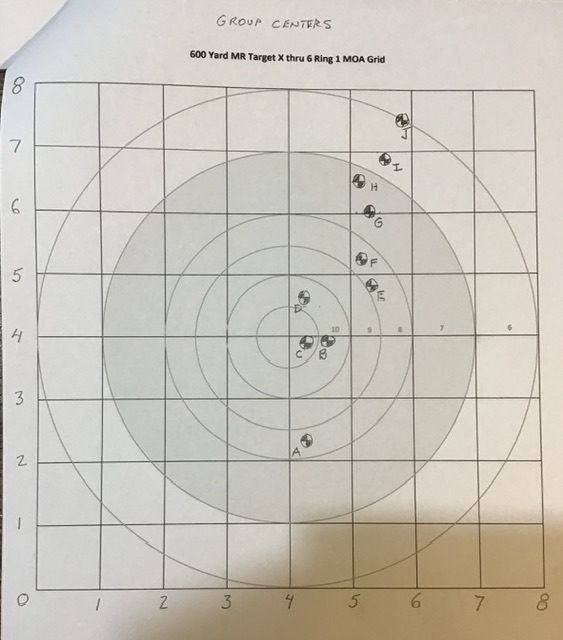 From the above, the trend is increasing elevation and drift to the right as powder charge is increased. This rifle does not appear to have positive compensation, not at this range anyway. This happens to be a Long Branch C Mk 4 barrel which is a right hand twist. You can see that loads B, C and D (39.7, 40.0 and 40.3 grains) are at an accuracy node. D, E and F are another accuracy node. The worst group was A (39.4 gr) very large and MPI well below the other groups. The bullet is not likely upsetting into the rifling very well. Here is an example of one of the 10 loads, 40.3 gr Varget which produced the smallest 3 shot group, under 1 MOA. This group was formed from shot # 4, 14 and 24. My standard load with 40.0 gr Varget also held excellent elevation, less than 1/2 MOA spread. 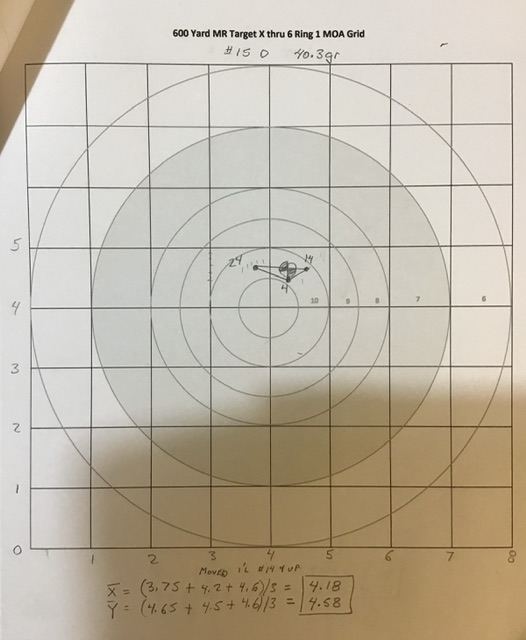 This is a very efficient method to determine the optimal charge weight for your particular rifle in relatively few rounds. You look for a cluster of three consecutive charge weights that group reasonably close together, especially in elevation spread. From this result, it appears my long standing 40.0 grain load is smack in the middle of the accuracy node. But, for grins, I’m going to load up 40 rounds at 40.5 grains and see how ten shot groups compare to the 40.0 grain load. |
|
|
|
|
britrifles
Senior Member
Joined: February 03 2018 Location: Georgia, USA Status: Offline Points: 8404 |
Post Options
Thanks(0)
Quote Reply
Posted: February 03 2024 at 2:43pm |
|
Something interesting in the results from this test. The rise in MPI per grain of powder charge is approx 1.5 MOA per grain (on average, discounting the lowest charge of 39.4 grains). So, the typical +/- 0.1 grain consistency of thrown charges from the powder measure amounts to +/- 0.15 MOA variation in elevation. Pretty much undetectable in Service Rifle position shooting where a 2 MOA group will get you a perfect score (which is almost never achieved).
The point of the OCW test is to find a vibration node where +/- 0.2 grain charge variation is not significant, which occurs at a charge of 40.0 grains and 40.6 grains of Varget with the 174 SMK. These are likely nodes at the bottom and top of the barrel vibration displacements. Typical variations in bullet weight likely produce even less variation in elevation. So, we can stop worrying about these minor variables and concentrate on the fundamentals of accurate shooting. |
|
|
|
|
Shamu
Admin Group 

Logo Designer / Donating Member Joined: April 25 2007 Location: MD, USA. Status: Offline Points: 20510 |
Post Options
Thanks(0)
Quote Reply
Posted: February 03 2024 at 2:46pm |
|
Nicely done. thanks!
|
|
|
Don't shoot till you see the whites of their thighs. (Unofficial motto of the Royal Air Force)
|
|
|
|
|
Mayhem
Senior Member
Joined: February 06 2016 Location: Australia Status: Offline Points: 335 |
Post Options
Thanks(0)
Quote Reply
Posted: February 03 2024 at 3:24pm |
|
britrifles - do you also fine tune with bullet seating depths, or does the anatomy of the 303 render this a mute point?
|
|
|
.303 - Helping Englishmen express their feelings since 1889
|
|
|
|
|
britrifles
Senior Member
Joined: February 03 2018 Location: Georgia, USA Status: Offline Points: 8404 |
Post Options
Thanks(0)
Quote Reply
Posted: February 03 2024 at 4:32pm |
|
That is certainly another variable you can play with in a ladder test. But, most LE’s will have a long throat, and the tangent ogive of the 174 SMK is quite jump tolerant. Seating this bullet longer than magazine length also reduces neck tension forces gripping the bullet, so diminishing returns if you seat much past 3.075. I ran this test at 3.07 inch OAL, because the vintage sniper matches are single shot only, I don’t have to worry about rapid fire stages loading from the magazine. For magazine rapid fire feeding in the vintage service rifle type matches, I seat to 3.05 inch OAL. |
|
|
|
|
Mayhem
Senior Member
Joined: February 06 2016 Location: Australia Status: Offline Points: 335 |
Post Options
Thanks(0)
Quote Reply
Posted: February 03 2024 at 5:45pm |
|
Thanks - that confirms my thoughts.
|
|
|
.303 - Helping Englishmen express their feelings since 1889
|
|
|
|
|
Zed
Special Member

Donating Member Joined: May 01 2012 Location: France Status: Offline Points: 6460 |
Post Options
Thanks(0)
Quote Reply
Posted: February 03 2024 at 11:47pm |
|
Lots of interesting information here Geoff.
Thanks for taking the time to share your experience with us. It's much appreciated!
|
|
|
It's nice to be important, but it's more important to be nice!
|
|
|
|
|
britrifles
Senior Member
Joined: February 03 2018 Location: Georgia, USA Status: Offline Points: 8404 |
Post Options
Thanks(0)
Quote Reply
Posted: February 04 2024 at 6:06am |
|
Thanks Shaun. Hope this is of some use to those who may be stuck in load development.
I did this with the T with original scope. The OCW test would best be done with a scope fitted to minimize aiming errors, but it still can be done with irons. The other benefit of finding the accuracy node is that you don’t need to go through load development again when substituting cases or primers or making minor changes in bullet seating depth. The powder charge variation of the test simulates those effects. Changing bullet or powder type would necessitate a new OCW test. |
|
|
|
|
britrifles
Senior Member
Joined: February 03 2018 Location: Georgia, USA Status: Offline Points: 8404 |
Post Options
Thanks(0)
Quote Reply
Posted: February 04 2024 at 12:24pm |
|
I’m still dissecting the results of this test. Found something rather surprising.
Charge weights of 40.0, 40.3, 40.6 and 40.9 grains had a vertical extreme spread of the 12 shots fired of only 1.8 MOA. That’s less than the height of the 10 ring of the Mid Range Target. That is a very tight spread for a 0.9 grain charge variation. The other interesting observation is the horizontal spread collapses at the higher charge weights. Not sure if that was a coincidence, or barrel vibratory response.
Clearly, the midpoint here is an accuracy node. I’ll shoot some test ten shot groups with 40.5 grains. Charge weights of 39.4 and 39.7 grains grouped very poorly.  |
|
|
|
|
Post Reply
|
|
| Tweet |
| Forum Jump | Forum Permissions You cannot post new topics in this forum You cannot reply to topics in this forum You cannot delete your posts in this forum You cannot edit your posts in this forum You cannot create polls in this forum You cannot vote in polls in this forum |


 Topic Options