
|
Inside neck reaming... |
Post Reply 
|
| Author | |
Goosic 
Senior Member 

Joined: September 12 2017 Location: Phoenix Arizona Status: Offline Points: 8842 |
 Post Options Post Options
 Thanks(0) Thanks(0)
 Quote Reply Quote Reply
 Topic: Inside neck reaming... Topic: Inside neck reaming...Posted: January 22 2024 at 4:13pm |
|
...and is it absolutely necessary?
I have been giving some thought into getting an inside neck reamer for my 303 British brass because I keep hearing stories about the , "dreaded doughnut." I did a comparison check between a new cartridge case and a case that has been reloaded 5 times and see no difference. The inside of both necks at the shoulder look identical. The reloaded case has been trimmed to 2.150" and when a bullet is seated, it is just above the cannelure, giving a C.O.L. of 3.085". The actual bullet to case contact area is 0.175" from the opening of the case down, which is 0.150" above the shoulder and well above this "dreaded doughnut." This puts me at odds with making this purchase because I see no benefit. I do see the potential to create a very thin case wall thickness however. To the forum I ask. Enlighten me as to the virtues of inside neck reaming. The pictured cartridge case is made by IVI and has been reloaded 5 times now and you can see that the bullet in no way can contact the shoulder area unless I attempt to seat the bullet well beyond the cannelure...
    |
|
 |
|
|
britrifles
Senior Member

Joined: February 03 2018 Location: Georgia, USA Status: Offline Points: 8404 |
Post Options
Thanks(0)
Quote Reply
Posted: January 22 2024 at 4:43pm |
|
I’ve only ever seen it with .223 cases reloaded many times, at least 10 times, probably more. It’s caused by brass flowing forward making the necks grow in thickness. The risk is that the case neck/shoulder junction diameter gradually reaches the chamber diameter and will restrict the release of the bullet from the neck. That will substantially raise pressure.
I became aware of this when I switched over to a bushing type FL sizer which does not use a neck expander ball. I could feel the donut as the bullets were seated into it. I could also detect it with a pin gage inserted into the sized case. With a standard FL sizer with an expander ball, you can’t detect the donut because the neck is expanded to a constant diameter. I did get a .223 inside neck reamer and it did remove brass right at the neck/shoulder junction. I posted this sometime last year, can’t remember exactly when. You do this only on a fired case because the neck takes the shape of the chamber. It helps if you anneal the necks so they fully expand. I also switched over to a bushing type FL sizer for .308, but no problems with the donut with my Lapua cases that had been reloaded about 8 to 10 times. I will continue to monitor them. If your sizing your cases with standard dies, you can’t detect the donut. The only thing you can do is measure the case neck outside diameter on a loaded round right at the junction to the shoulder. Then compare that to a fired case and see if the loaded round has a smaller diameter or not. |
|
|
|
|
britrifles
Senior Member
Joined: February 03 2018 Location: Georgia, USA Status: Offline Points: 8404 |
Post Options
Thanks(0)
Quote Reply
Posted: January 22 2024 at 5:58pm |
|
One other comment. If the bullet bearing surface does not protrude into the case at least as far as the case neck/shoulder junction, I suspect the donut has no affect because it can’t restrain the release of the bullet from the neck, such as a boat tail bullet seated into the .303 case when loaded to magazine length. I think some of the heavy flat based bullets for the .303, including the Mk 7 bullet, may be susceptible.
My .223 loads use 69 and 80 grain bullets which protrude into the case considerably, so are susceptible to this condition. I’ll have to check my 7.62/.308 loads with the Sierra 168 5MKs for the No. 4 DCRA conversion.
|
|
|
|
|
Goosic
Senior Member
Joined: September 12 2017 Location: Phoenix Arizona Status: Offline Points: 8842 |
Post Options
Thanks(0)
Quote Reply
Posted: January 22 2024 at 6:40pm |
|
My 243W cases that are necked down and F/L resized 7.62x51mm Lake City brass, I can see where inside neck reaming would greatly benefit me. The 90grn OTM Scenar-L BTHP projectiles protrude well past the neck/shoulder area.
My 7.62x51mm Lake City brass that has been Full Length resized will need to have the neck reamed eventually. My 180grn Norma Vulkan Flatbased projectiles protrude past the neck/shoulder area as well. The 170grn FMJ-BT M30 projectiles that I will be using along with the 174grn FMJ-BT projectiles that are made by the same manufacturer do not protrude into the case enough to cause an issue however...
|
|
|
|
|
Sapper740
Senior Member

Joined: July 15 2021 Location: Texas Status: Offline Points: 1737 |
Post Options
Thanks(0)
Quote Reply
Posted: January 23 2024 at 1:52am |
|
I've never experienced the doughnut either which may be due to the fact I usually retire my cases before I hit 10 reloads. Typically, having a Frankford Arsenal case prepping center set up for the .303 British I trim to length and chamfer both inside and outside the case mouth. Removing a little brass each reload might prevent the doughnut from forming? I don't know. From what I've read the biggest problem with the doughnut is when people neck cases up to a larger caliber.
|
|
|
|
|
britrifles
Senior Member
Joined: February 03 2018 Location: Georgia, USA Status: Offline Points: 8404 |
Post Options
Thanks(0)
Quote Reply
Posted: January 23 2024 at 3:59am |
|
I think it happens to some degree with all bottleneck rifle cases after a certain number of reloads. If you are trimming brass, the necks are gradually getting thicker with each reload, and it starts thickening at the neck/shoulder junction since the brass flows forward. Pushing the shoulder back with a FL die is squeezing the shoulder down also contributing to the condition. It’s not detectable if you are using standard dies with a neck expander, or with a collet type neck sizer.
|
|
|
|
|
Goosic
Senior Member
Joined: September 12 2017 Location: Phoenix Arizona Status: Offline Points: 8842 |
Post Options
Thanks(0)
Quote Reply
Posted: January 23 2024 at 5:44am |
|
Interestingly enough, it is detectable visually and with the right size drill bit with the shank of the bit placed into the neck, you can feel the slight tension when you get to the neck/shoulder junction of that bottlenecked cartridge...
|
|
|
|
|
britrifles
Senior Member
Joined: February 03 2018 Location: Georgia, USA Status: Offline Points: 8404 |
Post Options
Thanks(0)
Quote Reply
Posted: January 23 2024 at 6:12am |
|
I’ve detected it with pin gages in .223 cases resized with a neck bushing FL sizer. Pretty significant, several thousands reduced ID at the neck/shoulder junction compared to the rest of the neck. The inside neck reamer effectively removes it.
But, I’ve not detected it in .303 brass that is sized in either the Lee Collet neck die or standard FL die with expander ball. I don’t have a bushing type FL sizer for the .303. The pin gages come in increments of 0.0005 inches (half a thou). Useful for measuring bullet interference with the neck to achieve a desired neck tension. Annealing the cases helps reduce springback, so it may be that after 4 or 5 reloads without annealing, the donut will spring back from the expander ball and be detectable. Last year, I started annealing before every reload, and can’t detect it with pin gages in my .303 brass. |
|
|
|
|
britrifles
Senior Member
Joined: February 03 2018 Location: Georgia, USA Status: Offline Points: 8404 |
Post Options
Thanks(0)
Quote Reply
Posted: January 26 2024 at 2:40pm |
|
Reloaded .308 Win today, my Long Range load with 168 gr Tipped MatchKings.
I did not detect the donut on the fired .308 cases using pin gages. I’ve probably reloaded these cases 8 to 10 times. I neck sized these cases in the Lee Collet die, so unlikely to form the donut during sizing. I seat the 168 TMKs to 2.950 OAL to get within 0.025 inches from touching the lands. This also increases case capacity and lowers pressure. The bullet bearing surface is forward of the neck/shoulder junction, so very low risk of a donut causing any pressure issues. 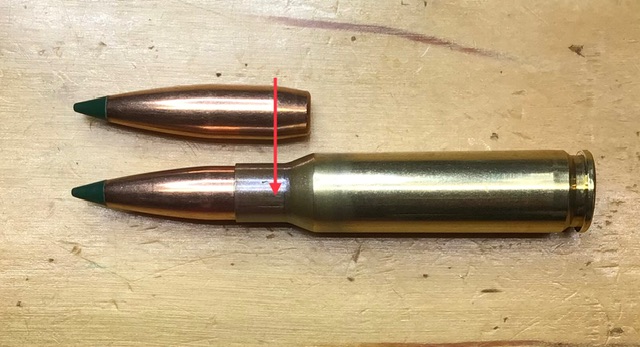 So, this seems to be a condition only associated with my .223 loads with 80 grain SMK. |
|
|
|
|
Post Reply
|
|
| Tweet |
| Forum Jump | Forum Permissions You cannot post new topics in this forum You cannot reply to topics in this forum You cannot delete your posts in this forum You cannot edit your posts in this forum You cannot create polls in this forum You cannot vote in polls in this forum |


 Topic Options