
|
No. 4 "Compensation" Tests |
Post Reply 
|
Page <1234 10> |
| Author | |
Zed 
Special Member 

Donating Member Joined: May 01 2012 Location: France Status: Offline Points: 6460 |
 Post Options Post Options
 Thanks(0) Thanks(0)
 Quote Reply Quote Reply
 Posted: August 04 2025 at 4:07pm Posted: August 04 2025 at 4:07pm |
|
I am enjoying your post Geoff.
I was thinking about this issue, and considering how you can differentiate between the error caused by the velocity and the barrel deflection? So I have an idea, but it's open for debate, to see if it would be worthwhile. So assuming the rifle bedding and the receiver rigidity/flexing is causing one part of the vertical spread, and the velocity differential is also causing part of the spread. Can we lay the rifle 90° to vertical, and test it? The idea being that the barrel deflection should present itself as a sideways error, and the velocity differential would remain in the vertical plane. So, it's just an idea, would it work?
|
|
|
It's nice to be important, but it's more important to be nice!
|
|
 |
|
|
britrifles
Senior Member 

Joined: February 03 2018 Location: Georgia, USA Status: Online Points: 8404 |
Post Options
Thanks(0)
Quote Reply
Posted: August 04 2025 at 5:38pm |
|
Interesting thought Shaun!
I don’t know what degree gravity plays a role in the vertical deflections of the barrel and action as the bullet travels down the barrel (when the rifle is held in the correct orientation). And would the rifle dynamic response change if rotated 90 deg? If deflection of the barrel and action to the bolt thrust loads is the principle cause of the compensation, and gravity plays a minor role, I believe your suggestion would work. An increase in muzzle velocity would thus result in a lateral POI shift at the target if the rifle is held at a 90 deg cant
I do know what the elevation change is for a given muzzle velocity change based on the external ballistics (Strelok) and the difference from what I measure must be due to compensation (positive or negative). If this rifle indeed has negative compensation (faster bullets leave the muzzle at a higher angle of departure from the line of sight) then this will be evident at 200 yards where bullet drop due to a 100 fps velocity spread is still quite small. I’ll run this test this weekend with and without the scope fitted. It’s interesting to read how strong the Compensation was on the converted 7.62 No. 4 rifles, presumably due to the higher muzzle velocity of the 7.62 NATO ball round and perhaps the greater deflection of the action under the higher chamber pressures. |
|
|
|
|
Zed
Special Member
Donating Member Joined: May 01 2012 Location: France Status: Offline Points: 6460 |
Post Options
Thanks(0)
Quote Reply
Posted: August 05 2025 at 7:58am |
|
Some thoughts on the issue.
If a difference in receiver rigidity and flexing is creating the barrel to deflect , why is it only in the vertical plane? It would seem logical ( to me) that a flex in the receiver caused by the difference in strength of the left and right sides, would cause a deflection in the horizontal plane. Does the upward pressure of the barrel and at the knox form cause it to always be vertical? To solve the problem, we need to understand exactly what is causing the deflection? It an interesting subject, which it seems, no one has really been able to diagnose completely. We know it exists, we know it is not in every rifle. Geoff, if your No4mk1 T has the same issue with the different barrels, that makes it very interesting! |
|
|
It's nice to be important, but it's more important to be nice!
|
|
|
|
|
britrifles
Senior Member
Joined: February 03 2018 Location: Georgia, USA Status: Online Points: 8404 |
Post Options
Thanks(0)
Quote Reply
Posted: August 05 2025 at 9:07am |
|
Yes, this behavior I observe with the T at 600 yards has occurred with all three barrels, to almost the exact same degree.
While it should not be surprising that a chamber pressure of some 45,000 psi acting on the bolt will cause deformation (elastic) of the bolt, body and barrel, the reason this seems to be mostly in the vertical plane may be simply the geometry of the action body and vertical position of the locking lug recesses within the body. The addition of the scope bracket and scope would alter the action stiffness considerably and since it sits vertically above the body, it would have more affect on body vertical bending stiffness than lateral stiffness. Having said that, I do see a pronounced lean to the right with bullet POI as velocity increases. This might be attributed to the fact that the scope mount is attached to the left side of the body, thus changing the bending "neutral axis" of the body in the lateral plane. I will have to dig out my test data where I plotted the group POI centers for the load ladder tests (by varying charge weights from 39.0 to 42.5 gr), its about 10 to 15 deg upward/right slope IIRC. From the descriptions I've read, this is all to do with the initial deflection that results from the very high impulse load to the locking lugs (like it was hit with a 12 lb sledge hammer) and how the action body initially distorts under that impulse load moving the muzzle before the bullet exits the barrel. This is really not about follow-on stable barrel harmonics after the bullet leaves the muzzle. We are talking about a change in the angle the barrel is pointing relative to the line of sight of around 0.03 - 0.05 deg; that is not very much for a very flexible barrel! |
|
|
|
|
britrifles
Senior Member
Joined: February 03 2018 Location: Georgia, USA Status: Online Points: 8404 |
Post Options
Thanks(0)
Quote Reply
Posted: August 06 2025 at 11:07am |
|
As I continue to think on this question in my "spare time", more pieces of the puzzle fall into place. Reynolds (both Maj E.G.B Reynolds and SQNLDR Dave Reynolds of DCRA) wrote about the compensation feature of the Lee Enfield and the particular frustrations with the No. 4 7.62 Conversions.
Velocity variations were particularly high with 7.62 NATO ball ammunition in the 1960's when the No. 4 7.62 conversions were first being used at Bisley and Connaught. What they saw was good scores at long range (900 and 1000 yds) but very poor grouping at short range (200 and 300 yds). Positive compensation would have this very effect with large velocity spreads. I also suspect that the higher muzzle velocity of the 147gr 7.62 bullet (compared to the 174 gr .303 bullet) resulted in the 7.62 bullet leaving the muzzle at the moment when the barrel was quickly moving upwards. The .303 bullet travelling slower may have been been close to the point of maximum upward barrel deflection when the barrel movement had considerably slowed down. What causes positive compensation is a rapid upward movement of the barrel when a bullet at nominal velocity exists the muzzle, and variations in velocity result in different angles of departure of the slow and fast bullets. All this conjecture and theory may be interesting (well, maybe only for me!), but I believe this can be proven, perhaps only indirectly. In the Table I generated earlier in this thread, I show the delta bullet Elevation at 600 and 1000 yards for a 100 fps velocity extreme spread. That was 2.2 MOA and 5.2 MOA respectively. Now, for a rifle that fully compensates for velocity variations (like my No. 4 7.62 does at 800 yards), the positive compensation effect is equivalent to the bullet elevation variation (and in the opposite direction). Ergo, something approaching 5 MOA! A 5 MOA elevation change for 100 fps velocity change would be dramatic at 200 yards where bullet drop trajectory change is just 1/2 MOA for 100 fps velocity change. 5.0 - 0.5 = 4.5 MOA. And that's about exactly what has been reported during the 1960's for group elevation values at 200 yards with the No. 4 7.62. The 200 yd Bisley target at the time had a 2.5 MOA bull, and if your ammo was giving velocity spreads of 100 fps, you would see elevation spreads of 4.5 MOA, not very satisfying. I've experienced this myself with some poor quality 1960's DAC 7.62 Nato ball ammo which I discovered had velocity variations of 100 fps and more. I pulled the bullets on some of this ammo and found powder charges varied by as much as 3 grains! The testing I intend to do this weekend should be interesting. I'll load up .303 ammo with 40.0 and 42.0 gr Varget, 174 SMK, and shoot the T with and without the scope at 200 yards to see how much elevation change occurs as a function of velocity change and in what direction it is. My prediction? Negative compensation with the scope attached (fast bullets hit substantially > 0.5 MOA higher than slow bullets) and perhaps neutral or slight positive compensation (fast bullets hit about the same elevation as slow bullets) without the scope. |
|
|
|
|
Strangely Brown
Senior Member

Joined: April 05 2022 Location: Wiltshire Status: Offline Points: 645 |
Post Options
Thanks(0)
Quote Reply
Posted: August 06 2025 at 11:17am |
I'm following this with great interest Geoff; every day should be a learning day!
|
|
|
Mick
|
|
|
|
|
A square 10
Special Member

Donating Member Joined: December 12 2006 Location: MN , USA Status: Offline Points: 16997 |
Post Options
Thanks(0)
Quote Reply
Posted: August 06 2025 at 7:20pm |
|
iagree , im reading every day , i seldom post on things im not knowledgable about but i do read to learn , thanks
|
|
|
|
|
britrifles
Senior Member
Joined: February 03 2018 Location: Georgia, USA Status: Online Points: 8404 |
Post Options
Thanks(0)
Quote Reply
Posted: August 07 2025 at 4:33am |
|
I finished prepping cases last night (something that really has become a "chore"). I culled about 20 of the 180 case lot that I've been using for the T, those that gave high/low fliers at the target due to high/low muzzle velocity. I will be able to determine if those cases were the reasons for the high/low muzzle velocities (ES as much as 100 fps) tomorrow when I run the compensation tests. If I still get muzzle velocity spreads of 100 fps, I'll be scratching my head for a while to figure out what else could cause this!
The next step would be to experiment with barrel bearing pressures and bearing locations to see how it affects compensation. The ideal outcome would be to have a slight positive compensation that reduces elevation spreads at 600 yards and minimize the adverse impact to spreads at 300 yards, i.e. a compensation range of around 500 yds. Easier said than done and it may not be possible with a scoped T to change from negative to positive compensation by barrel packing. |
|
|
|
|
britrifles
Senior Member
Joined: February 03 2018 Location: Georgia, USA Status: Online Points: 8404 |
Post Options
Thanks(0)
Quote Reply
Posted: August 07 2025 at 5:06am |
|
Some additional reading on the subject of compensation for anyone with boffin-like tendencies (which I confess to).
|
|
|
|
|
Shamu
Admin Group

Logo Designer / Donating Member Joined: April 25 2007 Location: MD, USA. Status: Offline Points: 20510 |
Post Options
Thanks(0)
Quote Reply
Posted: August 07 2025 at 11:51am |
|
I got curious, so I checked my reloading records. Over 279 "batches" loaded between Mar 9th 2002 & Jan 20th 2020, some for the 174/180 gr loads the SMLEs & No5 prefer, others for the 150 Gr ones the No4 Mk2 prefers. These include several primer types & a few different powders. (caused by availability) I have: A LOWEST E.S. of 13.8 FPS. A handful of 14 or 15 FPS. A whole bunch of 40~50 FPS & 2 at 104~108FPS Plus a dreadful trio at a whopping 138FPS** more on that later! All the low Numbers were CCI 200 primers & IMR 3031 & 150 Gr projectiles All the mediums (40~50's) were with Fed 210 primers & it happened with both 150 & 174/180 Gr projectiles. The sky-high ones were with Fed 210 primers & H335, a powder I had all sorts pf problems with in.303 loadings. I'm not sure what you can infer from this, but I went back to CCI #200 primers when I could find them & as 3031 seems to be hard to find round here IMR 4895 powder. I haven't had a chance to try the CCI 200 & 4895 recipe with anything yet, but plan on trying it with 150 gr & 174 gr tailored for the rifles individual preferences. LATER **  The whopping 138 FPS was with factory loaded RG & S African R1M3z! Just as a control!  All cases were either HXP or PPU/nny. They were all trimmed, chamfered, deburred, primer pockets uniformed & flash holes reamed. The later firings were also annealed after every 3rd load. Cases were trimmed to min length, minus 10 thou as I use a Dillon progressive this is the measured average elongation when resizing. when meeting or exceeding max COAL. The vast bulk of them were "Partial full length resized" to fit the individual chambers of the rifles they were to be fired in.
|
|
|
Don't shoot till you see the whites of their thighs. (Unofficial motto of the Royal Air Force)
|
|
|
|
|
britrifles
Senior Member
Joined: February 03 2018 Location: Georgia, USA Status: Online Points: 8404 |
Post Options
Thanks(0)
Quote Reply
Posted: August 07 2025 at 2:07pm |
|
Good info Shamu. Are these muzzle velocity Extreme Spreads (ES)? I assume so, a Standard Deviation (SD) of 40-50 fps would be pretty bad.
I’m probably getting an average ES of 40-50 fps. But also a fair number in the 30-40 fps range too, and these group well at 600 yds. But, I’ve had perhaps 3 or 4 ten shot groups at 90-100 fps! This with weighing out charges! Virtually all of this data was with WLR primers. I did a test with CCI BR-2’s and it gave me higher ES and SD values. I will try regular CCI 200’s next time. |
|
|
|
|
Shamu
Admin Group
Logo Designer / Donating Member Joined: April 25 2007 Location: MD, USA. Status: Offline Points: 20510 |
Post Options
Thanks(0)
Quote Reply
Posted: August 07 2025 at 6:51pm |
|
They are E.S. SD for the 40~55 ES range were in the low 20's as calculated
|
|
|
Don't shoot till you see the whites of their thighs. (Unofficial motto of the Royal Air Force)
|
|
|
|
|
britrifles
Senior Member
Joined: February 03 2018 Location: Georgia, USA Status: Online Points: 8404 |
Post Options
Thanks(0)
Quote Reply
Posted: August 08 2025 at 3:13pm |
|
I completed the compensation tests today, results are summarized here.
BLUF Addition of the No. 32 Scope alters Muzzle Jump substantially compared to iron sights and results in Negative Compensation. With a 174 gr bullet at a muzzle velocity of 2400 to 2500 fps, the No. 4 T Negative Compensation increases elevation spreads by nearly 0.2 MOA for every 10 fps velocity change. This combines with bullet drop effects to result in a total elevation spread of 0.4 MOA for every 10 fps velocity change at 600 yds. Test Results - Scope Removed The first test was to determine the degree of Compensation with the scope removed. To do this, I fired two different loads at 200 yards. Both loads with PPU cases, 174 gr SMK and WLR primers. Load 1: 40.3 gr Varget Load 2: 41.5 gr Varget After initial sighting in, I fired a 10 shot group of Load 1. I had one shot with a low velocity of 2343 fps, so discarded that from the muzzle velocity statistics and calculation of group MPI: Load 1 Results (9 shots): MV = 2405 fps ES = 26.9 fps Elevation Mean POI = -0.20 inches below target center. Load 2 Results (five shots): MV = 2476 fps ES = 40.9 fps Elevation Mean POI = + 1.56 inches above target center The resulting elevation difference is +1.76 inches (+ 0.88 MOA) for a 71 fps muzzle velocity increase. From my Strelok trajectory calculations, the elevation POI rise for +75 fps muzzle velocity increase at 200 yards is +0.40 MOA. Therefore, this rifle without the scope has a slight Negative Compensation of 0.88 - 0.40 = + 0.48 MOA for a 71 fps muzzle velocity increase. This works out to + 0.07 MOA rise in elevation per 10 fps velocity increase, excluding bullet drop effects. So even a 100 fps velocity ES at this range would not result in elevation spreads much more than 1 MOA, making it a good short range shooter. However, what I did find is that at the higher muzzle velocities of Load 2, the bullet POI of the five shots taken were very flat, less than 0.2 MOA vertical spread for a ES of 41 fps. For Load 2, the fast bullet hit low and slowest bullet hit highest on the target. This indicates the 41.5 gr charge is at an accuracy node and the barrel is likely near the top of its vertical rise, whereas bullets leaving the muzzle with the lower 40.3 gr charge occur later when the muzzle is moving downward. At muzzle velocities between 2450 to 2490 fps, the rifle compensates just beyond 200 yds. 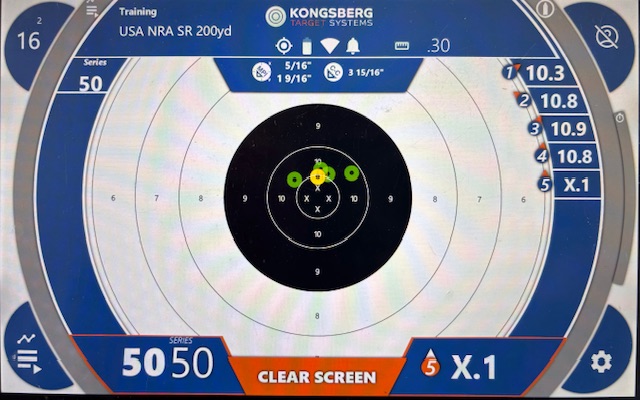 Test Results - Scope Fitted The above test was repeated with the No. 32 scope installed. The same loads were fired at 200 yards giving the following results: Load 1 Results (five shots): MV = 2415 fps ES = 29.5 fps Elevation Mean POI = + 0.81 inches above target center Load 2 Results (10 shots) MV = 2482 fps ES = 59.5 fps Elevation Mean POI = +3.94 inches above target center The resulting elevation difference with the scope fitted is 3.94 - 0.81 = +3.13 inches at 200 yards (+ 1.57 MOA) for a muzzle velocity change of 67 fps. Now, subtracting the contribution of the elevation rise due to change in trajectory bullet drop of approx 0.35 MOA, we get a net +1.22 MOA elevation rise for 67 fps velocity change for a negative Compensation effect of +0.18 MOA elevation rise per 10 fps velocity increase. This is more than 2X the elevation rise as compared to the scope removed. Where Do I Go From Here? I think what is happening is the added stiffness and mass to the action body from the scope and mount shortens the time it takes for the muzzle to rise and reach its first peak. Bullets are leaving the muzzle after the first deflection peak as the muzzle is moving downward., giving Negative Compensation. The options are to increase muzzle velocity and see if I can get the bullets to exit the muzzle on or before reaching the peak of muzzle rise. The other option is to experiment with barrel bearings/packing to alter the timing of muzzle rise/fall. I may try a 150 grain bullet to get the muzzle velocity over 2700 fps, this may prove the theory. More to do. |
|
|
|
|
Doco Overboard
Senior Member
Joined: January 26 2020 Location: USA Status: Offline Points: 279 |
Post Options
Thanks(0)
Quote Reply
Posted: August 09 2025 at 8:19am |
|
Here's what I would do the more I thought about this. Eliminate errors with sighting and hold by shooting at a closer distance. I would determine line of sight above the bore, level the rifle, peer through the bore laying an aim onto a target about 10 -12 yards away and mark the target. Then, whether through the sights or the telescope make a mark the same distance precisely above the first mark for an aiming point an equidistant distance. Obtain a ballistic or true zero or absolute trajectory zero. Not a corrected zero trajectory. Line of sight and bore are parallel. Then, go ahead and fire the rifle using the preferred sighting method using a consistent hold at the top mark and then finally determining where the shot strike occurs minus the diameter of the bullet. Once you know the velocity, drop, environmental conditions, temps etc you'll know what sort of compensation you have. And the finally you can remove/ add scopes try differing holds sling tension ammunition's, bedding packing etc to see what other effects come into play. The reason for my thinking is, you don't have to shoot a rifle at any kind of distance to determine trajectory, it can be done at short distance once you have a certain bit of information available to you and may save time effort ammo and all that sort of thing. I think off the top of my head you can determine Line of sight above bore trajectory or parallelism by dividing both the bolt and scope tube diameter in half and then by understanding the measurement from the top of the bolt and the bottom of the scope tube or some other fixed apparatus used for sighting. Thanks for sharing your experiences-following with interest. Brian
|
|
|
|
|
britrifles
Senior Member
Joined: February 03 2018 Location: Georgia, USA Status: Online Points: 8404 |
Post Options
Thanks(0)
Quote Reply
Posted: August 09 2025 at 1:24pm |
|
It probably would have been better to shoot at 25 yds, as that does practically remove the bullet drop from the calculation entirely. Although hold and aim errors still apply, group spreads are considerably smaller. But it also moves group centers much closer together.
200 yard is a short range for this rifle and these results have convinced me the rifle with scope indeed has negative compensation. But I already knew that by comparing 600 yd elevation spreads to POI elevation spreads at the target. This test allowed me to quantify it by removing most of the bullet drop by shooting at short range rather than 600 yds. My elevation error at 600 yards is entirely due to velocity variations, as bullets with the same velocity stack on top of each other at 200, 300 and 600 yds. Looking back at the plot sheets, very good groups only occur when velocity extreme spreads are less than 30 fps. This figure below shows what is occurring. Without the scope attached, bullets faster than about 2400 fps exit the muzzle on the left side of the peak, along the blue line, showing positive compensation. Bullets slower than 2400 fps exit on the right side of the peak, showing negative compensation. With the scope attached, the increased stiffness is making the muzzle rise sooner, and this entire muzzle projection curve is shifted to the left such that bullets slower than 2500 fps exit on the downward side of the peak along the red line. I don’t know about bullets faster than 2500 as I’ve not pushed my loads that fast. Question is, what muzzle velocity do I need to get them to exit close to the top of this curve and preferably on the left side of the peak? 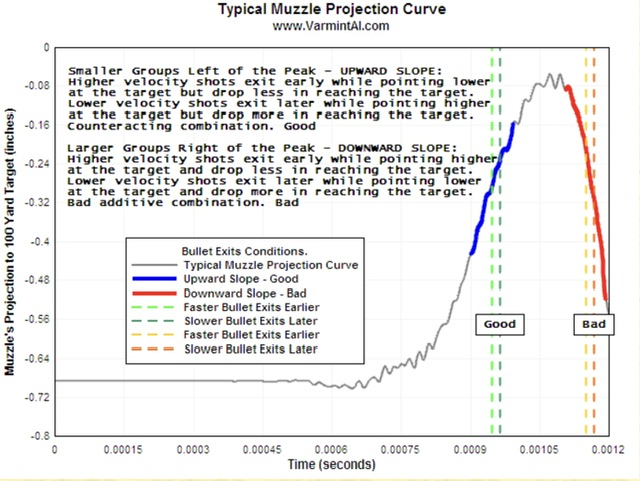 It’s possible that shooting with a sling rather than the forend rested on a sandbag and pulling the rifle into my shoulder might change the rifle dynamics enough to make a difference. I will also try 150 gr bullets at higher velocity to see if I can get them to exit the muzzle sooner along the blue line. The compensation with the scope, although negative, is not nearly as much as what the No. 4 7.62 rifles experienced back in the 1960’s which were particularly bad at short ranges. A rifle that fully compensates for bullet drop at 1000 yards will have vertical spreads as much as 5 MOA at short range for muzzle velocity spreads of 100 fps. Very poor ammunition with an ES of 200 fps will be double that! I dug up some early notes I made on my Fulton No. 4 and it also possessed negative compensation with a scope fitted. At the time, I did not realize this, and I did not have a chrono. The elevation rise at 100 yards was 0.83 inches per grain of powder (approx 50 fps increase in MV per grain) and very linear over a 3 grain charge range. If the rifle had positive compensation, the POI would have decreased for an increasing powder charge. |
|
|
|
|
britrifles
Senior Member
Joined: February 03 2018 Location: Georgia, USA Status: Online Points: 8404 |
Post Options
Thanks(0)
Quote Reply
Posted: August 10 2025 at 4:39am |
|
In sorting thru my bullet stocks, I found several boxes of Lapua 123 gr .311 inch open base FMJs. I can load these up to 2900 fps and see if that moves the bullet exit time from the muzzle as it is moving upwards (positive compensation).
I’ll load three different velocities, approx 2700, 2800 and 2900 fps. I tested these some years back in the Savage and Long Branch No. 4 and they shot quite well at 200 yds. Of course, I don’t expect a 123 gr bullet will perform beyond 300 yds, but worth seeing what it does at 600 yds, who knows, might be just the ticket. 123 gr Lapua on the left and 174 gr SMK on the right. 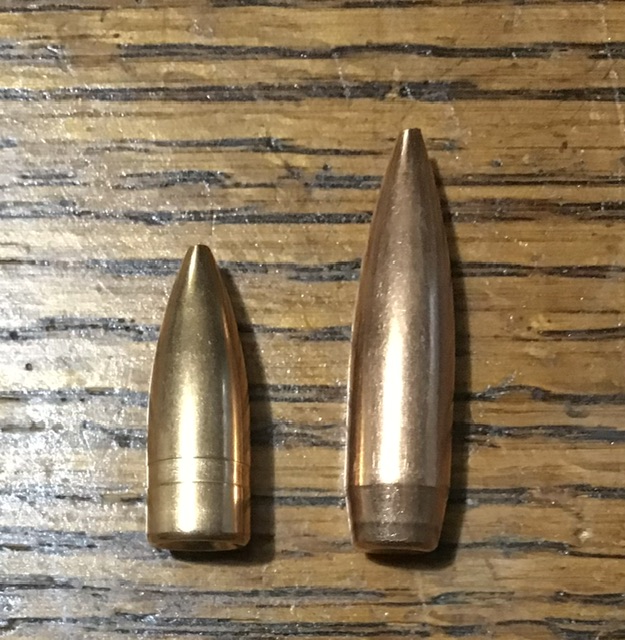 |
|
|
|
|
Post Reply
|
Page <1234 10> |
| Tweet |
| Forum Jump | Forum Permissions You cannot post new topics in this forum You cannot reply to topics in this forum You cannot delete your posts in this forum You cannot edit your posts in this forum You cannot create polls in this forum You cannot vote in polls in this forum |


 Topic Options
 britrifles wrote: