New 1941 Lithgow! Did I get Fleeced?
Printed From: Enfield-Rifles.com
Category: Enfields
Forum Name: Enfield Rifles
Forum Description: Anything that has to do with the great Enfield rifles!
URL: http://www.enfield-rifles.com/forum_posts.asp?TID=10140
Printed Date: March 26 2026 at 8:19pm
Software Version: Web Wiz Forums 12.07 - https://www.webwizforums.com
Topic: New 1941 Lithgow! Did I get Fleeced?
Posted By: thrawnformbi
Subject: New 1941 Lithgow! Did I get Fleeced?
Date Posted: November 29 2019 at 7:25am
|
he!!o all and thank you for letting me join the forum. I'm new to the Enfield world but have always wanted one of these iconic rifles. Unfortunately, I didnt do enough research and when I saw this rifle in my local shop I immediately decided I wanted it. Spur of the moment will be the death of me. I'm unclear on this mismatch of serial #'s and markings. I've done a fair amount of investigating and eventually found a JJCO stamp (rats!) and that immediately sent up a red flag of panic. The damn thing was hiding (see pic) and I didn't spot it in the shop. The condition was excellent and we were all gushing over it in the shop - but now I'm realizing that this was most likely one of their janky rebuilds. I'm very familiar with the John Covino shop in NYC and was aghast when I made the connection. It's a terribly run shop these days and a notoriously unfriendly/unhelpful place. I wonder if you all would mind sharing some insights if you have any. I'm not too familiar with Enfields so this is all new territory for me. Im incredibly concerned that its missing the brass recoil pads but I may be wrong. I've put maybe 30-40 rounds through it and it shot wonderfully but I'm concerned about its longevity without them. Many thanks for all of your help. I made a little wrap for the stock - I'm sure it might offend some purists but I like doing it so what can I say. There are ZERO markings on the stock however so no information is lurking behind that bridle leather.                              |
Replies:
Posted By: Shamu
Date Posted: November 29 2019 at 8:45am
|
I think you're OK. Your serial numbers do match, the ones on the underside of the bolt handle (L1381) are "assembly numbers" only, the actual serial number is on the rear face. They're also in the correct format (X #####)for a real Lithgow-built rifle. most of the bitsters were ####A, formatted. Also not every Lithy had recoil blocks. The trick is deciding if yours needed them, or not. If It should have been, but wasn't, then, yes its a problem. However if it was early enough that they hadn't designed the upgrade to them than its OK. The real serial number (B 82454) should also be stamped on the end of the bayonet boss at the muzzle, OR under the forend wood, but not both . Yours is a 1941 & most of the fakes were '43 or '44 dated thats a plus as well. See if you can positively identify the wood type, the early ones had better wood & so the blocks weren't needed, it was only after they switched to "coachwood" that the problem occurred. Here's most of what I've been able to track down & piece together. Much of it comes from, but is not limited to : Dr. Skip Stratton, who
published this warning on his Enfield rifles on his website & Greg
Young's Alaska Enfield Headquarters site. "No. 1 Mk III* (Lithgow - "New")
Often
advertised as “collector grade” or “mint - unfired” or
“unissued” and selling for $200 and up. Where JJ Co used unissued receivers,
they did not have serial numbers on them from Lithgow. For knowledgeable collectors of Lithgow Enfields, these assembled new rifles are pretty easy to spot by their light colored stocks and parkerized finish. Another dead give away for the assembled rifles is that they are not in the normal Lithgow serial number ranges. Most of the assembled rifles have serial numbers that either start with a "G" prefix or have a "A" suffix. import marks on your Lithgow on the right hand side of receiver just above the woodline in front of the bolt handle? If so, I think it you look hard at your import marks, you will see that they are actually IA CO SAC CA but the first "I" looks like a "T" due to the mark being stamped at an angle. I have had a couple of the IA imported Lithgow rifles with the IA CO SAC CA import marks on the location I mentioned and others with the import marks on the bottom of the charger bridge on the right side. IA was the "Inter American" company and they imported a lot if military surplus arms as well as new AKs and Sks. If I remember right, they went out of business around 2005 or so. Anyhow, they had some pretty nice Lithgows as well as some not so nice like any importer. They did not assemble rifles from NOS parts either like Jovino did." ------------- Don't shoot till you see the whites of their thighs. (Unofficial motto of the Royal Air Force) |
Posted By: Goosic
Date Posted: November 29 2019 at 8:52am
|
Howdy and welcome from Phoenix Arizona. Mismatched serial numbers?? The bolt,receiver,and rear sight serial numbers are all marched. The furniture is on par with being new wood and the metalwork appears to be in pristine condition. Someone here with more knowledge of No1Mk111 type rifles will be able to give you a better assessment but in the meantime, enjoy it. You have a very fine example of an Enfield rifle..
|
Posted By: Canuck
Date Posted: November 29 2019 at 9:51am
|
I like it! I think you did well, enjoy shooting it. ------------- Castles made of sand slip into the sea.....eventually |
Posted By: Honkytonk
Date Posted: November 29 2019 at 10:09am
| Very nice rifle! I, too, am not a purist but I gotta ask... reason for the leather? |
Posted By: pisco
Date Posted: November 29 2019 at 12:20pm
| hi as i stated on another forum it is easy to fit the copper blocks just take your time |
Posted By: A square 10
Date Posted: November 29 2019 at 5:06pm
|
welcome , glad you joined us JJCo had acquired a lot of parts and assembled into rifles , it is why there are folks looking closely at what they offer , they were not a war producer - that would be lithgow , they were an aftermarket seller , nothing wrong with the product at all that i know , just not collectible provenance so to speak , so no - you did not get fleeced as long as you got what you wanted and paid what you were willing , all is good , let us know how it shoots for you , im not certain about the stock sock tho - that could be hiding damage or just a shooting aid , rest of it looks like typical JJCo to me , everything has been refinished tho - anything of 41 vintage went to war , it was the height of the production , very little got wasted or neglected
|
Posted By: shiloh
Date Posted: November 30 2019 at 3:11am
|
Looks like a very nice refinished Australian rifle to me. Good find, if by fleeced you mean did you pay too much, hard to say, all original will fetch more coin then a refinished rifle, you did well. So if you're happy use it and enjoy your new find, good ones are getting harder to come by. 
|
Posted By: MJ11
Date Posted: November 30 2019 at 8:58am
|
I'm not seeing how you got fleeced ? Numbers fit right in 1941 to 1942. And where is the JJCO stamp ? I think you got a complete Lithgow rifle. Unless you had to throw in your dog on the deal I don't think so.  ------------- The Spartans do not ask how many the enemies are but where they are |
Posted By: Shamu
Date Posted: November 30 2019 at 9:31am
|
"And where is the JJCO stamp?" 5th image from the top, looking down on rear-sight base, kinda hidden under the other stamps. I'm not even sure it's refinished? ------------- Don't shoot till you see the whites of their thighs. (Unofficial motto of the Royal Air Force) |
Posted By: pisco
Date Posted: November 30 2019 at 10:47am
| hi fit some copper blocks to save the forend go and shoot it and let us know how it goes |
Posted By: shiloh
Date Posted: November 30 2019 at 2:56pm
|
Its in too nice of shape to be an early 1941 rifle. My guess is JJ&Co got a complete rifle in one of there buys that only needed spit and polish. Still an excellent buy. 
|
Posted By: Goosic
Date Posted: November 30 2019 at 3:22pm
| ... the general consensus being that, you have a very nice example of a No1Mk111 Enfield rifle. Take it out and kill some paper with it...👍 |
Posted By: Honkytonk
Date Posted: November 30 2019 at 3:26pm
| Actually... total rip-off! Clone, used parts, etc... I'm not sure what you paid, but it was too much. PM me... I will reluctantly give you $100 CDN to relieve you of this obvious hideous example of a Lee Enfield. (Of course, you will need to pay for shipping...) |
Posted By: Shamu
Date Posted: November 30 2019 at 3:41pm
|
Honkytonk: Tree Fiddy 'Murican!  ------------- Don't shoot till you see the whites of their thighs. (Unofficial motto of the Royal Air Force) |
Posted By: BJ72
Date Posted: November 30 2019 at 3:55pm
|
For what it's worth here's my take on your rifle. I don't
think you got fleeced BUT, is it a factory new rifle? I don't think so. It’s
possible but unlikely and here are my reasons why.
My interest is Australian built No1 Mk3 and 3* rifles. Apart from experimental trials rifles, they are the only variations of the Lee Enfield made in Australia. I can't speak for British built rifles and when it comes to No4's, I haven't got a clue. I don’t consider myself an expert but I do know a bit about our Australian rifles. Your rifle carries a B prefix serial number. These B prefix rifles were manufactured from the early 1920's (about 1922) until early 1941. Each prefix, A, B C, D etc went through all the numbers from 00001 - 99999. All B prefix rifles were manufactured at the Lithgow Smalls Arms Factory. Your serial number is clearly towards the end of the B series which accounts for the 1941 date on the action body. The 1941 date on the action body is not necessarily the year the rifle was assembled; it’s the year that particular action body was made. Why is that important? It’s why you often see later production timber on an earlier receiver. A lot of the B series rifles were stocked in Qld Maple however the later ones were stocked in Coachwood. Coachwood was used in Australia from 1940 to the end of new production in 1955. Your rifle is stocked in Coachwood which would be correct. Qld Maple is much lighter in colour. There’s a couple of photo’s missing from what we for a positive ID on your rifle. A factory new No1 Mk3*from 1941 will have the serial number applied throughout. It should be found on, the bolt, receiver, nose cap, rear sight, underside or the forend just behind the nose cap and on the barrel. Some also had the serial number stamped into the butt. If the serial number is missing from any of these places, it’s not factory new, but a refinished rifle. Someone wrote above about the serial number being applied to the nose cape or the forend but not both. That is definitely incorrect for factory new Australian built SMLE’s. The serial number was applied to the forend as well as the nose cap for the entire Australian production of new rifles. If you have a rifle with an un-number forend, it’s not the forend the rifle left the factory with when it was new. During World War 2, production of the SMLE was moved from the Lithgow Small arms factory to Orange. It was during this time the serial number was omitted from the barrel and rear sight on new rifles. It was never omitted from the forend or nose cap. Australian refurbished and FTR rifles are a different story again when it comes to serial number markings. Rifles refurbished in the late 40’s at Lithgow will have a large stamp on the butt, R over MA over the month and year of refurbishment. Example R MA 11/45 for a rifle refurbished in November 1945. These refurbished rifles normally have no serial numbers other then on the bolt and receiver. Rifles that went through the Factory Thorough Repair Process (FTR) in the 1950’s seem to be a bit of a rule unto themselves. They will always have matching bolts, receivers and nose caps, but sometimes forends, barrels and rear sights are or aren’t numbered. Your rifle is NOT a FTR rifle because it does not have the FTR stamp on the receiver above the serial number. Rifles that were refurbished at Lithgow will either have the R MA stamp on the butt for 1940’s refurbished rifles or the FTR stamp for the 1950’s FTR process. If it doesn’t have either, it wasn’t refurbished by Lithgow but by someone else. Your rifle is wearing coachwood stocks manufactured by Slazenger. Slazenger was contracted to produce the SMLE stocks and bayonet grips from December 1941. Your forend is marked SLAZ 42 meaning it was made by Slazenger in 1942. The stock butt is marked under the wrist SLAZ 44 meaning it was made in 1944. For your rifle to be factory new, the action body and bolt sat in storage from 1941 and wasn’t assembled until at least 1944 to account for the production date on the butt. Considering the urgent need for rifles in 1941, I can’t imagine your receiver just sat around until 44? Your rifle is also made up of parts made at various feeder factories. The OA stamp on the rear sight protector wings is for the Orange feeder factory which later in the war is where all No1 Mk3* assembly took place. The Orange factory didn’t commence component production until March 1942. The sling swivel also appears to be marked OA. Your nose cap is marked BA for Bathurst feeder factory. Bathurst started producing parts in September 41 so that does fit. The MA code on your rear sight, trigger guard and trigger is correct for a 1941 rifle. MA being the code for Lithgow production. I don’t see any markings on the end of the magazine. It should be marked with the Lithgow 7 point star or the MA code. There’s something that looks it could be a star near the top but I can’t be certain from the picture supplied. The final thing that makes me think your rifle is not factory new is the finish on both the metal and wood itself. The metal finish is very dark and appears too new. The parkerizing on original Lithgow rifles tends to fade and take on an almost greenish appearance. Also, the rear sight leaf is normally not blackened on top. The top section of the sight leaf where the graduations are marked are normally left in the white. The timber finish is also way too light for an original gun. It has the appearance of new timber recently fitted and oiled. The Linseed oil applied to the stocks darkens over time and yours does not have that aged appearance. On the up side, from the photo’s you supplied, your rifle is
made of all original Australian World War 2 components. The market is starting
to fill with modern reproduction parts which I for one dislike. It just makes
it even more important to look very close when buying something that’s being
sold as “original”. To me, your rifle looks like an original rifle that was refinished by JJCO. They purchased complete rifles as well as parts, including lots of new stocks. Some of the rifles they sold were original Lithgow or Orange assembled rifles. They refinished others and some they completely built from parts which are the ones which normally have the letter at the end of the serial number. It's these total parts build rifles that tarnished the JJCO marked rifle reputation. Providing your stock has been correctly fitted, you've still purchased a very good rifle that you can shoot enjoy and be proud of.
|
 Here’s a picture of a factory new Lithgow rifle from my
collection. This is what a new unissued Lithgow stocked in coachwood should
look like.
Here’s a picture of a factory new Lithgow rifle from my
collection. This is what a new unissued Lithgow stocked in coachwood should
look like.
Posted By: A square 10
Date Posted: November 30 2019 at 6:43pm
|
tree turdy tree was bid now raised to tree fiddy can i get ............ seriously - i would love to see the stock under the sock - its where the ausies put some important info , might tell more of it ? just sayin ,
|
Posted By: thrawnformbi
Date Posted: November 30 2019 at 8:35pm
|
Much obliged gents! Great info and good to get a bit of edification/education. Here's a few more pics from when I took it off the lot. Couldnt find anything on the stock at first but after closer inspection I did find what seemed to be a stamp at one point. Pretty worn down so maybe the stock was refinished? It was barely visible so really had to boost the definition in the camera editor. Sorry for the funky colors. I'm pretty sure im seeing Slaz 44 but but its so hard to tell. The forend is marked Slaz 42 and mid way up the rifle there's a crown with a 5S. Sigh they dont make it easy do they. 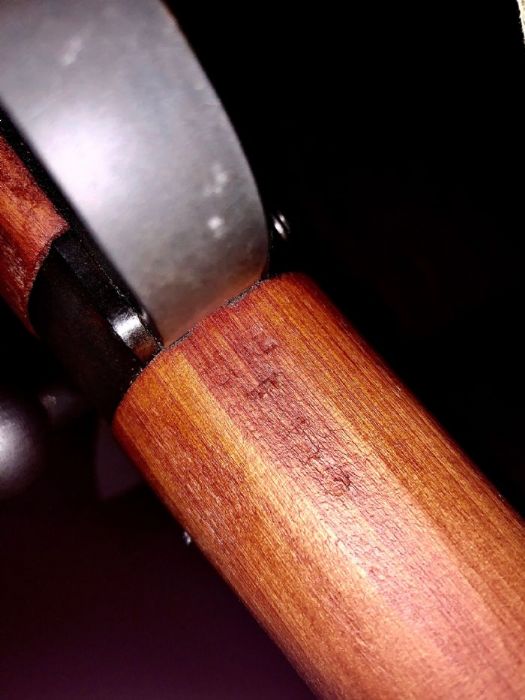   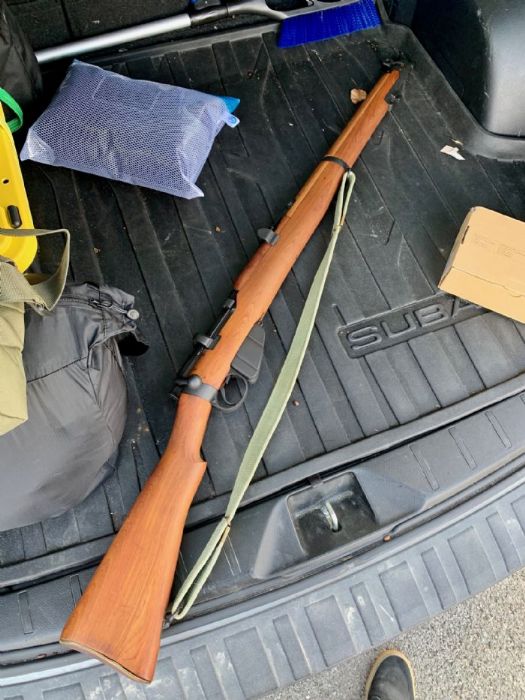   |
Posted By: BJ72
Date Posted: December 01 2019 at 3:10am
|
The fact that the right hand side of the butt is devoid of markings
tells me it's definitely been fitted with a new butt since it first left
the factory. This isn't a real good photo but it will give you the
idea. The butt of your rifle when new would have be marked like this.  That doesn't mean your rifle isn't any good. Just take it for what it is, a good rifle that's been reworked since it left the factory. Aussie shooters and collectors pay big money for new SLAZ stock sets and yours appears brand new. Just make sure the recoil plates were fitted to the stock and your good to go. You can normally just see them looking down into the action with the bolt removed. Here's a picture of what they look like with the forend removed from the rifle. Your looking for the two little brass plates. These were actually omitted from production for a short time but reinstated shortly thereafter. Your forend will definitely last longer with then fitted.  If you decide to pull your rifle apart, make sure you remove the forend first. If your try and remove the butt first, you'll damage the forend, most likely splitting it and stuffing up an otherwise very good rifle. I didn't create either of these photo's. I googled them, so credit to whoever took the images.
|
Posted By: Canuck
Date Posted: December 01 2019 at 7:46am
|
What a great looking rifle! Congrats! Just as a precautionary note....the sling is on wrong, the brass tangs should be pointing away from that beautiful wood. ------------- Castles made of sand slip into the sea.....eventually |
Posted By: Shamu
Date Posted: December 01 2019 at 8:46am
|
Replacing bits during use was perfectly normal, if your butt is a '44 & the action a '41 thats probably what happened. That's a far cry from a JJ&Co Bitster though. I don't think you got "done" depending on price. correct sling installation: ------------- Don't shoot till you see the whites of their thighs. (Unofficial motto of the Royal Air Force) |
Posted By: thrawnformbi
Date Posted: December 01 2019 at 10:02am
|
Thanks for all your help. I know there's some debate as to whether Queensland maple needed the blocks - as I understand it, Lithgow added them into the mix once they switched to Coachwood. Any idea what type of wood this is? Forend is marked 42', butt is marked '44. Regardless of historical accuracy, I'd like to have the recoil pads put in so I could use this as my daily shooter for deer season/target shooting. I don't plan on tucking it away and firing off a few rounds every year or so. I'd really like to hone my skills with the ole girl and gather recoil pads would then be a necessity.
|
Posted By: thrawnformbi
Date Posted: December 01 2019 at 10:50am
Some shots from the inside. Looks like I'm missing the recoil pads eh?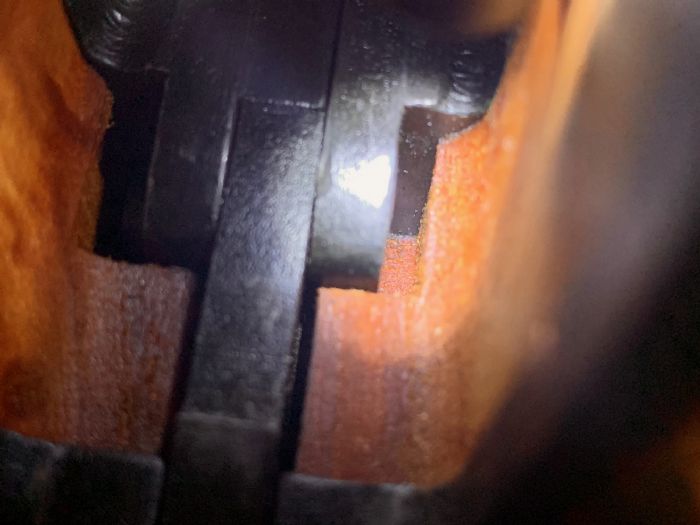 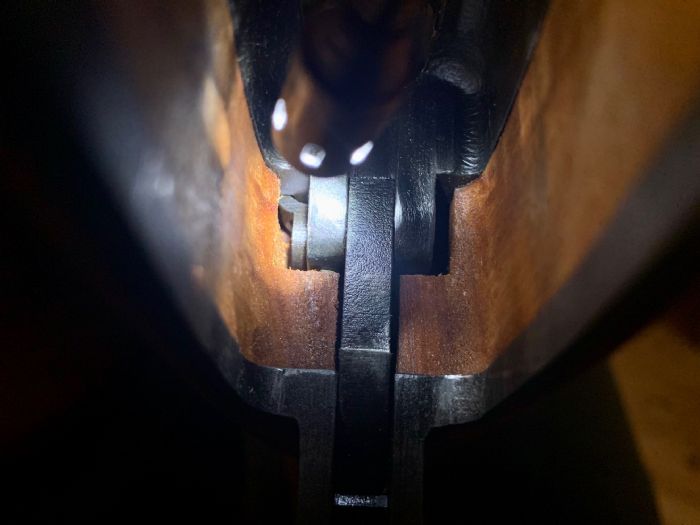 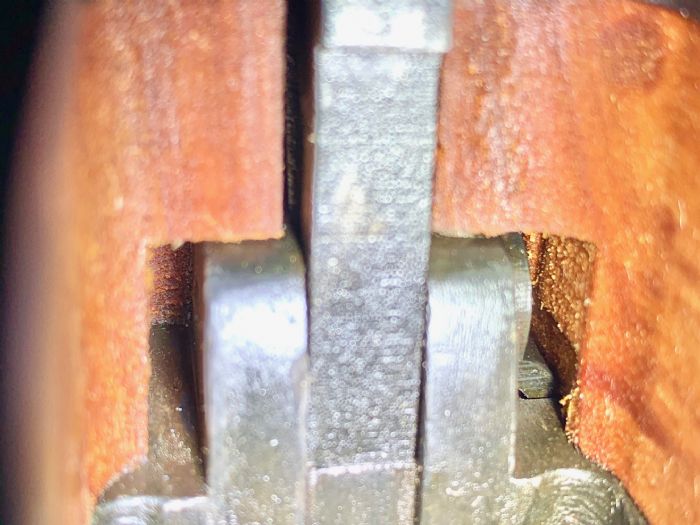 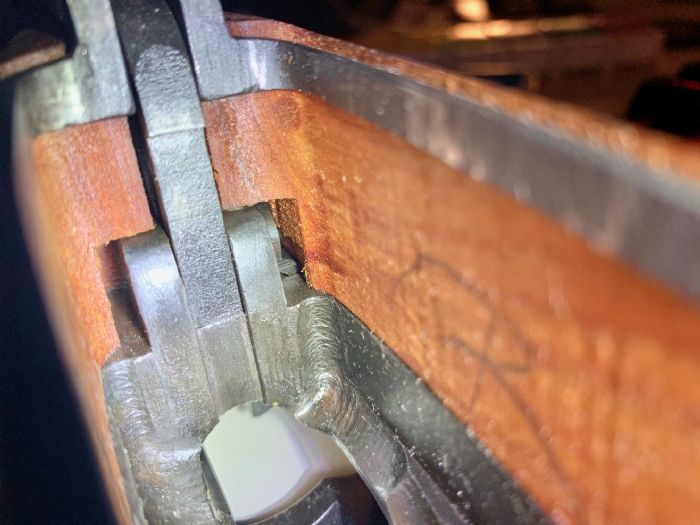 |
Posted By: A square 10
Date Posted: December 01 2019 at 11:23am
| beautiful rifle - thats what ive been looking for all these years - never quite came together yet and ive all but given up on the lithgows |
Posted By: thrawnformbi
Date Posted: December 01 2019 at 12:43pm
Thanks so much for this incredibly detailed response. Very grateful. I took another snap of the magazine for you. Seems to be a star on the inside. Also any idea what the stamp in the 2nd photo indicates? I think it says "I/A VII" Also, dont think there's any brass recoil plates in there. Given that its coachwood do you think its safe to shoot? 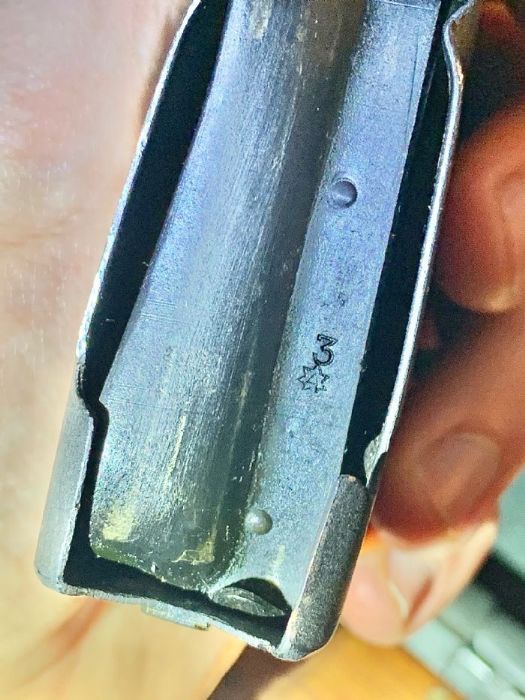 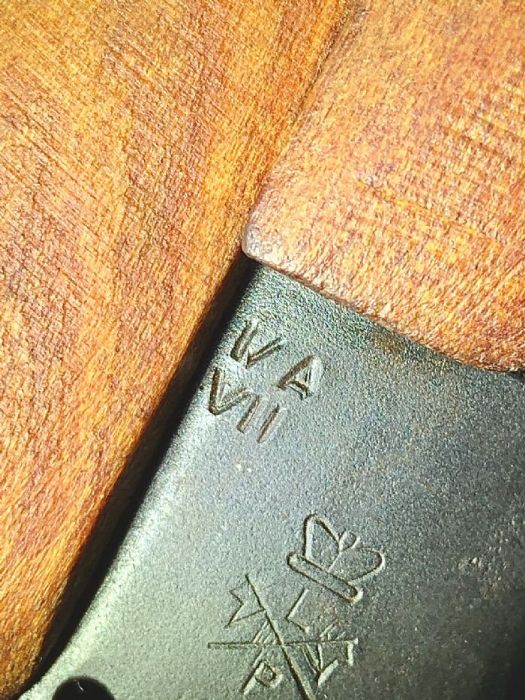 |
 BJ72 wrote:
Posted By: Shamu
Date Posted: December 01 2019 at 2:21pm
|
I don't think you have them fitted either. Maybe you don't need them, maybe you do. The thing is you can't just "bung a set in there" either! That is one of the more critical area of metal-to-wood fitting, sure you can buy a set easily, but whoever fits them will need to be experienced to do it well. I'd suggest handing the job to a gunsmith, but an Enfield experienced one, not just the local guy who's really good.
------------- Don't shoot till you see the whites of their thighs. (Unofficial motto of the Royal Air Force) |
Posted By: thrawnformbi
Date Posted: December 01 2019 at 2:49pm
| Appreciate the response. I've been looking around for guys that are Enfield pros. Seems like BDL LTD down in SC is recommended pretty heavily. I see you're in MD - I'm from DC so down that way pretty often visiting the family. Anyone in the MD/VA/PA area you know of that might be able to do the work? |
Posted By: Shamu
Date Posted: December 01 2019 at 3:06pm
|
Not the way BDL would. I wish I could help more. If you're this way & need a pair of eyes/hands to check I'd be glad to help but I don't have the facilities to do this kind of work. ------------- Don't shoot till you see the whites of their thighs. (Unofficial motto of the Royal Air Force) |
Posted By: BJ72
Date Posted: December 02 2019 at 2:21am
Your magazine follower has the Lithgow star with A inside it. I was referring to the magazine box itself. It would normally be marked somewhere on the back. A MA stamp would be correct for a 41 rifle. Here's a picture of a later magazine marked OA to show it was made at Orange.  I think you'll find that "I/A VII" stamp you refer to on the receiver is actually a poorly struck MA above VII. To the best of my knowledge it's a Lithgow acceptance mark which would have been applied when the action body passed final inspection. Remember MA is the code for Lithgow production. You'll find a similar mark on your barrel, normally MA VI. The crossed flags with L over P beside it is the Lithgow proof mark. When production of the rifles moved to Orange later in the war, that MA VII acceptance mark changed to OA VII. Likewise, very late production rifles have crossed flags with O over P for the proof mark. As for the recoil plates, I'd definitely get some fitted. They were fitted to help prevent the action from pounding back into the timber under recoil. Coachwood is not as dense at Walnut and is prone to splitting. The plates were omitted from production during the war as an emergency measure for a very short period. The fact they went back to fitting them tells me they are needed. From memory, I think they were only omitted from production for something like 2 - 3 months. The rifle won't blow up in your face without them, but you risk damage to your stock. Once that metal to wood fit in the draws becomes loose, accuracy will drop off. Your stock could also split under recoil. As previously stated, unless you really know what your doing, I'd get a good Gun Smith to fit them. They are fitted on an angle to match the receiver and both plates need to bear evenly and snugly allowing the barrel to lay centered along the forend channel. The fact your stock doesn't have the plates fitted is another very good indication it was restocked by JJ CO. Their parts rifles and refurbished rifles are well known for not having the plates fitted. Rifles in Australian service wouldn't have been restocked in Coachwood and sent back out without the plates. We haven't seen the date, or other marks on your barrel yet but I definitely wouldn't refer to your rifle as a parts gun. From what we've seen so far the major components are original matching pieces. I'd refer to your rifle as refurbished, most likely by JJ CO. Don't let any of this JJ CO stuff put you off. You still purchased a very good rifle. Take the time to get the plates fitted, give that stock a good drink of Linseed oil and that rifle will most likely outlast all of us. I'm sure it will outlast me anyway
 |
Posted By: Zed
Date Posted: December 02 2019 at 3:59am
|
Seeing how lovely this rifle looks; I think it would be well worth getting some brass recoil reinforcment fitted to avoid possible premature wear or damage to the coachwood. It would be worth contacting BDL to discuss the options. ------------- It's nice to be important, but it's more important to be nice! |
Posted By: thrawnformbi
Date Posted: December 02 2019 at 8:45am
| Many thanks all. Curious if anyone has a lead on brass recoil plates? Seems like nobody's had a set for years now. Been calling all around and checking ebay aus with no luck. |
Posted By: pisco
Date Posted: December 02 2019 at 10:49am
| i have some spare sets but have to send to america let me know how you go |
Posted By: Zed
Date Posted: December 02 2019 at 11:47am
|
Not difficult to make them if someone can supply the recommended thickness. ------------- It's nice to be important, but it's more important to be nice! |
Posted By: thrawnformbi
Date Posted: December 02 2019 at 1:46pm
|
This is taken from page 87 of The 2012 Complete Book on Lee Enfield Accurizing B&W By Roger Wadham. I just purchased a copy but portions of it are available on google. It seems like a remarkable book with all sorts of information. "These plates were made of brass or copper, and were 17/32 inch by 7/16th inch in size, (.428 by .528 inch on calipers) and .125 inch thick. They are held in place with everyday 1/2 brass countersunk wood screws, and the holes are located dead center of the plate." See link here. https://books.google.com/books?id=f0ycAwAAQBAJ&ppis=_e&printsec=frontcover&source=gbs_vpt_buy#v=onepage&q=recoil%20plate&f=false" rel="nofollow - https://books.google.com/books?id=f0ycAwAAQBAJ&ppis=_e&printsec=frontcover&source=gbs_vpt_buy#v=onepage&q=recoil%20plate&f=false
|
Posted By: pisco
Date Posted: December 02 2019 at 10:04pm
|
hi rogers book is one of the best to have if you want accurize a smle another good book is the lee enfield performance tuning manual by david watson
|
Posted By: MJ11
Date Posted: December 03 2019 at 9:05am
|
I am surprised not a single soul had made up a batch of them. If I ever start shooting my '44 I will keep an eye on the draws.  I the present I have a totally capable '43 BSA to use. I was just wondering what the OP's draws look like at this point ? ------------- The Spartans do not ask how many the enemies are but where they are |
Posted By: Shamu
Date Posted: December 24 2019 at 10:51am
|
UPDATE I Finally found this: Installing Lithgow recoil plates https://drive.google.com/file/d/0B2BZ02FcI7g2Nm85eHROV0RfbVk/view" rel="nofollow - https://drive.google.com/file/d/0B2BZ02FcI7g2Nm85eHROV0RfbVk/view
------------- Don't shoot till you see the whites of their thighs. (Unofficial motto of the Royal Air Force) |
Posted By: pisco
Date Posted: December 24 2019 at 7:18pm
| hi you haven’t sent me me your address so i can send you the copper plates |
Posted By: melrod@knology.net
Date Posted: February 26 2020 at 5:05pm
|
I looked at a 1942 JJ CO , it had the correct range serial number but probably a new added stock like yours. Guy wanted $850.00..to Rich for my blood. ------------- 8thmarines |
Posted By: Marco1010
Date Posted: February 26 2020 at 8:11pm
| Re the brass recoil pads , down here they use the small brass squares that are used to hold down electrical wires, seems that old British made electrical fittings used exactly the same size as the factory made pads. |
Posted By: Zed
Date Posted: February 27 2020 at 4:27am
|
Thanks Marco, that's useful info. ------------- It's nice to be important, but it's more important to be nice! |
Posted By: pisco
Date Posted: March 09 2020 at 9:47pm
| now you have the plates we need a range update |
Posted By: My Ladies
Date Posted: November 03 2022 at 6:27pm
|
I joined to discuss this post and this rifle. I'm no expert but I have all the books. And my ladies. That's right--- my ladies and that's what I'm here to talk about... them and their kin. There's Matilda {Queensland Maple} [Mk. III (WW1)] and Adelaide {Red Gum} (Mk. III* WW2)], SMLEs from Lithgow. Custom Parker-Hale peep sights, oil-blackened finish. Minty. Now a for your piece, at this stage of theme who cares if it is a "parts gun".. But to be a parts gun it would have different serial numbers and it doesn't. But who cares if it assembled in Lithgow? Who even cares if it is Parkerized? The manufacturing tolerances at the British arsenals that made these rifles in England, Canada, Australia, and India were so exacting that you could assemble a working rifle out of parts made all over the world. These rifles were made at the peak of the industrial revolution under conditions that people today would consider appalling--- like what it really takes to create an oil-blackened finish on gun parts at an industrial scale. They lived with a little pollution to create the most durable protective finish every applied to gun metal. OK--- you missed out on that. But the hardware you have is absolutely impeccable and you should see to it that it is brought up to spec including installation of the buffers and a full inspection. I believe there is a gunsmith and vendor in Maryland or Virginia that specializes in Lee-Enfield if you are any where near that part of the country. One day, I might wax poetic on this forum about how an SMLE feels when she comes into the rifleman's arms life a willing woman, elegant, poised with perfect balance. You take a deep breath, close your eyes, raise her to your cheek, and sighing, open your eyes. You're already right on target. ------------- Cheers! |