Military vs Homegrown
Printed From: Enfield-Rifles.com
Category: Enfields
Forum Name: After Market Enfields
Forum Description: What have you done to that Enfield??
URL: http://www.enfield-rifles.com/forum_posts.asp?TID=10971
Printed Date: March 26 2026 at 1:20pm
Software Version: Web Wiz Forums 12.07 - https://www.webwizforums.com
Topic: Military vs Homegrown
Posted By: Goosic
Subject: Military vs Homegrown
Date Posted: November 25 2020 at 6:29pm
|
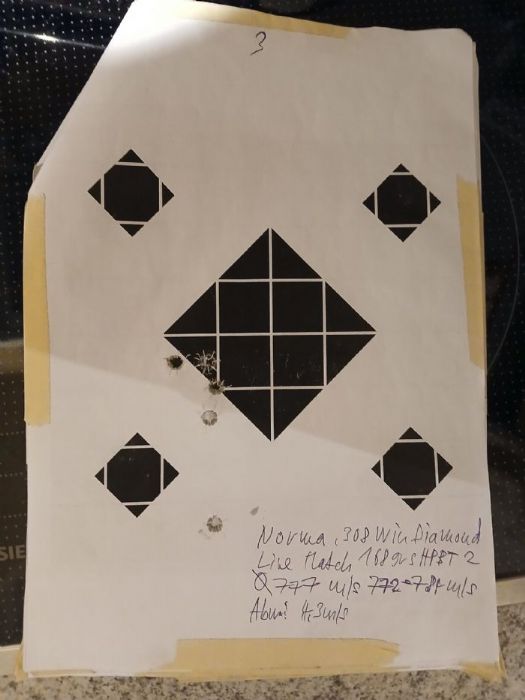
Took the No4Mk1/2 7.62x51mm NATO conversion to the range this morning to run a 200 yard test between the M852 Match and my handloads of 41.7grns of IMR4064. I only had two targets available to use with one of those being an official SR1. I had enough time to set up the chronograph @ 78ft from the muzzle to reproduce military measured velocities. I only had 45 minutes to work with at that time with no sight in shots. The first test was with my handloads. The very first cold bore shot was high and to the right. After the second shot every following shot settled down enough to get a good fifteen shot grouping in. The averaged velocity came to 2512 fps. The military round grouped tighter along the horizontal axis but the vertical spread was not what I had anticipated. The averaged velocity measured for these fifteen shots came out to 2545 fps. Between the two, the handload was a little more consistent which is what I had expected. However, I was impressed with the military ammunition. If it had not been for the elongated vertical spread of the military stuff, I believe the results would have been equal. Again, this was all done at 200 yards...
     |
Replies:
Posted By: Honkytonk
Date Posted: November 25 2020 at 6:56pm
| Very good shooting! |
Posted By: Goosic
Date Posted: November 25 2020 at 7:13pm
| This range time really played heII with me today. Because of this covid crapola, our reserved times are now in 1 hour blocks unless you have paid for additional time. I was not as focused as I should have been and I rushed myself. |
Posted By: klondike
Date Posted: November 25 2020 at 10:59pm
| Awesome shooting, well done!!! |
Posted By: britrifles
Date Posted: November 26 2020 at 7:32am
|
Here’s a page out of the Army Ammunition Data Sheets, Technical Manual 43-0001-27, April 1994. May be of interest. The velocity requirement is 2550 fps out of the M14 Rifle with 22 inch barrel measured 78 ft from the muzzle. Nominal charge given in the TM is 42 gr IMR 4895, but adjusted for each powder lot to meet the velocity specification (e.g. first lot for the 1980 National Matches was loaded with 43 gr IMR 4895 at a chamber pressure of 44,100 psi copper radial method). Consistent velocity was the primary requirement since everyone was issued the same ammunition at matches and you don’t want your elevation range settings continually changing from match to match. The TM doesn’t give the maximum velocity extreme spread, but other sources identified this as +/- 30 fps with max chamber pressure of 50,000 psi (Radial Copper method). These loads typically did not get close to this max allowable pressure. Approx 20 fps increase in MV per inch of additional barrel length so for a 25 inch barrel, you might expect an increase of 60 fps over the 2550 fps standard. If the chrono is placed closer than 78 feet from the muzzle, that would give a higher velocity measurement too.  |
Posted By: Goosic
Date Posted: November 26 2020 at 7:52am
|
With the introduction of the 7.62-mm, M14 National Match rifle and the M118 7.62-mm Match cartridge in 1964, the caliber .30 rifle and its ammunition have been gradually phased out of competitive matches. Although the velocity of the 7.62-mm cartridge is somewhat lower than its predecessor (2550 versus 2650 fps), the accuracy of these two cartridges is nearly identical, in large part due to the fact that they share the same bullet design. Development of 7.62-mm match ammunition actually started in 1956 when the Office, Chief of Ordnance, directed Frankford Arsenal to manufacture 7.62-mm Ball ammunition of match quality for use in international matches on 300 meter ranges. The resulting design was designated the T275 International Match cartridge. Several changes were made to this cartridge which ultimately evolved into the M118, 7.62-mm Match cartridge in 1964. THE T275 MATCH CARTRIDGE The T275 cartridge and four later variations, designated T275El through T275E4, were assembled extra-long in order to assure that the bullet would rest against the forcing cone in the so-called "free rifles" of that period. A summary of the variations in these cartridges are listed below: T275 Bullet - FA28871 174.5 grain, 9 degree boattail (.245" long) Overall Cartridge Length - 2.860 -0.030" Velocity - 2250 +/- 30 fps Primer - FA No. 26 T275E1 Bullet - FA28871 Overall Cartridge Length - 2.960 -0.030" Velocity - 2400 +/- 30 fps Primer - FA No. 26 T275E2 Bullet - FA28871 Overall Cartridge Length - 2.960 -0.030" Velocity - 2600 +/- 30 fps Primer - FA No. 34 T275E3 Bullet - 8595434 174.5 grain, 9 degree boattail (.225" long) The same bullet as the M72 Overall Cartridge Length - 2.860 -0.030" Velocity - 2640 +/- 30 fps Primer - Remington #72 T275E4 Bullet - 8595434 Overall Cartridge Length - 2.860 -0.030" Velocity - 2275 +/- 25 fps Primer - FA No. 36During 1958, funds were provided to production engineer the T275E4 design and prepare a technical data package for mass production. It was during this effort that definitive weights and tolerances for the bullet and its components were determined, and a two-draw bullet jacket process evolved. This process improved jacket wall thickness variations and significantly improved bullet accuracy. M118 MATCH CARTRIDGE In 1961, Frankford Arsenal received an order for 50,000 Match cartridges from Springfield Armory, to be used for testing the M14 National Match rifle. The T275E4 cartridge was at that time redesignated the XM118. These cartridges were loaded with Hercules HPC 6 propellant at a nominal velocity of 2550 fps, and the overall length was reduced to 2.83-.03 inches to facilitate feeding in the M14 magazine. Mouth Waterproofing During this period, testing was conducted to determine if mouth waterproofing had any effect on the ballistic characteristics of the cartridge. Much to the chagrin of competitive shooters, these tests indicated that mouth waterproofing did not effect bullet accuracy, but would improve storage stability. Because the M118 cartridge was intended for use in combat by snipers, in addition to its primary competitive match function, storage for long periods was considered an essential requirement. The cartridge drawing was, therefore, changed to reflect the addition of mouth waterproofing in November 1961. Determination of Velocity-Accuracy Relationship Up to this time, no scientific study had ever been conducted to establish an optimum velocity-accuracy relationship for 7.62-mm Match ammunition, as was evidenced by the changing velocity specifications of the T275 cartridge series. The various velocities for each cartridge type were determined and prescribed by the Infantry Board at Fort Benning, Georgia. A comprehensive test to determine the relationship between velocity and accuracy at various ranges was initiated by Frankford Arsenal in 1961 and completed in early 1962. These tests were conducted at ranges of 200 to 1000 yards using velocities of 2300, 2400, 2500, 2600, 2640, and 2700 fps. At the conclusion of these tests, it was determined that for ranges up to 600 yards, the best accuracy was achieved with a velocity between 2500 and 2600 fps. On 23 August 1962, an Engineering Change Request was issued that changed the velocity specification from 2640 ± 30 fps to the present specification of 2550 ± 30 fps. Primer and Propellant Evaluations Although the T275 cartridge series used IMR 4895 propellant, the emphasis on increased velocities and the attendant increase in chamber pressures, necessitated the search for a propellant compatible with the No. 26 Primer and capable of achieving up to 2700 fps. Several propellants were tested, and a Hercules propellant, designated HPC #6, was selected for use in the first 50,000 rounds of XM118 to be shipped to Springfield Armory. However, high pressures, experienced with this propellant at cold temperatures, led to the reduction of the velocity specification to 2640 fps. This change allowed the use of additional propellants and eventually WC846 was selected as the prime propellant in lieu of the HPC #6. Shortly thereafter, the velocity-accuracy tests mentioned previously were completed, which now established 2600 fps as the top velocity requirement and recommended use of the #34 Primer. A new series of propellant tests were then conducted which ultimately determined that both WC846 and IMR 4895 were compatible with the #34 Primer, and were subsequently recommended for use in the XM118 cartridge. A summary of M118 Match cartridge performance requirements as specified in MIL-C-46934 is listed below: Velocity @ 78 feet - 2550 ± 30 fps Accuracy @ 600 yds - 3.5 Mean radius max Chamber Pressure @70 degrees - <50,000 psi (radial copper) Port Pressure @ 70 degrees - 12,500 ± 2000 psi |
Posted By: Goosic
Date Posted: November 26 2020 at 7:53am
|
User Dissatisfaction with the M118 Cartridge For several years after its introduction, the M118 cartridge performed satisfactorily, and was well received, although complaints were registered regarding excessive barrel fouling associated with ammunition lots having WC846 ball propellant. A series of tests conducted at Frankford Arsenal concluded that, although the WC846 did foul the bore somewhat, the fouling was no worse than when IMR 4895 was used, and the effect of the fouling on accuracy was too small to be observed. However, they noted that WC846 residue was much harder to remove from the bore than IMR 4895 residue. Another user complaint regarding propellant was the higher bulk density of WC846 (0.980 g/cm versus 0.900 g/cm for IMR 4895). WC846 generally meets the required velocity/pressure levels at a charge weight that allows a small air space inside the cartridge. Whereas, IMR 4895, having a lower bulk density, will normally be loaded to 100% case capacity. Residual air space within the case has always been regarded as undesirable, due to its contribution to variations in velocity and pressure, causing an accuracy variation. As a result of these problems associated with WC846 propellant, all M118 Match cartridge production since 1970 has been loaded with IMR 4895 propellant. By the early 1970's, the accuracy performance of the M118 cartridge was being severely criticized as inferior, when compared to hand loaded cartridges using commercial Match grade bullets. In fact, several Marksmanship Training Units had initiated a procedure whereby they extracted the bullet from the M118 cartridge and replaced it with a 168 grain Sierra, cal. .30, International Match bullet, and referred to it as the "Mexican Match" cartridge. The ammunition loaded in this manner reportedly achieved an accuracy which was 25% to 50% better than standard M118 cartridges. Several early attempts were made by Frankford Arsenal, circa 1972-1975, to initiate Product Improvements to the M118 by investigating the adequacy of commercial match bullets, by tightening the M118 Cartridge tolerances, and modernizing production equipment. However, these efforts never evolved into actual approved programs. Finally in 1976, ARRCOM instructed ARRADCOM to implement a "product-definition" to the Technical Data Package (TDP) of the M118 Match cartridge. This effort was to improve the M118 accuracy and made the following changes to the technical requirements: Velocity The average velocity, at 78 ft from the muzzle, of the sample cartridges conditioned at 70°F ± 2°F shall be 2550 ± 20 fps. The standard deviation of the velocities shall not exceed 18 fps. Accuracy The mean radius of any target of the sample cartridges shall not exceed 2.5 inches at a target distance of 600 yards. Air Space The cartridges shall be loaded such that the average and standard deviations of the velocities of various samples of cartridges, each sample handled when fired so as to vary the propellant position from sample to sample, shall not be statistically different. Bullet Weight The bullet weight within any lot shall be limited to a tolerance of 0.8 grains. In addition to the above changes to the M118 specifications, several tolerance changes were incorporated into the drawings of the bullet and cartridge case to reduce concentricity and wall thickness variations. The Lake City Army Ammunition Plant (LCAAP) agreed to produce the M118 cartridge to the revised TDP on a "best effort" basis, since they could not guarantee that compliance with the above mentioned changes would produce a more accurate cartridge. The M118 Match cartridge was produced to those specifications starting in February 1977, the first lot being LC-60. On 17 August 1978, a briefing was conducted at ARRCOM for Undersecretary of the Army, Dr. Walter LaBerge, to review the status of the M118 Match cartridge. By comparing the past performance against the latest production efforts, it was apparent that the changes made to the TDP had not achieved the desired effect. The ten year production average prior to the change in the TDP was a 2.47-inch mean radius. After producing 12 lots to the revised TDP, this average remained essentially unchanged at 2.41 inches, see below: LC-60-1 600 yd mean radius - 3.0 LC-60-2 600 yd mean radius - 2.6 LC-60-3 600 yd mean radius - 2.3 LC-60-4 600 yd mean radius - 2.4 LC-60-5 600 yd mean radius - 2.5 LC-60-6 600 yd mean radius - 2.6 LC-60-7 600 yd mean radius - 2.4 LC-60-8 600 yd mean radius - 2.2 LC-60-9 600 yd mean radius - 2.4 LC-60-10 600 yd mean radius - 2.3 LC-60-11 600 yd mean radius - 2.1 LC-60-12 600 yd mean radius - 2.1 12 lot average mean radius - 2.41 It appeared then that a 2.4 to 2.5 inch mean radius represented a practicable limit for the average lot of M118 Cartridge when manufactured by the process employed at LCAAP. Two apparent alternatives remained to improve the M118 cartridge accuracy; completely modernize the production equipment at an initial investment cost of approximately one million dollars or, investigate the practicality of purchasing commercial "Match Grade" bullets and providing them to the load plant as Government Furnished Materiel (GFM). The decision reached at the 17 August 1978 meeting was to pursue the latter alternative. The final action taken at this meeting was to draft a tentative requirements document, which Headquarters, U.S. Army Forces Command (FORSCOM) formalized in a letter to ARRCOM on 14 December 1978. On 22 January 1979, ARRCOM responded to this requirement by requesting that ARRADCOM prepare a Product Improvement Program (PIP), to be initiated in FY81. This was later changed to an Engineering Study Program (ESP) approved in September, and initiated in December, 1979. The activities detailed in the following sections are the result of that program |
Posted By: Goosic
Date Posted: November 26 2020 at 7:54am
|
EVALUATION OF COMMERCIAL CALIBER .30 MATCH GRADE BULLETS This engineering study was undertaken to improve the accuracy of the M118 Match cartridge, as authorized by U.S. Army Forces Command (FORSCOM) letter requirement, dated 14 December 1978. Specifically, the requirement states that the accuracy of any five, 14 shot targets at 600 yards shall not exceed a 6-inch extreme spread. Other requirements of the M118 Match cartridge were to be retained. In addition, bullets having an open nose were authorized. Since earlier attempts to improve the accuracy of the M118 cartridge through process and tolerance controls had been largely unsuccessful, this program was directed towards the evaluation of commercial match-grade bullets as a potential replacement for the current bullet used in the M118 cartridge. Technical Approach A survey of commercial sources for off-the-shelf caliber .30 Match bullets in the 168 to 170 grain weight range indicated that three American and one foreign corporation market this type of bullet, and another was developing such a bullet that was not yet available, see below: Commercial Match-grade bullets Sierra Bullets #2200 Hornady Mfg Co. #3050 Nosler Bullet Co. #28473 Lapua (Finland) #D46 (170 gr) Omark Industries (SPEER) #2040 (not available for testing) All bullet designs except the Lapua are manufactured in the United States by a soft swaged, nose closing process, more commonly referred to as "hollow point". The Lapua bullet, manufactured in Finland, is the only bullet evaluated which has a conventional hard nose, like the M118 bullet. Other than manufacturing tolerances, the main difference in the Lapua bullet is it's rebated boattail, common to many European bullet designs. All bullets evaluated in this study could be freely substituted for the standard M118 bullet with only a minor propellant charge adjustment to achieve the desired velocity. All of the other cartridge components used in this study were standard M118 components. Because the prime consideration was to improve accuracy, the bulk of the testing was geared towards evaluation of the accuracy of the bullet candidates at various ranges. In addition, other testing was conducted to insure complete compatibility with the M14 rifle. Tests and evaluation factors 1. Accuracy at ranges up to 600 yards 2. Velocity and pressure uniformity 3. Radar evaluation of velocity decay 4. Trajectory mismatch 5. Cost comparison 6. Dimensional and weight uniformity In order to evaluate the performance under normal production conditions, 11,040 rounds (12 wirebound crates) of each bullet type were loaded on regular production loading machines at the Lake City Army Ammunition Plant. The only process change made was the substitution of a contoured-bullet insertion tool to prevent damage to the bullet points, and a cartridge case identity knurl for identification. The balance of the assembly process was unchanged from normal production of Match ammunition. To insure compatibility of test data, an M118 cartridge lot, LC 79K-130-007 was earmarked as a control lot and shipped with the test cartridges to the testing facilities listed below: U.S. Army Research & Development Command U.S. Army Marksmanship Training Unit, Ft Benning U.S. Marine Corps Marksmanship Training Unit, Quantico U.S. National Guard Marksmanship Training Unit, Nashville Test Program Accuracy Testing As originally structured, all of the Marksmanship Training Units were scheduled to shoot identical accuracy test programs at 200, 600, and 1000 yards. This was later modified slightly to accommodate the varying range facilities at each agency. The 1000-yard requirement was eliminated from the MTU tests due to difficulties encountered in the testing of the first Sierra bullet lot LC80C-300-S-090 prior to the 1980 National Matches, and because the MTU's felt that 1000-yard tests were unwarranted. However, testing at 1000 yards were conducted at ARRADCOM's Ft. Dix Test Site to gather information on dispersion at that range. Although the diversified accuracy testing by the test agencies gives a broad evaluation of the potential of the candidate bullets under varying conditions, it does not indicate how well these bullets can perform when the selection of barrels is considered. The discrete test, which allows the best barrels to be used, is a much better indicator of the lowest dispersion potential for these bullets, and is a more realistic means of comparing performance in competitive matches, where the shooters will be using finely tuned weapons. Testing at ARRADCOM and Lake City Army Ammunition Plant was conducted using 7.62-mm accuracy barrels from a fixed mount, while the MTU's conducted their testing in National Match M14 rifles. Analysis of the accuracy data from the test agencies was complicated somewhat by inconsistencies. The Marine Corp MTU data, for example, was based on Figure-of-Merit measurements rather than extreme spread, and the 300-yard accuracy tests were conducted using 5-round targets. In general, the Sierra bullet displayed the greatest accuracy performance with a range averaged improvement 32% better than the M118 cartridge. The Lapua bullet also showed a significant improvement at 23% better than the M118. Of the other two bullets evaluated, the Nosler ranked third with a 15% improvement and the Hornady bullet fourth with performance slightly worse than the M118. The Marksmanship Training Units unanimously recommended the adoption of the Sierra bullet. Velocity and Pressure Uniformity Velocity and pressure measurements indicated that all of the bullet candidates are very consistent, with only slight variations between bullet types. The tight tolerances associated with these bullets is a major contributor to this uniformity. The small variations in velocity and pressure between bullet types are considered to be a function of propellant loading and/or other system variables. |
Posted By: Goosic
Date Posted: November 26 2020 at 8:00am
|
One hundred bullets of each type were randomly selected and weighed on a Metzler PC 180 electronic scale. Additionally, twenty bullets of each type were measured on a comparator uniformity of outside diameter, overall length, and boattail length. The results of this survey are summarized below: Bullet weight inspection (all weight in grains) Bullet Type//Avg Wt//Ext Spread//High Wt//Low Wt Sierra//168.0//0.60//168.3//167.7 Hornady//167.7//0. 60//168.1//167.5 Nosler//168.0//0.80//168.5//167.7 Lapua//169.8//0.78//170.3//169.5 Bullet dimensional check (all dimensions in inches) Bullet Type//Overall Length//Diameter//Length of Boattail Sierra//1.242 max-1.234 min//0.3084 max-0.3081 min//0.170 max-0.160 min Hornady//1.239 -1.230//0.3086 -0.2080//0.200-0.190 Nosier//1.211-1.200//0.3084-0.3079//0.110-0.100 Lapua//1.255 -1.250//0.3092-0.3086//0.250-0.236 Downrange Velocity Decay The four commercial bullets and the standard M118 cartridge were tested for velocity retention and coefficient of drag using a Hawk doppler radar to track the projectiles. As would be expected, the M118 bullet being slightly heavier, retains its velocity slightly longer than the others. The Sierra, Hornady, and Lapua bullets track very closely together. The Nosler bullet loses velocity rapidly, which accounts for the poor long range accuracy experienced with this bullet. Accuracy Mismatch A series of tests were conducted with each bullet to determine if there was any noticeable trajectory mismatch or other functional problems associated with the commercial bullets relating to the M14 rifle and sight system. No problems were encountered with any of the candidate bullets. As might be expected, when changing from the M118 to any of the other lighter bullets, a minimal sight correction is required. Aerodynamic Analysis of Match Projectiles A limited aerodynamic analysis was undertaken to predict why the commercial match bullets are more accurate than the conventional M118 bullet. This analysis consisted of determining the sensitivity of various bullet dimensions on accuracy. The conclusion of this analysis was that the effect of the studied external geometry variations on dispersion is much less than acceptable lot variations, and these variations act only in the vertical plan. Other sources of dispersion that act in both horizontal and vertical planes are: the offset of the center of mass of the projectile from the center of form, rifle barrel vibrations, non-symmetrical reverse flow over the projectile at muzzle exit, core imperfections and improper seating, and yawing during the first few feet after exit. Any difference in dispersion between the standard M118 bullet and the commercial Match bullets tested can only be attributed to the manufacturing processes that allow better control of both internal and external dimensional variations. Comparison of Bullet Costs Cost estimates for the two most accurate bullets, the Sierra and Lapua, were obtained from the bullet suppliers, and compared with the latest available M118 bullet manufacturing cost. Costs of the two commercial bullets are predicated on quantities of 5 million or more delivered freight pre-paid to the Lake City AAP. Unit costs for smaller quantities would obviously be higher. It should be pointed out that the cost of the Lapua bullet, because it is imported from Finland, will vary due to fluctuations in currency exchange rates. M118 - (actual 1980 cost = 6.7c) Projected 1981 Cost (c) - 7.4 Sierra - Projected 1981 Cost (c) - 7.1 Lapua - Projected 1981 Cost (c) - 8.6 |
Posted By: Goosic
Date Posted: November 26 2020 at 8:02am
|
The Lapua bullet is the only design tested that has a hard nose similar to the standard M118 bullet, and it is one of the two bullets that gives a significant increase in accuracy. Because it has a hard nose rather than hollow point, it could be directly substituted in the M118 cartridge and used in sniper applications. To determine what advantage, if any, the Lapua would have in the sniper role, a series of hit probabilities were calculated which compared it to the M118 standard bullet. The hit probabilities were based on zero error and 0.5 mil aiming error, and considered against standing, prone and kneeling man-sized targets. With zero aiming error the hit probability is 1.0 for all targets out to 600 yards and then the Lapua bullet, because of increased dispersion at longer ranges, drops off much faster than the M118 bullet. For instances with 0.5 mil aiming error, which is probably the largest expected of snipers, the aiming error partially masks the better dispersion of the Lapua bullet with the net result that the Lapua bullet does not offer any real advantage in the sniper role. When the added cost of the Lapua bullet is considered, there is no longer any reason for advocating its use in the sniper role. For competitive shooting up to 600 yards, however, use of the Lapua bullet is second only to the Sierra bullet.1980 NATIONAL MATCH CARTRIDGE Work on the basic engineering study to evaluate commercial match-grade bullets had just been initiated when, in January 1980, the U.S. Army Armament Materiel Readiness Command (ARRCOM) notified ARRADCOM that they had received a request from the Director of Civilian Marksmanship (DCM) for an improved accuracy 7.62-mm Match cartridge for the 1980 National Matches. Specifically, the requirement was for a quantity of 200,000 rounds to be delivered to Camp Perry, Ohio, by 17 July 1980. ARRADCOM responded by redirecting the Engineering Study into a priority effort to meet the July 1980 deadline. A coordination meeting was held at Lake City Army Ammunition Plant (LCAAP) between representatives of ARRCOM, ARRADCOM and LCAAP contractor personnel to discuss this effort on 7 February 1980, determine priorities and work up a schedule to meet the July delivery. This effort was undertaken on a best effort basis with no guarantee that an improved accuracy cartridge could be tested and approved within the available time given the five month schedule. It was determined at the 7 February meeting that an initial evaluation quantity of 13,800 rounds would be fabricated and tested by ARRADCOM and three Marksmanship Training Units (MTU) prior to a final decision on production of the 200,000 quantity. Arrangements were made with the U.S. Army, Marine and National Guard MTU's to test a portion of the initial test lot, in order to get a broad based evaluation in a short period. As for the choice of which bullet to use, the Sierra 168 grain International Match bullet was considered to entail the lowest risk since the MTU's had been using this bullet for some time. If the initial test lot performed as expected, the Sierra bulleted cartridge would then be type classified as Limited Procurement (LP) to allow the production of the larger 200,000 round lot for the 1980 National Matches. Meanwhile, ARRADCOM would hand load and test a small quantity to provide data for the release of an Interim Safety Statement, prepare the necessary drawings, and obtain the nomenclature assignment. Sierra bullets, more commonly referred to as hollow points, are made by a soft swaged nose process as are all American made commercial Match bullets. Because these hollow pointed bullets, loaded at a United States loading facility, might be construed as a violation of the Geneva conventions, special markings on all exterior packaging and on identity knurl on the cartridge case were considered essential. Special care was taken with the handling and marking to prevent inadvertent use of these cartridges in a potential combat situation. Subsequently, a legal opinion was received from the Office of the Judge Advocate General, which stated that the use of Sierra bullets, these bullets as intended could not be construed as violation of any International Convention. By the middle of February, drawings had been prepared and an interim 7.62-mm cartridge, designated Special Match, PXR-6308 had been assigned. The load plant completed the first lot of 13,800 rounds, LC80C-300-S-090 on schedule, and testing by ARRADCOM and the MTU's proceeded without delay. A standard M118 cartridge Lot LC79K130-007 was earmarked as a control lot and used by all test agencies to compare the accuracy of the test lot. Results of these tests are summarized below: Ballistic acceptance data for Lot# LC80C 300-S-090 Propellant Charge - 43.0 grains IMR 4895 Velocity @ 78 feet - 2535 fps Chamber Pressure - 44,100 psi Port Pressure - 12,300 psi Accuracy @ 600 yds - Mean Radius: 2.2 inches/extreme spread: 8.8 inches Results from comparison testing (extreme spread): LCAAP (Mann Barrel/Machine rest) - M118: 9.6 (@ 600 yds) - PXR-6308: 8.8 ARDEC (Mann Barrel/Machine rest) - M118: 2.3 @200yds/3.9 @300/9.9 @600 - PXR-6308: 1.8 @200yds/3.3 @300/7.3 @600 FT Benning AMU (M14/Machine rest) - M118: 7.3 @300/13.9 @600/27.3 @1000 - PXR-6308: 4.7 @300/9.5 @600/25.0 @1000 US National Guard AMU (M14/Machine rest) - M118: 4.5 @200/15.7 @600 - PXR-6308: 3.3 @200/11.9 @600 USMC MTU (M14/Shoulder) - M118: 6.9 @300/12.8 @600 - PXR-6308: 5.0 @300/10.3 @600 Comments of the MTU's on the performance of the Sierra bulleted cartridges were very favorable due to the obvious improvement in accuracy over the standard M118 Match cartridge. The actual improvement in accuracy averaged at least 25% better than the M118 cartridge for all ranges out to 600 yards. On 7 May 1980, the Special Match cartridge, PXR-6308 was type classified as limited procurement, and fabrication of the 200,000 round 1980 National Match lot was initiated. This lot, designated Lot LC-80F-300-S111 was delivered to Camp Perry on 10 July 1980, one week ahead of schedule. The above article is mostly derived from ARSCD-TR-81018 "7.62mm Match Cartridge Accuracy Improvement Program" by J. W. Hettel |
Posted By: britrifles
Date Posted: November 26 2020 at 8:32am
|
Yes, I’ve read all that info that is available on line. Much of it is extracts from Hettel’s Report. Your accuracy results are in line with those original first lot tests shot from a M-14/machine rest.
I’ll have to look for some of this ammo, I’m sure some of my shooting buds have it from the days before the AR became the popular Service Rifle for CMP matches. I’ve got a full .30 Cal ammo can of 1961 .30 Cal. M72 Match as originally packed from the same lot but I can’t bring myself to shoot any of it. Frankly, we can do better with our own handloads. Goosic, did you say you pulled a bullet and weighed the powder charge in some of these cases? Did the powder stick size conform to IMR 4895? As far as I know, the M852 Match was only loaded with IMR 4895. |
Posted By: Goosic
Date Posted: November 26 2020 at 9:02am
| After realizing my mistake in assuming the powder was IMR4064, (I misread the MK 316 MOD 0 info and overplayed it on the M852 info) I pulled a bullet and weighed the charge. It was 42.8grns. And yes it is IMR 4895. |
Posted By: A square 10
Date Posted: November 26 2020 at 9:03am
| ive a couple 30 cans of radway green 762 that i cant bring myself to shoot yet - i still have a lot of lake city im shooting first , unlike you folks im not reloading for my M14type yet |
Posted By: Goosic
Date Posted: November 26 2020 at 9:05am
| Your comment about trying to find some of this ammo. A waste of time ,money and energy. As you said, our handloads will outperform this Match round hands down. |
Posted By: Goosic
Date Posted: November 26 2020 at 9:10am
I had 80 rounds of this M852 stuff as of yesterday. Now I have one box of 20 rounds left. I shot it mainly for the curiosity factor. I would do the same if I was given some of the Radway Green.
|
 A square 10 wrote:
Posted By: britrifles
Date Posted: November 26 2020 at 12:39pm
|
We often overlook the minor details of things like what distance the velocity measurements are taken and the length of the barrel. US .30 Cal and 7.62x51 published military cartridge data is based in instrumental measurements at 78 ft from the muzzle and for the weapon they are primarily intended for. So, for M852 with the spec mean velocity of 2550 fps corresponds to about 2700 fps at the muzzle (from a 22 inch barrel) based on a ballistics calculation for the 168 gr SMK. I’m not sure what the British standard distance was for measuring bullet velocity, and if it was corrected to velocity at the muzzle. The Mk 7 cartridge had a specified mean velocity of 2440 fps. Does anyone know how far from the muzzle that measurement was taken or if that is a velocity calculated at the muzzle? Much of the Mk 7z Canadian surplus I have tested runs about 2420 to 2440 fps at approx 20 feet from the muzzle (25 inch barrel). I only bring this up as these two factors (barrel length and distance from muzzle where velocity is specified or measured) are often overlooked when we attempt to duplicate a factory load. Most loading manuals will give velocities at the muzzle and the barrel length for which it applies to. |
Posted By: The Armourer
Date Posted: November 26 2020 at 1:15pm
The only information I have is on the cartons of British produced MkVII. Taken at the muzzle.   |
Posted By: Shamu
Date Posted: November 26 2020 at 2:33pm
|
I believe it may have been times for the "100m" & back calculated from that. Chronographs back then were infinitely more of a PITA to set up or use as they relied on printed paper "screens" with conducting ink/paint. They were good for one shot Then you'd set them up with new ones & start all over. Timing TOF & calculating was much easier. ------------- Don't shoot till you see the whites of their thighs. (Unofficial motto of the Royal Air Force) |
Posted By: Honkytonk
Date Posted: November 26 2020 at 2:46pm
| Did I mention that was really good shooting? |
Posted By: Goosic
Date Posted: November 26 2020 at 3:57pm
Thank you HT. I definitely appreciate it. It was 46° with a 11mph crosswind across the range, I was not dressed for the occasion so I was a tad cold and I had absolutely no time for any sighting in stuff. It was a cold bore shot the second the range was cleared for live fire and from there on out, it was a race against the clock to get everything accomplished. I am going out next Wednesday without the chronograph. I will be using my M700P this time just to see if I can tighten the groups up.
|
Posted By: Enfield Envoy
Date Posted: January 27 2026 at 8:08am
------------- Enfield Envoy |
Posted By: Enfield Envoy
Date Posted: January 27 2026 at 8:14am
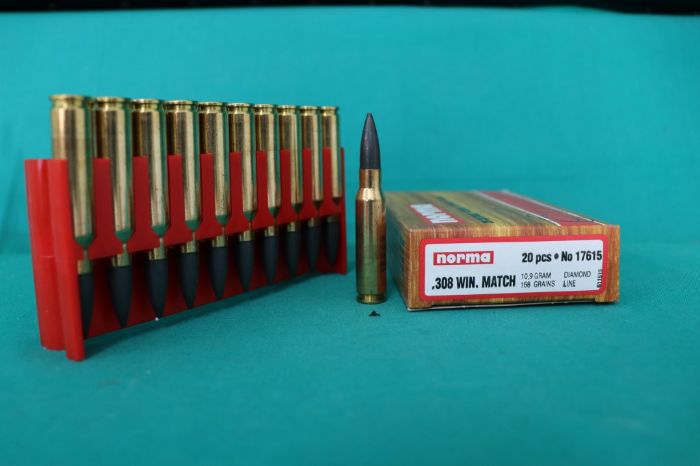
The pic says more than 1000 words... 
------------- Enfield Envoy |

Posted By: Enfield Envoy
Date Posted: January 29 2026 at 5:00am
|
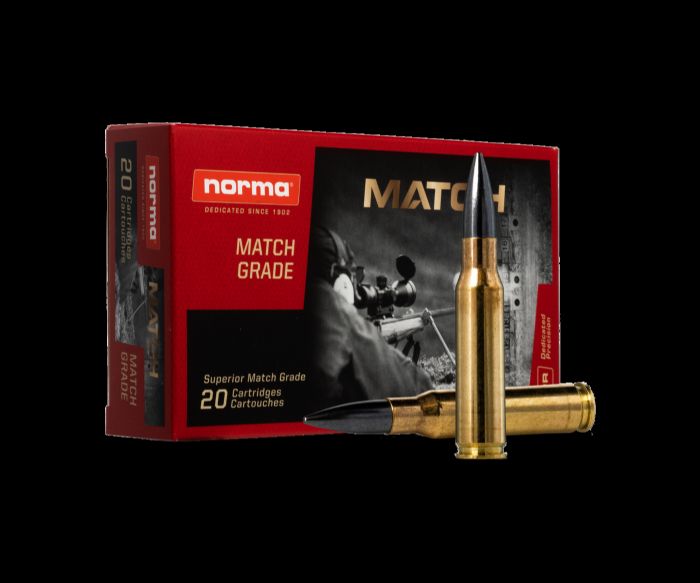
.308 Win. Norma Military Production 168 gr HPBT Match  ------------- Enfield Envoy |
Posted By: Shamu
Date Posted: January 29 2026 at 11:09am
|
NIce. ------------- Don't shoot till you see the whites of their thighs. (Unofficial motto of the Royal Air Force) |
Posted By: britrifles
Date Posted: February 01 2026 at 4:54am
|
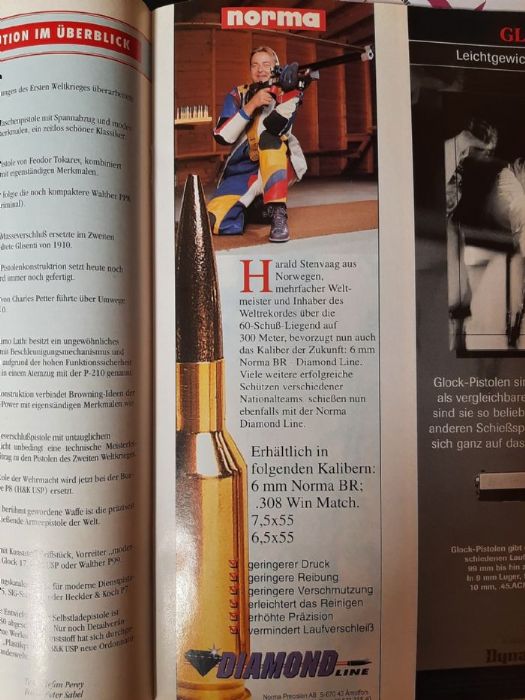
Factory ammunition quality for “match grade” products have made large improvements over the years. So much so that handloads don’t have the large accuracy advantage they once did. However, there is always the possibility that a tuned handload will produce tighter groups than factory, but we are talking small differences that may only show up in perhaps F-Class and bench rest shooting. The other good reason to hand load is you have full control of the variables, like chamber pressure. I decided I would not shoot .308 Win factory loads thru my DCRA, not knowing how close they are to .308 Win max pressures with the chamber/throat on my No. 4 7.62 conversions. They are all probably fine, but no good reason to take the chance when you can handload. The claim that Norma is making that the diamond line (moly coated) bullets substantially increases barrel life is interesting. Barrel life is governed by throat erosion and that has a lot to do with powder burn temps and pressures. While the claim might be true in the sense that a one for one substitute of a plain jacketed bullet with a moly coated bullet keeping the same powder and charge weight would slightly lower pressures due to lower friction, bullets loaded to the same velocities seems unlikely there would be much difference in barrel life. NOS Enfield hammer forged heavy barrels for the L39/L42/Envoy must be very hard to find. But if the barrel life is truly doubled by substituting a plain jacketed bullet for a moly coated bullet, I would probably do that. Alternatively, you can shoot reduced pressure loads for short to mid range work, save the “full” pressure loads for long range. Factory ammunition is usually loaded to magazine length. You can substantially reduce pressures by seating bullets further out if the throat length allows it, which is the case for my DCRA 7.62 conversion. For 800, 900 and 1000 yards, I’m loading the Sierra 168 grain Tipped MatchKing (TMK) seated to a OAL of 2.95 inches, .020 inches off the lands. Cramming that long bullet in the case to a 2.81 OAL reduces case volume significantly with a corresponding pressure increase. I’m not seeing any load data specific for the TMKs, yet we know that when seated to the same length as the SMK, they must result in higher pressures for the same charge weight. |
Posted By: Shamu
Date Posted: February 01 2026 at 12:45pm
|
^^^ THIS regarding seating depth. I seat with one full caliber in the case neck (ignoring the boat tail.)you won't get a to the lands in even a brand new .303 barrel so I split the difference between bullet run-out & jump to lands. ------------- Don't shoot till you see the whites of their thighs. (Unofficial motto of the Royal Air Force) |
Posted By: britrifles
Date Posted: February 01 2026 at 1:07pm
|
Absolutely, a good rule of thumb Shamu. Especially with tangent shaped ogives. I experimented with the secant ogive 168 TMK and accuracy improved significantly by seating closer to the lands. I did not want to risk getting so close that it could be jammed into the lands, so settled on 0.020” off the lands. That Hornady OAL gage is a very useful tool. |
Posted By: Shamu
Date Posted: February 01 2026 at 3:33pm
|
I'm actually seating pretty much to the longest COAL that will feed from my magazines. ------------- Don't shoot till you see the whites of their thighs. (Unofficial motto of the Royal Air Force) |
Posted By: A square 10
Date Posted: February 01 2026 at 9:50pm
| what happened to your avitar shamu - its distracting |
Posted By: Sapper740
Date Posted: February 02 2026 at 2:56am
| I always choose the longer COAL of either the maximum COAL allowed by the magazine or the COAL allowed by being .025" off the lands. For some rifles, however I'll choose to single load if I get unsatisfactory accuracy with a COAL based on the magazine length. I have a civilian M.L.E. target rifle that has massive freebore, so much that any bullet I load would be 1/2" outside of the case if I attempted to load it .025" off the lands which makes me wonder if the rifle was originally chambered for one of the pre-MkVII rounds. |
Posted By: britrifles
Date Posted: February 02 2026 at 4:26am
|
Not too likely bullets for a No. 4 (or No. 1 for that matter) can be seated to within .025 of the lands and still be magazine length. Not with any of the bullets I tried anyway, but perhaps with a heavy round nose bullet? The closest I got to that was with the Lothar Walther barrel I fitted last year. I did not do any reaming of the chamber and set headspace to minimum. IIRC, OAL with a 174 SMK is about 3.11 at touch. The nice BSA barrel I shot out on that rifle had a very long throat, jump to the lands was over 0.5 inches. I hadn’t shot any appreciable amount of cordite loads, but about 10,000 founds of NC powder. Your MLE could have that much throat erosion from the years shot with cordite. A borescope pic would tell the tale. I have wondered if the rifling lead dimensions were changed after the Mk VII cartridge was introduced in new production barrels, but haven’t found anything to indicate this. I suspect that the thinking was the rifle should be able to chamber and fire all previous marks of ammunition. |
Posted By: Shamu
Date Posted: February 02 2026 at 10:52am
|
I tried that with some 215 Gr RN bullets I was gifted. It wasn't even close, If I wanted my self-imposed minimum seating depth of one full caliber! ------------- Don't shoot till you see the whites of their thighs. (Unofficial motto of the Royal Air Force) |
Posted By: Shamu
Date Posted: February 02 2026 at 10:55am
I'd exceeded my bandwidth for images & had to do a little slash & burn editing to clear out the files. I still have everything both on line at Imgur & on the hard drive so nothings actually "lost"  ------------- Don't shoot till you see the whites of their thighs. (Unofficial motto of the Royal Air Force) |
Posted By: britrifles
Date Posted: February 02 2026 at 10:58am
| I’ve had to delete about half of the pictures I posted. Lost my Imgur account. |
Posted By: Shamu
Date Posted: February 02 2026 at 10:58am
|
OUCH! ------------- Don't shoot till you see the whites of their thighs. (Unofficial motto of the Royal Air Force) |
Posted By: britrifles
Date Posted: February 02 2026 at 12:28pm
| It’s a PITA for sure. The process to delete photos is not very user friendly either! |
Posted By: A square 10
Date Posted: February 02 2026 at 12:38pm
| OK , i get it , had to do that a few years back , probably have to do it again , photos go away in old posts |
Posted By: britrifles
Date Posted: February 02 2026 at 12:45pm
| I just had to go delete a few more so I could PM an image. I try to find the older pictures I’ve posted, but you have to open the link one photo at a time to see it, no way of knowing what you’re about to delete. |
Posted By: Enfield Envoy
Date Posted: February 12 2026 at 7:57am
------------- Enfield Envoy |