Fake or Real??
Printed From: Enfield-Rifles.com
Category: Enfields
Forum Name: Enfield Bayonets
Forum Description: General discussion about bayonets for the Enfield rifles
URL: http://www.enfield-rifles.com/forum_posts.asp?TID=11543
Printed Date: March 26 2026 at 7:59pm
Software Version: Web Wiz Forums 12.07 - https://www.webwizforums.com
Topic: Fake or Real??
Posted By: AussieShooter
Subject: Fake or Real??
Date Posted: July 08 2021 at 1:27pm
|
I have a Lithgow 1907 bayonet manufactured in 1914, EXCEPT it is a straight quillion, not a hooked quillion. Skennerton mentioned the hooked quillion was phased out in 1915. So how can this be?? I own it, so let's hope I have the rarest of unicorns, not a rookie purchase mistake! It's interesting, I have had this for a while in storage, and something has been niggling me about it so I finally checked today. Duh! The scabbard is also problematic. I knew it wasn't a match, but it has a tear drop lock stud on a 1944 sheath and a OA marked nosecap. It looks as though a WWI locket was stapled to a WWII sheath? Thanks,  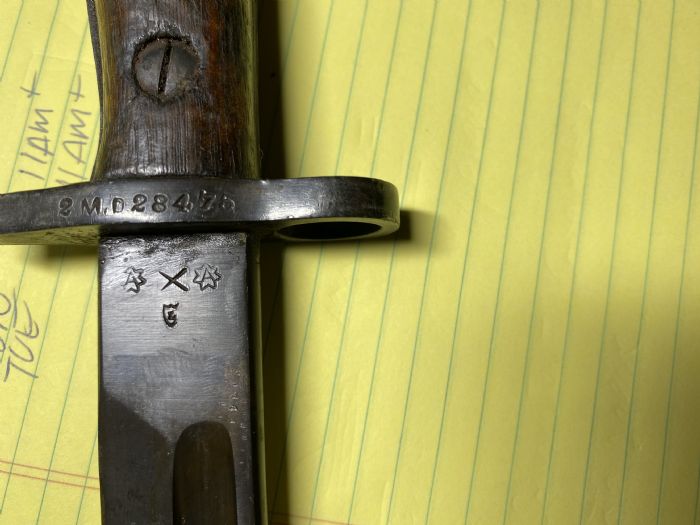  ------------- "Corruptissima re publica plurimae leges" - Tacitus The more corrupt the state, the more it legislates |
Replies:
Posted By: BJ72
Date Posted: July 08 2021 at 3:32pm
I'm no expert on the bayonets but I believe the quillion was removed (ground off) from bayonets still in service once the change was accepted. That would account for your early bayonet with no quillion. Looking at your first photo, it almost appears as though it's been ground or modified where the quillion would have been. It also explains why hooked quillion bayonets are so hard to find and so ridiculously expensive. The scabbards were also rebuilt and repaired in service which could account for the mixed parts on yours. That's still a very nice early Lithgow bayonet you have there  |
Posted By: A square 10
Date Posted: July 08 2021 at 6:47pm
| that would be correct - most all "in service" were cut , they look just like the later non-quillon items , those that survived would be the rare ones , so what you have is a really nice example of a bayonet that served past the quillon era , sorry not a more valuable than standard at this point but still a fine example in great shape for its age , |
Posted By: Shamu
Date Posted: July 09 2021 at 9:51am
|
From what I remember there's actually a subtle difference in the shape of the remaining part of the quillion between the "Hookies" that were docked & the later ones made without one. The later ones were strait sided albeit with a taper, but the originals inwardly were curved IIRC. 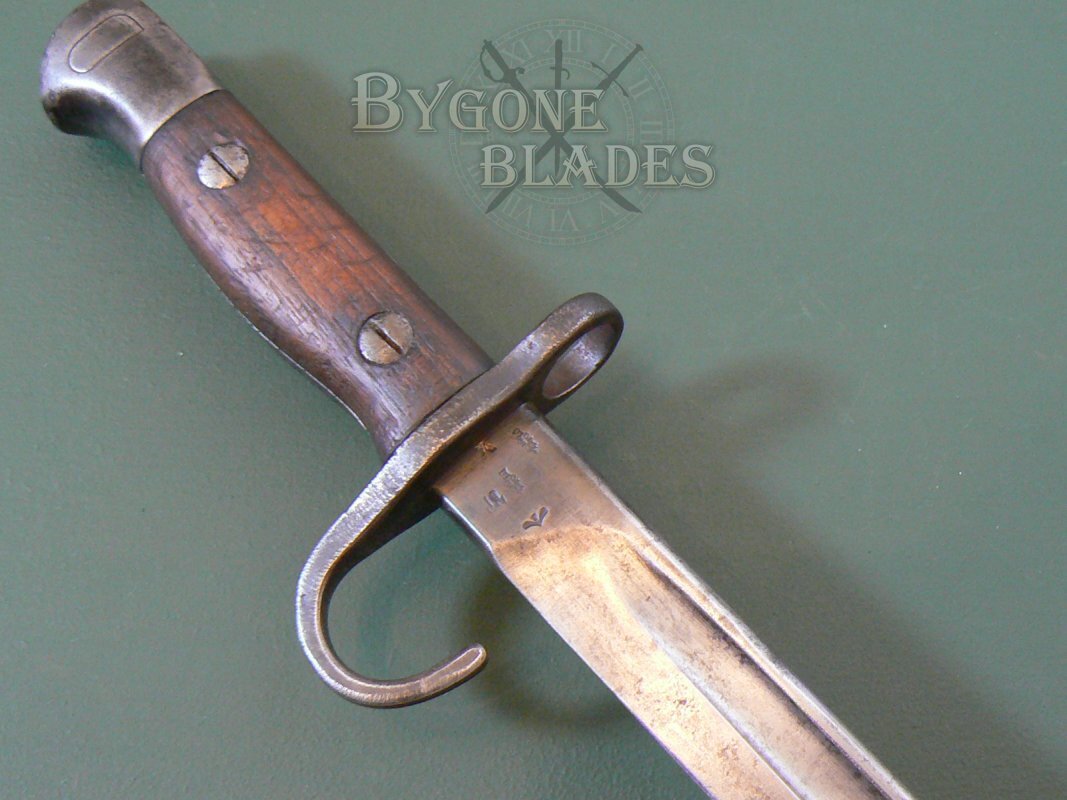  ------------- Don't shoot till you see the whites of their thighs. (Unofficial motto of the Royal Air Force) |
Posted By: A square 10
Date Posted: July 09 2021 at 5:54pm
| one thing is clear - this is not a fake , its a real bayonet of that date , not a hookie anymore but a fine example |
Posted By: bubba ho tep
Date Posted: July 09 2021 at 9:03pm
| I had a 1911 dated enfield hookie...was a decent piece. I almost kept it but it had seen Australian service and was marked so , and traded it off. Got a gorgeous sanderson hookie to take it's place. Been trying to find am English only issue hookie dated 1911 for my 1911 SMLE , or one marked to the K.R.R. My sanderson I think was marked to the scots guards then over stamped to the Irish guards on the pommel. I always joked it was pilfered by an Irishman from the scots to my Irish relatives. |
Posted By: AussieShooter
Date Posted: July 11 2021 at 3:52pm
|
As usual thanks for the great input. Potential disappointment has turned it into an even more interesting bayonet. I had no idea they de-hooked the quillion! In a way it makes sense as I imagine the hook just got in the way. The photo's do show some slight marks which look like vice marks which may have been from the removal/grinding process. I do have a really nice 1942 and I will compare the shapes of the quillion to see if I can detect the difference - I'll post photo's if I can detect the difference. Very cool. Thanks gents. ------------- "Corruptissima re publica plurimae leges" - Tacitus The more corrupt the state, the more it legislates |
Posted By: A square 10
Date Posted: July 11 2021 at 8:51pm
| mine is marked 1910 and was a mole mfgr , served with the royal irish rifles , also the royal dublin fusiliers in its life , the cancellations are a line out without loosing the markings , some of these did a lot of duty not that any of this relates to yours |
Posted By: AussieShooter
Date Posted: July 12 2021 at 6:26am
|
it’s all interesting Asquare. :) These firearms tell a fascinating story. ------------- "Corruptissima re publica plurimae leges" - Tacitus The more corrupt the state, the more it legislates |
Posted By: Shamu
Date Posted: July 12 2021 at 10:39am
|
I've heard, but can't confirm, that they were removed because the tangled in barbed wire way too much. ------------- Don't shoot till you see the whites of their thighs. (Unofficial motto of the Royal Air Force) |
Posted By: A square 10
Date Posted: July 12 2021 at 7:55pm
|
"...it’s all interesting Asquare. :) These firearms tell a fascinating story. ..." yes indeed and if they could only talk , i very much enjoyed researching mine over the years , its sad so much is lost to the ages but what we can find is always fun
|
Posted By: bayo500
Date Posted: August 09 2021 at 12:04am
| 2md is NSW |
Posted By: AussieShooter
Date Posted: August 13 2021 at 2:35pm
|
Thanks for the ID "Bayo500"! I promised to do a side by side of the ground hookie and a non-hookie. My photo skills are not great, but I took a few angles and you can definitely tell it was ground down. Great insight from the board. I compared the 1914 with the 1942 and marked the photos accordingly. 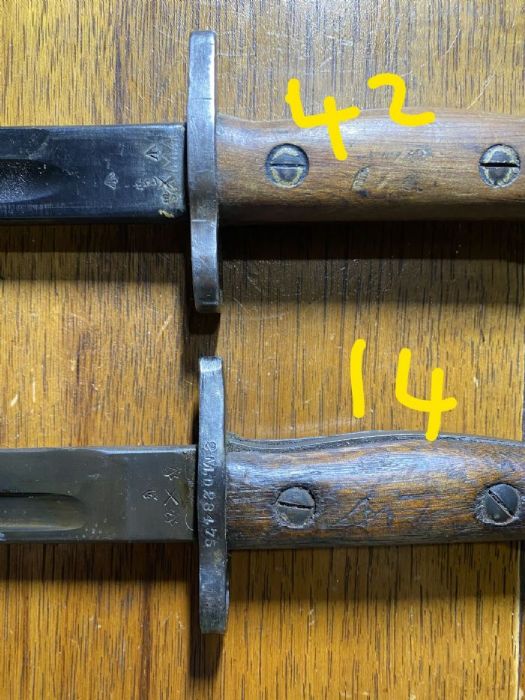 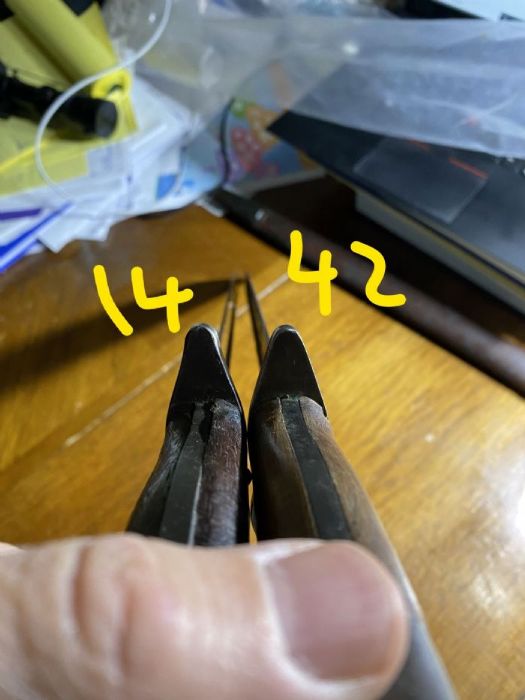 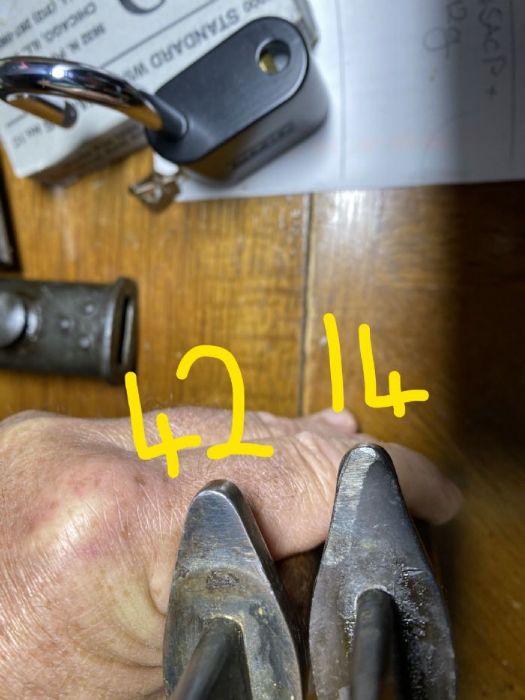 ------------- "Corruptissima re publica plurimae leges" - Tacitus The more corrupt the state, the more it legislates |
Posted By: Shamu
Date Posted: August 13 2021 at 6:35pm
|
Thanks. That really shows the different profiles. ------------- Don't shoot till you see the whites of their thighs. (Unofficial motto of the Royal Air Force) |
Posted By: SGonger
Date Posted: August 17 2021 at 12:02pm
Howdy y’all; I do believe you are correct ole cobber & here (hopefully photo shows up ok) are 3 more for reference to your post. L-R 1919 Lithgow non Hooky,1908 EFD Hooky,1915 Lithgow Ex-Hooky. Cheer’s all. 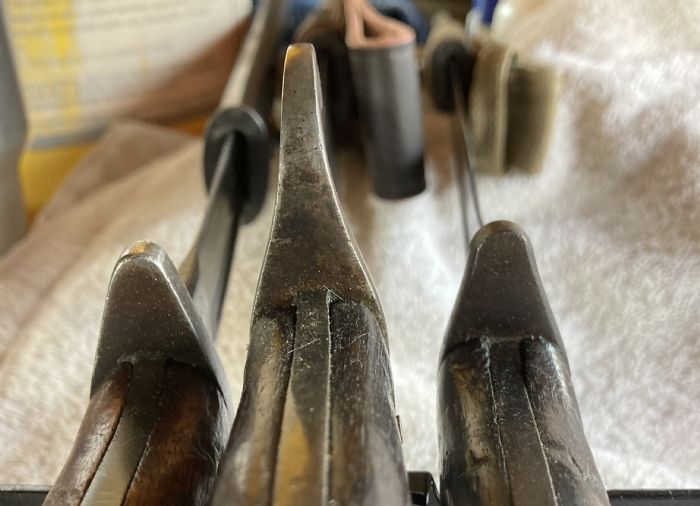 ------------- Anyone seen the Tardis Box anywhere? 🤨 |
 Shamu wrote:
Posted By: Shamu
Date Posted: August 17 2021 at 2:19pm
|
Great, thanks. ------------- Don't shoot till you see the whites of their thighs. (Unofficial motto of the Royal Air Force) |
Posted By: AussieShooter
Date Posted: August 17 2021 at 2:27pm
|
They seem consistent, although your de-hooked is a little less pronounced, but you can see the tapers. The apprentice armourer de-hooking mine must have been a little heavy handed on the grinder! ------------- "Corruptissima re publica plurimae leges" - Tacitus The more corrupt the state, the more it legislates |
Posted By: Zed
Date Posted: August 18 2021 at 12:10pm
|
Great photos, thanks for posting. It'll certainly help us all when looking at bayonets. ------------- It's nice to be important, but it's more important to be nice! |
Posted By: A square 10
Date Posted: August 19 2021 at 10:56pm
| good photos always help in giving accurate and reasonable responses to questions asked here |
Posted By: MARTINRF
Date Posted: January 31 2022 at 6:46am
  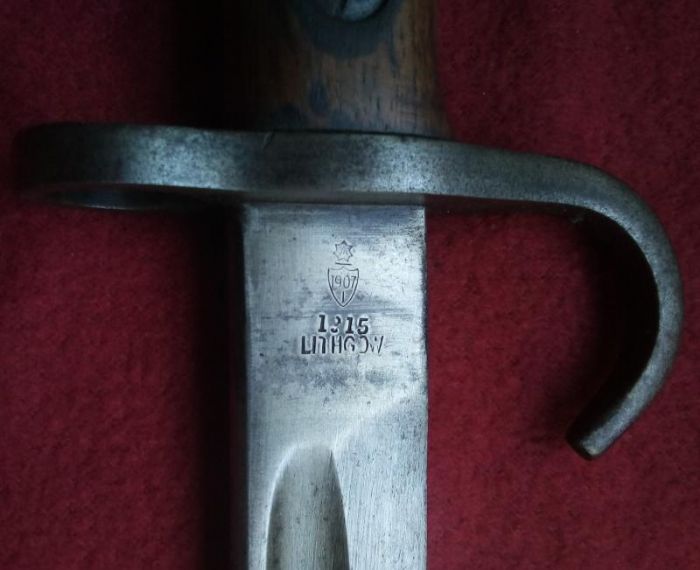
...here is my example - among the last of the hooked-quillion examples...made at SAF Lithgow, they started production in 1913 with about 1k rifles/bayonets in that year, about 10k in 1914 and about 15k in 1915...as the hook to the quillion ceased being applied sometime between August/October of that year, there were only somewhere between 11k and 20k bayonets with the hook ever made at Lithgow...the blade on my example has a bright finish all the way from the quillion to the (very) sharp point...does anybody know if there was a variation in the amount of blueing applied to the bayonet blades...(8{
|
Posted By: smerdon42
Date Posted: January 31 2022 at 4:06pm
| If I could find a 1913 for my 1913 rifle at a reasonable price it would complet my 1913-1918 collection of Lithgows |
Posted By: Sarge
Date Posted: March 02 2022 at 5:50pm
|
AussieShooter. You pose a couple of concerns about your Lithgow '07', which... are quite simple to explain. Firstly... The absence of the 'Hooked' Quillon. In GB, production of the curved quillion ended in November of 1913, with the War department.... through the official 'List Of Changes'.... announcing the end of production, and the removal of the curved quillon from all future production. The curved quillon was also to be removed, as and when a bayonet were to be presented for either repair or inspection. History has shown that quite a substantial amount of curved quillon '07's' ( for one reason or another ) have survived in their original form. Australia was slightly behind in curved quillon '07' matters, including stopping production, and the removal. So, what you have is a perfectly authentic Lithgow 'Quillon' removed example. Secondly...The scabbard. With the '07' bayonet, there are three frog studs which will be encountered : 1) The original 'Tear Drop'; 2) The 'Roundal'... announced to replace the 'Tear Drop' in mid 1916; 3) the Australian 'Roundal', which is noticeably smaller than it's British counterpart. It's quite feasible that the original scabbard to your '07' was replaced due to it being unserviceable for a number of reasons. Also, stampings military area's differ between WW1 and WW2. So, each difference you have, is one instance in the bayonets lifeline. To add to that, when a bayonet is submitted for inspection / repair / modification.... the bayonet and scabbard are inspected separately. So, it's quite logical to assume the two may never be together again.... although there are cases of staying as one unit.
------------- This is MY rifle, there are many like, but this one... is MINE! |
Posted By: Sarge
Date Posted: March 02 2022 at 5:54pm
he!!o everyone. Nice to be back after such a long absence.  ------------- This is MY rifle, there are many like, but this one... is MINE! |
Posted By: AussieShooter
Date Posted: March 02 2022 at 7:51pm
|
Hi @Sarge great to have you back. I appreciate the explanation and am pleased it is an interesting example. There is a story to it! @martinrf I love the photos of Lithgow Hookie. That is nice to have in your collection. Congratulations! We are all a little jealous 😀 ------------- "Corruptissima re publica plurimae leges" - Tacitus The more corrupt the state, the more it legislates |
Posted By: Zed
Date Posted: March 02 2022 at 10:39pm
|
Good to see you back here Sarge. Glad you are still with us! ------------- It's nice to be important, but it's more important to be nice! |
Posted By: Sarge
Date Posted: March 03 2022 at 4:24am
|
Thanks 'Zed' 'AussieShooter'. If I can work out how to post pics on here again, I'll share my '07' Vickers collection----> '9' examples to-date. ------------- This is MY rifle, there are many like, but this one... is MINE! |
Posted By: A square 10
Date Posted: March 03 2022 at 7:34am
| well that answers one of my questions - lithgow was still producing hookies in 1915 |
Posted By: smerdon42
Date Posted: March 03 2022 at 3:16pm
| Lithgow also still produce rifles with volley sights until 1916/17,deleting the volley sight but leaving the mag cutoff in play then in 1918 no mag cutoff and then back in 1940 a mag cut off back .i still need a 1913 lithgowhooky any one got one for sale lol |
Posted By: MARTINRF
Date Posted: March 09 2022 at 2:51pm
 ...the bayonet combination came out of a WW1 British collector friend living up in Bradford, West Yorkshire, after working on him for something over 28 years to release all of his AIF items to me so the deal, a few years ago, had a very long gestation period, indeed...all of the items came to him from various fairs in the Leeds area so I assume this item saw service either in France/Belgium - or even the Dardenelles - but of course I cannot be 100% certain of that...all I know is that very few dealers/collectors, if any, over here get AIF items sent over from Australia - the AIF bits that I come by all seem to originate from sources the UK...(8{ 
|
Posted By: AussieShooter
Date Posted: March 09 2022 at 6:30pm
|
That hookie looks in fantastic condition. What is the wooden item strapped to the scabbard? I haven't seen this before. Congratulations on your collection - I look forward to seeing some more of it over time. ------------- "Corruptissima re publica plurimae leges" - Tacitus The more corrupt the state, the more it legislates |
Posted By: A square 10
Date Posted: March 09 2022 at 10:40pm
mine is a 1910 mole ,  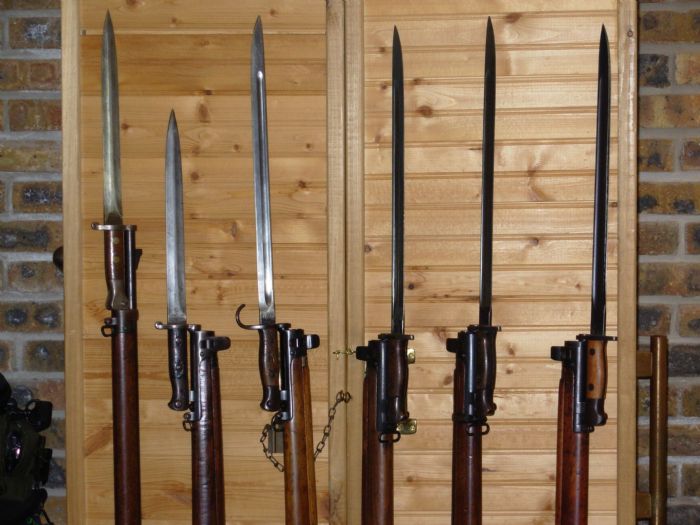 |
Posted By: Marco1010
Date Posted: March 10 2022 at 12:02am
|
The wooden handle attached to the bayonet has the official nomenclature of "Implement, Entrenching, Patt. '37, Helve Mk I". Originally these were issued pre-WW1 through WW1 for the Pattern 1908 pattern sirhind tool. However, in 1923 these were discontinued. In 1939, the British decided on the need for an entrenching tool again and the square blade, Linneman style spade was adopted. After a couple of years, the British decided that there was a problem with their "new" style entrenching tools. In 1941, the spade model was discontinued and the British reintroduced the old, Pattern 1908 Entrenching Tool, but gave it a new nomenclature, the "Implement, Entrenching, Patt. '37". It was called the Pattern 1937, but was actually adopted in 1941. The first of these were issued with a plain style handle, just like the original Pattern 1908 tools. These early wood handles were called the "Helve, Mk I". Not often found complete for some reason, but a cool item. |
Posted By: Zed
Date Posted: March 10 2022 at 4:00am
|
Thanks for sharing your knowledge. I've learnt something today.👍 ------------- It's nice to be important, but it's more important to be nice! |
Posted By: MARTINRF
Date Posted: March 10 2022 at 4:49am
...here is the pattern Australian '08/15 leather equivalent to the web equipment combination...the bayonet was made in '11 by Mole with the (pre-November 1913 Military District adoption) State of Victoria Ordnance Department stamps applied to both the crossguard and the scabbard throat - unusual to find a bayonet snd scabbard that have been together after all that amount of time...(8{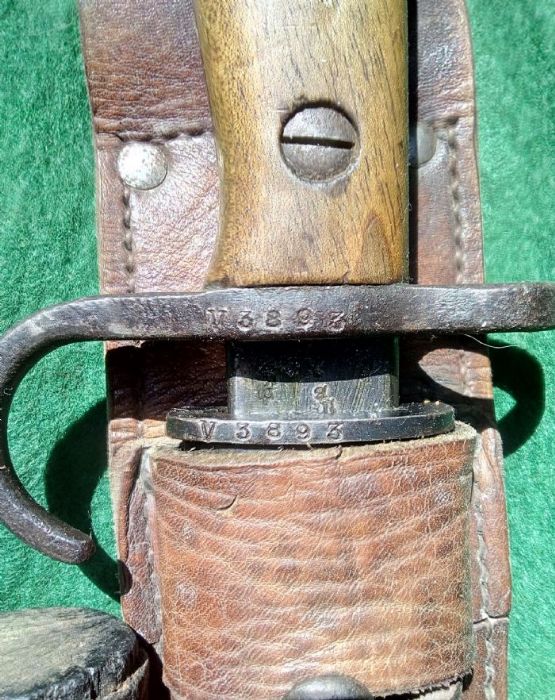    |
Posted By: AussieShooter
Date Posted: March 10 2022 at 5:22am
|
Thanks Marco, great insight. I had no idea. Can you imagine digging fox holes, or worse, trenches with an entrenching tool! I guess it is a labor of necessity when someone is shorting at you! ------------- "Corruptissima re publica plurimae leges" - Tacitus The more corrupt the state, the more it legislates |
Posted By: Shamu
Date Posted: March 10 2022 at 9:08am
|
Small trivia point. The "Sirhind tool" was originally issued as an INtrenching tool & later changed to be an ENtrenching tool. There were 2 versions of it. One (shown) was "plain", the other had a "fake" no4 barrel top & bayonet lugs on the end of the handle, to allow a bayonet to be attached to "probe for mines"! 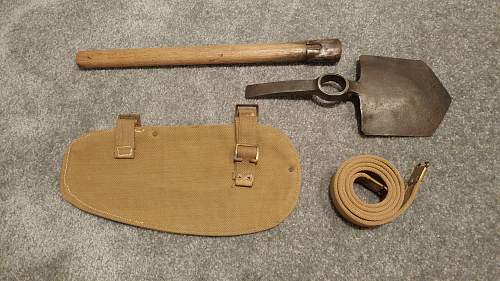 ------------- Don't shoot till you see the whites of their thighs. (Unofficial motto of the Royal Air Force) |
Posted By: Marco1010
Date Posted: March 10 2022 at 4:41pm
|
I had an old family friend who served with the NZ division in North Africa in WW2 , he made the point that when under fire or being bombed the most effective way to dig in fast was using your helmet. He said that unlike most british units the New Zealanders tended to dump useless british army equipment fast and scrounge (or steal where necessary) anything better. He was a signaler and started out armed with a revolver (only good for throwing at the enemy) then a Thompson SNG (heavy and rattled loudly with the drum mags, also poked you in the back when slung) then used a lee enfield rifle ( meant you didn't stand out as a high value target) and was useful to tie aerial wires to when stuck in the ground with the bayonet fitted) this was because there were very few trees around in North Africa to tie the aerial wires to.
|
Posted By: Goosic
Date Posted: March 10 2022 at 5:09pm
I have the second version...
 |
Posted By: Shamu
Date Posted: March 10 2022 at 5:29pm
|
Me too. The locals are becoming a little concerned with me hacking "zombie mint" out of my yard with it. Gawd bless em. ------------- Don't shoot till you see the whites of their thighs. (Unofficial motto of the Royal Air Force) |
Posted By: Zed
Date Posted: March 11 2022 at 4:08am
Wait until you start shooting the dead branches of the trees with the .303 ------------- It's nice to be important, but it's more important to be nice! |
Posted By: MARTINRF
Date Posted: March 03 2023 at 3:40am
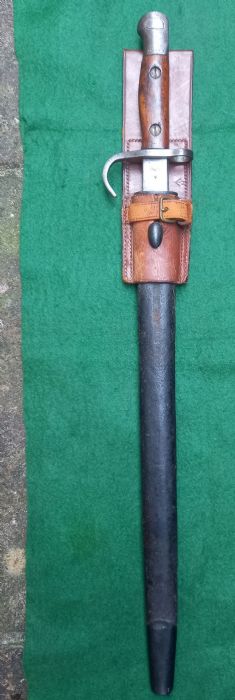  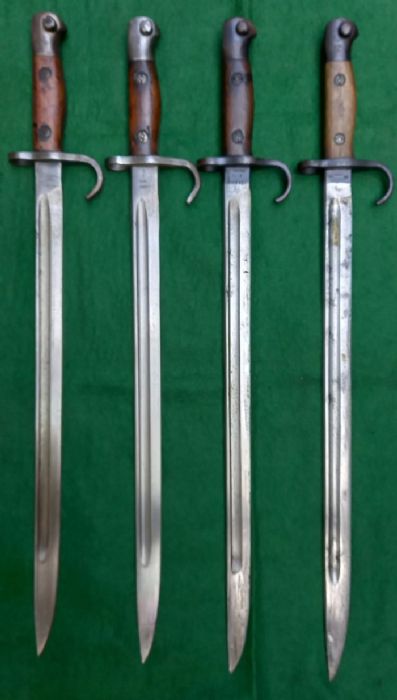 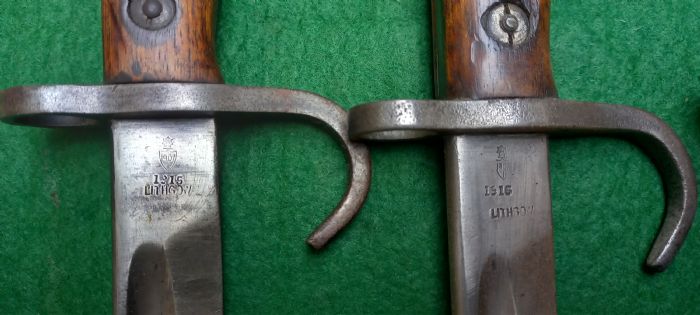 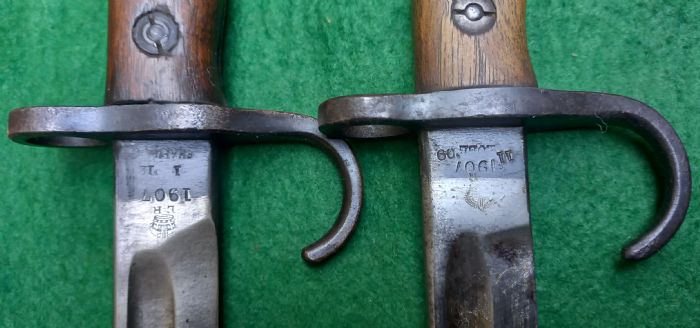  
...here is my latest acquisition - another 1915 Lithgow, with the hooked-quillon intact...it joins a small, but perfectly formed, collection of 1907 bayonets...all have either 1 MD, 2 MD, 3 MD, or pre-M.D., markings showing their service within the Australian military forces...the shape of the quillon differs between British and Australian manufacturing, as does the hand stamping upon the ricasso...(8{
|
Posted By: MARTINRF
Date Posted: November 15 2023 at 9:31am
   ...another recent acquisition...an early CHAPMAN marked blade, numbered with the State of Victoria marking on the crossguard and 3MD on the throat edge... |
Posted By: A square 10
Date Posted: November 15 2023 at 9:37pm
| very nice collection |
Posted By: MARTINRF
Date Posted: February 06 2024 at 3:06am
...I have added another bayonet to the collection - all with Australian Military District stamps...early Chapman made P'07 with issue stamps...   |
Posted By: ShineRose
Date Posted: May 08 2024 at 3:53am
Good and huge collection.
|
Posted By: MARTINRF
Date Posted: July 07 2025 at 7:24am
...my latest acquisition...another Chapman made '07 - manufactured in November '09 - with Australian (pre-MD designation) service markings (as do all of those in my small collection)...(8{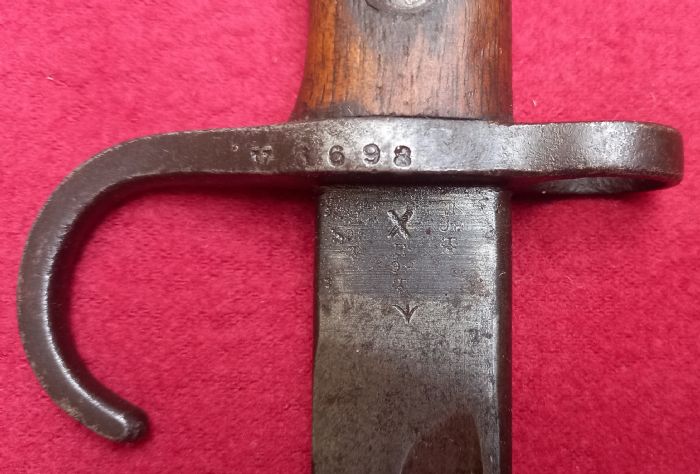    |