Concidering the 7.62 posts recently
Printed From: Enfield-Rifles.com
Category: Enfields
Forum Name: 7.62 Enfield
Forum Description: All things to do with the 7.62 Enfield
URL: http://www.enfield-rifles.com/forum_posts.asp?TID=12464
Printed Date: March 26 2026 at 6:03pm
Software Version: Web Wiz Forums 12.07 - https://www.webwizforums.com
Topic: Concidering the 7.62 posts recently
Posted By: Shamu
Subject: Concidering the 7.62 posts recently
Date Posted: January 04 2023 at 12:58pm
|
You might find this interesting. I did. ------------- Don't shoot till you see the whites of their thighs. (Unofficial motto of the Royal Air Force) |
Replies:
Posted By: britrifles
Date Posted: January 04 2023 at 5:21pm
|
Interesting video. I’ve never noted a significant rear sight elevation difference between .303 and 7.62. I was surprised to see how much the range index mark on the rear sight slide was moved for the L8 rifle. However, I’ve not shot my 7.62 conversions with the standard Mk 1 rear sight either, so I can’t say for certain. But, I have swapped the PH 5C rear sight between the .303 and 7.62 rifles and not noted much of a change in elevation zeros at 200 yards. In the wide range of loads I’ve shot in the 7.62 with bullet weights from 150 to 175 grains, and various powder charges giving muzzle velocity changes on the order of 200 fps, the 200 yard zero setting hasn’t changed by more than a few Minutes. That rear sight he showed for the 7.62 looked as if the range index marks on the slide had moved by perhaps 8 to 10 minutes (increasing the elevation). Very surprising to me… This all may be related to barrel packing/bearing position in the forend. My DCRA conversion is not a standard bedded forend with a bearing at the muzzle, it has a bearing at the middle band (sling swivel band) and barrel is free floated forward of this bearing. And for this rifle, faster bullets impact higher on the target at 200 yards, whereas the standard bedded forend is supposed to put faster bullets lower on the target at that range. I’ve yet to run an experiment on a standard bedded No. 4 .303 to confirm the so called “positive compensation” feature of this rifle. |
Posted By: Shamu
Date Posted: January 04 2023 at 6:43pm
|
From everything i've read the difference between .303 ball & 7.62 ball is "irrelevant below 300 yds". An interesting side note, (Dons asbestos fire suit) "Positive compensation" worked perfectly with Mk VI, but didn't with Mk VII so its all kind of in the lap of the gods anyway!  ------------- Don't shoot till you see the whites of their thighs. (Unofficial motto of the Royal Air Force) |
Posted By: Goosic
Date Posted: January 04 2023 at 6:48pm
|
I have both a .303 and a 7.62x51mm chambered Enfield. Both are scoped so, it's all a matter of, "Point and Squeeze" for me...
|
Posted By: britrifles
Date Posted: January 05 2023 at 3:50am
|
E.G.B Reynolds wrote that the “Positive Compensation” feature of the No. 4 rifle was the reason the 7.62 conversions shot well at long range but not at the short ranges, the “compensating range” being somewhere around 900 yards. I’ve never heard that there was a modified rear sight for the L8, I thought they all used the original Mk 1 rear sights. Gotta listen to that video again so see if he explains where that sight came from. Perhaps it was a “one off” for a rifle that had a problem? Extract from a 1969 article written by Maj Reynolds on the 7.62 Conversions:  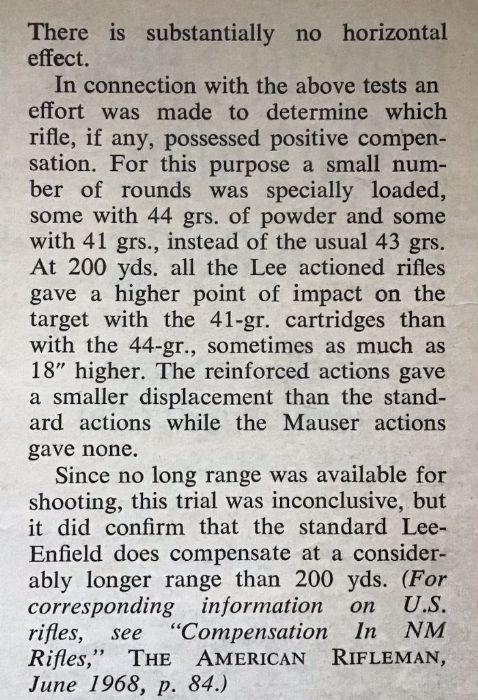  |
Posted By: Shamu
Date Posted: January 05 2023 at 1:12pm
|
I think its just the indexes are scribed lower on the ladder. Not sure if its a mod or done to an original sight. By all accounts they're rare than unobtanium. ------------- Don't shoot till you see the whites of their thighs. (Unofficial motto of the Royal Air Force) |
Posted By: britrifles
Date Posted: January 05 2023 at 2:32pm
| Something not making sense here…to me, the position of the range marks looked the same on the leaf, but the slide (moving part) had the index marks much lower on each side of the slide, looked like by about 8 to 10 MOA worth… |
Posted By: Shamu
Date Posted: January 05 2023 at 7:01pm
|
Yep, that was the difference. ------------- Don't shoot till you see the whites of their thighs. (Unofficial motto of the Royal Air Force) |
Posted By: britrifles
Date Posted: January 06 2023 at 4:20am
|
This may have been posted before, Forgotten Weapons story on L8(T) trials that were not successful circa 1965. Bet they were using crappy 7.62 Ball service ammo to run the tests, so what do you expect? https://www.forgottenweapons.com/l8t-enfield-the-british-army-fails-to-make-a-sniper/" rel="nofollow - https://www.forgottenweapons.com/l8t-enfield-the-british-army-fails-to-make-a-sniper/ |
Posted By: Goosic
Date Posted: January 06 2023 at 8:05am
My personal opinion is that, besides the absolute possibility of them using crappy service ammo, they needed an alibi to drop the L8 to move forward with the L1A1 so they came to the general consensus to all agree that the rifle was just not worth fiddling with any longer due to the "Accuracy Issue" with the 7.62mm barrel. I am fortunate enough that I have a L8 barrel that is fitted to my No4Mk1* reciever. I even went so far as to cut the barrel down past the bayonet lugs. I do not use the 144, 147, 155, or 175grn bullets. I do use the 168grn TMK or SMK projectiles however and I can positively say that, the rifle can and will put ten round groups inside the X ring out to 200 yards all day long without fail. "I have not shot it out past 300 yards yet." The diminished accuracy is an absolute farce... .
|
 britrifles wrote:
Posted By: Strangely Brown
Date Posted: January 06 2023 at 12:51pm
Absolutely! Also a very convenient excuse when sales had dried around the world; I think the last hope for sales abroad was probably the Indo/Pakistani conflict over Kashmir, and they had enough stocks of Ishapore 2a1's to last for years. Couple all of the above with a divisive workforce at ROF Fazackerley which the government wanted to close. Its been said that if you repeat a lie often enough it becomes the truth! ------------- Mick |
Posted By: britrifles
Date Posted: January 06 2023 at 2:10pm
|
Agree with all the above, but perhaps a slight clarification is in order. I don’t think the accuracy issue was fictitious or a farce. It was real. It’s the reason for the accuracy issue that has been clouded, and perhaps even known, but not brought to the light until it was too late for the L8. I believe it was because of the poor quality of the 7.62 service ammunition being made at that time. My guess is that 7.62 service ammunition was being made on worn out WWII ammunition loading machinery, both in Canada and in the UK. And perhaps with little attention or concern for accuracy. The UK NRA and Canadian DCRA did document the struggle to get the 7.62 conversions to group “at least as well as the .303” and it went on for numerous years with numerous attempts to correct vertical stringing at the short ranges (out to 300 yds) and to some lesser extent the mid ranges (500 - 600 yds). Long ranges (800 to 1000 yds) did not suffer from this because of the positive compensation features of the No. 4 action that Reynolds has described. Why it took so long to fully recognize the root cause was poor ammunition, I don’t know. Several of us here on this forum, and others on other forums, have demonstrated excellent accuracy out of our 7.62 conversions at short ranges, and indeed at all ranges out to 1000 yards, with rifles fitted with standard service weight barrels (not the L39/L42 heavy and longer barrel). I can only conclude that NRA and DCRA shooters at the time were not reloading, mainly because ammunition was supplied at service rifle matches, and military ammunition was likely “passed under the table” to members to use in practice, so they had no need to reload. The Canadian 7.62 ball ammunition I have from that period strings groups pretty bad, 3 to 5 MOA, it’s a crap shoot literally, a decent group forms, then the 8th, 9th, or even 10th shot goes high, or goes low. When I pulled the bullets from a sample of 40 rounds, I weighed individual case powder charges and the max - min was 3 grains!!! No wonder it strung groups vertically! The dumped powder was re-metered thru my reading measure and the 147 gr Service bullet reseated in the case shot very well, under 2 MOA. By 1969, right after the development of the 4 lb 7,62 barrel, a light seemed to have gone off and it was recognized that “something needed to be done” about ammunition quality for purposes of target rifle shooting. No kidding…. I have a notebook from my Dad’s late shooting friend, a very good DCRA competitive shooter, that documents the testing and modifications he made to the forend bedding of his DCRA 7,62 (which I now have) in the mid 1960’s. In his final iteration, out of frustration, he fully bedded the barrel in the forend, from chamber reinforce all the way to the muzzle! The rifle shoots exceptionally well with hand loads. Shoots crappy with service ammunition though… So, we can conclude that the poor quality of 7.62 service ammunition played a role in the development of the L39/L42 (and commercial variants) and the adoption of the Target Rifle (TR) class for UK NRA competitive shooting. |
Posted By: Goosic
Date Posted: January 06 2023 at 2:30pm
|
britrifles. I totally understand the crappy ammunition point if view. But, my contention is with "The Powers That Be" just dropping the whole L8 series project because they put the blame directly on the rifle and not the ammunition. With that reasoning becoming the main reason of scrapping the project and focusing primarily on their new L1A1 project. With everybody agreeing that the 7.62mm ammunition at that time was not up to par and it showing accuracy issues across the board, it would have almost certainly showed up with the live fire testing of the L1A1 but, they proceeded anyways. Why? Because the L1A1 automatic rifle was and is the future whereas that clunky old bolt action is as old as Methusela and is no longer wanted or needed on today's battlefronts. You want to look good at the dragstrip, bring a manual four speed car. You want to win at the dragstrip, bring an automatic...
|
Posted By: Strangely Brown
Date Posted: January 06 2023 at 2:39pm
As mentioned elsewhere on this forum it was the gift of some Raufoss that alerted many Bisley shooters (and the NRA) to the shortcomings of RG ammunition at that time; it would be interesting to know what part the bedding of the L8 rifles played in this with regard to accuracy. ------------- Mick |
Posted By: britrifles
Date Posted: January 06 2023 at 2:55pm
|
I also suspect that target rifle accuracy was of no concern to the military (with the exception of the sniper rifle of course). But it was most certainly the prime concern of the UK NRA Target shooting fraternity. No one wants a rifle that drops points from what they previously had. The L8 was a dead end project from the get go. Clearly, the WWII experience showed the advantage of the self loading rifle, so the L8 was never going to be the next Service Rifle for the British Army. And, it became unnecessary to hold these in reserve as the L1 production ramped up. The No. 4 did indeed live on for many more years after the L8, in the form of the L42. If anything, the L1 (FAL) was the rifle with “accuracy issues”, no matter what ammunition it was fed, it was no sniper rifle and no target rifle. I know, I’ve shot these rifles on the range. Like many things in history, the facts seemed to have gotten in the way of a good story. Perhaps there was some pressure to hide the ammunition accuracy issues as the military didn’t want any bad press for the L1 project either. Easier to just declare the No. 4 as “unsuitable”, or that it had an inherent issue with accuracy in the 7.62 form. I’ve even heard it was because of the length of the barrel (25.3 inches) that caused the accuracy problem! But, from what I know of E.G.B Reynolds and Dave Reynolds (no relation) of the DCRA, they were likely honest and very knowledgable engineers/armourers who were trying to get to the root cause of the issue and improve the accuracy of the No. 4 7. 62 conversions. And in the end, they succeeded. |
Posted By: britrifles
Date Posted: January 06 2023 at 3:13pm
Mick, I think the bedding does play a role here, but it alone would never be able to resolve the issue, just as the heavy barrel alone did not resolve the issue. It seems to have transpired that the ammunition problem was realized in the UK at about the the same time as the trials with the new heavy barrel took place in 1968/1969. E.G.B Reynolds seems to have concluded this in his 1969 article on the subject. It’s interesting that both Canada and the UK struggled with this, but with different ammunition. Dominion Arsenals in Quebec (DAQ) had a contract to manufacture 7.62 Service ammunition, with inconsistent accuracy issues. Some lots were quite good, others poor as I have experienced. However, the DCRA seems to have discovered the ammunition issue first and had selected a specific lot of Canadian Industries Limited (CIL) 7.62 ammunition to use in the 1967 Palma Matches shot with DCRA No. 4 conversions with excellent results. Perhaps DCRA and UK NRA were not communicating all that clearly at the time. |
Posted By: Strangely Brown
Date Posted: January 06 2023 at 3:31pm
Geoff, I feel the authorities (read ROF Enfield) must have known about ammunition quality concerns, whilst Major Reynolds was retired he still had connections with Enfield Lock and Radway Green through his articles in the shooting press. The question is, did they bother to do anything about it given it was deemed good enough for "government work" at that time? Borneo, Cyprus and Aden were fairly hot postings in the 1960's and Bisley might have been seen in some eyes as a nuisance...I'm thinking out loud as I type this! Another connection from Bisley to ROF Enfield was Herbert (Bert) Whitaker who worked there on various projects and won the Grand Aggregate at Bisley in 1967, right on the changeover period to 7.62mm. ------------- Mick |
Posted By: Strangely Brown
Date Posted: January 06 2023 at 3:46pm
Quite possibly Geoff, even in recent years there have been communication problems between contractors and the MOD, let alone shooting organisations. The last big one I recall was in 1986 when a a company called Pylon industries attempted to fabricate the then new L96 sniper rifle without telling the MOD they had lost their certification to do the job. ------------- Mick |
Posted By: britrifles
Date Posted: January 06 2023 at 4:38pm
Excellent point Mick, and as I said, the L1 was certainly no target rifle, and the government arsenals would not be all that interested in hearing complaints from the NRA on “ accuracy problems” with the No. 4 conversions. I have to believe the No, 4 conversions were at best an afterthought, the train was already in motion for a self loading rifle well before there were any notions of changing calibers for the No. 4. And it does seem that Sterling were first to see the market for converting No. 4 rifles and not RSAF. This is not to say that there was no specification for ammunition accuracy, for surely there must have been, but I suspect it’s safe to say that the 7.62 ammunition made at the time did not exceed the specified accuracy by a wide margin, and said specification was not likely something a target rifle shooter would be too excited about. Canada had manufactured various lots of .303 ammunition that became known for its exceptional accuracy and successful attempts were made to secure some of it for DCRA matches. I have ammunition from two lots used in numerous DCRA annual matches: 1945 Cordite and 1951 NC powder loads that to this day will still shoot to 1.5 MOA. Although, I don’t like shooting the Cordite loads much for known reasons. |
Posted By: Goosic
Date Posted: January 06 2023 at 4:46pm
Any information on how good this stuff is. My recent purchase that showed up today. Dated 1943...
  |
Posted By: britrifles
Date Posted: January 06 2023 at 5:31pm
|
I don’t know much about the Winchester .303, other than it is a ball powder load, could be corrosive primers, made during WWII. I’m curious what the bullet composition is, looks like it might be all lead core based on the length protruding from the case mouth. What is the overall length? You could shoot some, just make sure you clean the bore and chamber with water afterwards (same day), dry out, then use your your normal cleaning solvent. But, that looks to me to be a very collectible box of WWII service ammo. |
Posted By: Strangely Brown
Date Posted: January 07 2023 at 4:57am
|
An observation from over the last 50 years: (actually more of a rant!) Radway Green used to sell their ammunition (once they had ironed out the bumps) and Green Spot was very popular with target shooters having been given the service tag of "sniper" attached to it. The Royal Ordinance Factory at Enfield Lock manufactured the commercial Envoy target rifle which was almost identical to the conversions for the ARA (Army Rifle Association) and the issued L39 for tri service competitions. Where am I going with this? Well it would be unheard of today for a UK government department to sell ammunition to civilians, the army target shooting club will give serving members L42A3 7.62mm ammunition but heaven help you if you're retired you have to buy the club's home loads which are probably slightly better but that's a debate in the bar for another evening! The thought today that you could buy a firearm from a government contractor (Accuracy International aside) is almost laughable, although I do know of one person who purchased a cadet version of the SA80 (single shot with a large cocking handle at the side) from his work place which just happened to be BAE Systems who made them at the time. His rifle was seized by MOD police along with two from one of my clubs, in total they impounded 11 and a lengthy court case ensued. I hope to post the full story once it's published by our chairman who fought the case...we did get them back eventually. A lot has changed in 50 years! 
------------- Mick |
Posted By: Goosic
Date Posted: January 07 2023 at 5:42am
| Laidler? |
Posted By: Strangely Brown
Date Posted: January 07 2023 at 5:47am
Yes he was involved but it became a very messy business for all of the others, in fact I'm not sure how many people got their rifles back as some couldn't afford the legal costs and just walked away. ------------- Mick |
Posted By: Goosic
Date Posted: January 07 2023 at 6:58am
I can only use what I have as a reference in regards to, "Poor Quality of .303 service ammunition." The following photo shows a total of 168 rounds of Winchester branded .303 inch Mk VIIz 174grn ammunition with date ranges 1941, 1942, and 1943. My initial intention was to pull the bullets, dump the old powder and replace it with fresh powder, reseat the bullets and go. That was until I decided to weigh each bullet. Out of 168 bullets, I found 40 bullets that weighed exactly 173.6grns. "Close enough for government work in full swing here." I found 24 that weighed between 168.9grns and 171.2grns. I found 54 that weighed between 174.9grns and 175.6grns. The remaining 50 bullets weighed between 173.1grns and 174 .4grns. The two well worn boxes on the right have the 173.6grn bullets. The rest of those bullets are sitting in a coffee can. I removed every primer and reprepped the cases. Reprimed with GM215M primers, used 40.0grns of VVN540 and seated every case, "minus the 40 previously mentioned" with a Hornady .311 174grn FMJ-BT to an OAL of 3.035" What I found in weighing all those bullets individually was appalling, and it can only be assumed that the other manufacturers of the Mk VIIz ammunition were doing the same with what they had, "as long as they were close enough in weight" get it shipped out asap. The irony that the BMOD turned their noses up at the fledgling 7.62 and huffed about crappy accuracy issues while it clearly evident just with my small lott that, given the extreme varying range in bullet weights would have certainly produced crappy accuracy issue as well decades earlier is humorous to say the least. The ONLY reason the L8 project was sh*tcanned was that the BMOD did not want to be left behind in the production of a SLR...
 |
Posted By: britrifles
Date Posted: January 09 2023 at 9:17am
|
This thread brought up the subject of “compensation”, which is the word used to describe how a rifle “compensates” for varying muzzle velocities to reduce changes in vertical POI on the target at some particular range. I dug thru my score book and found that my No. 4 Savage which has the standard muzzle bearing does exhibit this behavior when fired prone. Fast bullets leave the muzzle at a lower angle of departure of the bore axis than slow bullets, presumably due to action and barrel deflection while the bullet is still in the barrel. I saw this in comparing two different loads, my regular match load of 40 gr Varget with 174 gr SMK and a new test load with 44 gr Varget and a 123 gr Lapua FMJ. The second load is obviously at a much higher muzzle velocity, yet it impacted the 200 yard target 8 inches lower than the first load. I ran a similar test with the 123 grain Lapua bullets with my Fulton No. 4 which has a barrel bearing 5 inches forward of the breech and bullet impact at 200 yards was almost the same between the two loads, only 1 MOA lower for the faster bullet. I’d guess the compensating range might be 300 or 400 yds. The second test is rather interesting as it would indicate both bullet weight variances and muzzle velocity variances has little affect on accuracy with centre bedded rifles, at this range anyway, which may be why Fultons chose this location for the barrel bearing. |
Posted By: britrifles
Date Posted: January 09 2023 at 10:43am
|
One more interesting data point, in looking at my rear sight settings for 100 thru 1000 yards on my DCRA No. 4 7.62, I see that the rifle does indeed “compensate” right at 800 yards with identical elevation settings and also nearly identical elevation settings at 600 yards with these three different loads: Load 1 - 155 gr Palma MK, MV = 2720 fps Load 2 - 175 gr TMK, MV = 2560 fps Load 3 - 168 gr TMK, MV = 2620 fps This rifle has a barrel bearing at the lower band (sling swivel band) with about 12 lbs pressure, fitted by DCRA armourer Dave Reynolds back in the mid 1960’s. He knew what he was doing… At 100 yds, Load 1, the fastest bullet, required the highest rear sight setting, but only 2 MOA above Load 2, the slowest bullet. My conclusion is not to worry too much about bullet weight variations that are less than 5 grains. I don’t think I’ve ever sorted bullets by weight, except for cast bullets, to cull those that may have voids or casting defects. The above loads had bullet weights that varied by 20 grains and muzzle velocities that varies by 160 fps, yet the point of impact change was quite small, with no change at all at 800 yds and a 2 inch change at 100 yards. Again, I suspect that the forend barrel bedding method plays a very significant role here and these competition rifles were bedded in ways to reduce the influence from manufacturing variations in ammunition. Well, I learned something today! |
Posted By: Goosic
Date Posted: January 09 2023 at 11:43am
You mentioned barrel bedding. Specifically at the lower band area. If you look at the following photos, you will see where the barrel on my 1944 Maltby just makes contact at the reinforce, the lower band area, and the muzzle. It also appears that the barrel bedding was inspected by Inspectors 5 and 12 according to the penciled in 5 & 12 in the barrel channel. I have not shot this rifle yet but, it definitely looks as if it was given a little bit of extra accuracy attention before it left the factory floor. When I do finally get a chance to fire the rifle, the rounds fired should have a MV of 2388 and will be using FMJ-BT projectiles...
    |
Posted By: britrifles
Date Posted: January 09 2023 at 12:01pm
|
Goosic, the barrel bearings done by Fultons and DCRA (and others) are quite different. On my DCRA, the bearing at the lower band location pushes up on the barrel by about 12 lbs, with at least 0.05 inches of barrel clearance with the forend forward and aft of the bearing. This one was done by Dave Reynolds. Looking forward to see how your new No. 4 shoots.
 |
Posted By: britrifles
Date Posted: January 09 2023 at 12:09pm
Here’s my Fulton’s No. 4 forend, bearing is much closer to the chamber reinforce and at about 22 lbs barrel pressure. |
Posted By: shiloh
Date Posted: January 09 2023 at 12:29pm
|
I would think that with every unit at the front screaming for ammunition it would be a moot point on sending match ammo. Snipers got good stuff to start but eventually in the field you`d use what you could get. Most battles consisted of suppression firing to keep the line moving, once at closer quarters it didn`t matter as long as you rifle went bang. Battle is brutal and if your boys armed with lee enfields could keep up fire with 10rnd mags vs 5 rnd mausers, who do you thing won the day.
|
Posted By: britrifles
Date Posted: January 09 2023 at 1:18pm
|
Shiloh, none of this has any application to “as issued” rifles in military service. This all pertains to competitive Service Rifle shooting, that was quite popular at one time. There would be over a thousand competitors at the annual matches held at Connaught and Bisley back in the days of SR(b) shooting with the No. 1 and No. 4, which those two rifles I have were intended to be used in. The DCRA 7.62 rifles were built just for that purpose. The No. 4 is long gone from large bore competition, except for vintage service rifle type matches, for which these specially bedded rifles are not eligible for since they are not “as issued”. But, yes, to your point, that’s why the M1 was such an effective service rifle in WWII and why other countries followed, the UK with the L1 SLR rifle, Canada with the FN, etc. Target accuracy was of no concern, except for snipers, which have gone in and out of “fashion” over the years. Canada did however take steps to produce more accurate Lots of 7.62 ball to support the DCRA matches in the 1960’s. Radway Green in the UK eventually did as well. Here in the US, there were more active programs to produce actual “Match” ammunition for the National Matches. All this stopped when the government stopped providing ammunition for the matches and made it the competitors responsibility to provide. |
Posted By: Goosic
Date Posted: January 09 2023 at 1:32pm
| Kind of where I was going with this. My particular setup/barrel bedding, incorporates the near identical bedding practices your rifles are shown to have but without all the bedding compound and as such can be used in the large bore competition since it is, "As Issued." |
Posted By: britrifles
Date Posted: January 09 2023 at 1:59pm
|
Yes, you can shoot your Malby in the 200 yd CMP Vintage Military Rifle matches. I have two No. 4s that have standard forend bedding methods which I use for this. My DCRA 7.62 can’t be used in the CMP match because of the non-standard calibre (7.62) and forend bedding compound. But it shoots good, so I use it for mid to long range shooting “in the spirit” of the 1960’s SR(b) match shooting.
|
Posted By: Shamu
Date Posted: January 09 2023 at 4:20pm
|
I'm still concerned with the "shiny line" (indicated by the green arrows.) in your barrel channel. That is not "bedding", but it IS unwanted contact. I had the same issue with one of my mummy unwraps. After I got it to where it passed "the dollar bill test" groups shrank noticeably, particularly vertical stringing from a cold bore as it warmed.  ------------- Don't shoot till you see the whites of their thighs. (Unofficial motto of the Royal Air Force) |
Posted By: britrifles
Date Posted: January 09 2023 at 7:03pm
| Most likely a bit of forend warping since it was machined 80 years ago. |
Posted By: Goosic
Date Posted: January 09 2023 at 8:16pm
The gap between the barrel and the barrel channel from the reinforce to the muzzle on both sides is exactly 0.010" It is the straitest forend I have ever encountered. You can lay a straightedge on the flats and there are no gaps. Same goes for the hand guards. There is absolutely nothing wrong with this rifle britrifles, nothing...
|
Posted By: Shamu
Date Posted: January 10 2023 at 2:20pm
|
Seriously, that shiny strip is barrel contact. It compresses the wood over time. Its
an easy fix, just wrap a suitable sized dowel with some medium fine
sandpaper & run it back & forth a few times. Then mount the
forend as you would normally & see if a thin shim (typing paper
strip, or a new dollar bill "catches" as you slide it back & forth.   ------------- Don't shoot till you see the whites of their thighs. (Unofficial motto of the Royal Air Force) |
Posted By: Goosic
Date Posted: January 10 2023 at 6:40pm
Shamu: I used 600 grit sandpaper and removed just enough material to barely let an Icelandic 1000 Kronur note slip between the the barrel and barrel channel. The note is thinner than a dollar. I temporarily installed a Singer MkI micrometer sight as well...
|
Posted By: Shamu
Date Posted: January 11 2023 at 12:53pm
|
There you go! It doesn't have to be a LOT of clearance, but it does need to exist. Especially if you re oil the stock which will make it swell back to the original size. ------------- Don't shoot till you see the whites of their thighs. (Unofficial motto of the Royal Air Force) |