Case Neck Concentricity
Printed From: Enfield-Rifles.com
Category: Reloading
Forum Name: Reloading .303 British
Forum Description: Enfield-Rifles.com accepts NO responsibility for any loads that may be used by persons reading this forum. USE CAUTION WHEN TRYING ANY NEW LOADS!!! ANY DATA DEEMED UNSAFE WILL BE REMOVED!!!
URL: http://www.enfield-rifles.com/forum_posts.asp?TID=12714
Printed Date: March 26 2026 at 8:18pm
Software Version: Web Wiz Forums 12.07 - https://www.webwizforums.com
Topic: Case Neck Concentricity
Posted By: britrifles
Subject: Case Neck Concentricity
Date Posted: June 07 2023 at 3:11pm
|
My RCBS Case Runout Gage came in today. I got this to see if I can quantify how much case neck and bullet run out I’m getting in my reloads. I did a partial length (P/L) resize on a batch of PPU .303 cases that have had quite a few reloads as the bolt was getting to the point of a slight resistance to fully locking. Rolling the reloaded cases on the bench was rather shocking, the bullet tip wobbled around in a large arc. I hadn’t noticed this before on my .303 reloads. I also loaded up some new PPU cases and had some Canadian DI’43 cases I had neck sized on my Lee Collet neck sizing die. The results were pretty interesting. First, the P/L sized PPU reloaded cases. Considerable variation, all above 0.005 inches, the one below had a whopping 0.011 inch runout. No wonder these P/L reloads shoot like crap.   Then, I checked new PPU cases, and they ran from 0.003 to 0.004. Fairly respectable. Last, was necked sized DI ‘43 cases done on my Lee Collet die. They ran .002 or less. And I think most of that is variation in case neck thickness. At last, the secret of the collet neck sizing die is revealed. I get excellent accuracy with these neck sized only cases. So, my old RCBS FL sizer is going in the trash. I bought a new Forester “Benchrest” FL sizer and I’ll report on how well it does to keep necks concentric with the case body. |
Replies:
Posted By: Goosic
Date Posted: June 08 2023 at 2:47pm
|
How far out are you seating those projectiles? The reason I ask is because I have been purposely using a Lee Loader (whack-a-mole) for my .243W and seat the bullets out to 10 thousandths over what is considered standard and have almost zero run out. My "BR" acquaintance however is consistently plagued with bullet runout issues because he his always seating his loads to just 5 thousandths of an inch from touching the rifling. He's shooting a .220 Swift chambered Weatherby and replaces the barrel every 500 rounds as well. The only time I have ever experienced a bullet runout issue with my 303 is when I attempted to seat the bullets 20 thousandths of an inch off of the rifling. Accuracy was severely affected and pressure spikes were an added nightmare. I reset everything back to military specs and the accuracy returned with no unusual pressure spikes with abnormal runout becoming nonexistent...
|
Posted By: britrifles
Date Posted: June 08 2023 at 4:08pm
|
These bullets are seated to a COL of 3.05 inches for reliable magazine loading and are a whopping 0.5 inches from the lands. The barrel of my Long Branch shooter has a lot of rounds thru it, perhaps approaching 10,000. The throat is obliterated, but the rifle still shoots very accurately for my purposes. I think the only reason that the partial length resized cases can even be chambered is that the die reduced the case body diameter near the shoulder by a lot, and the bullet will somewhat self align in the bore. But, I’ve always had best accuracy when neck sizing only with the Lee Collet die, and now I know why that is. The collet die will not move the neck centerline position, it squeezes the neck onto a mandrel with no subsequent expansion of the neck as it is drawn out of the case. |
Posted By: Goosic
Date Posted: June 09 2023 at 7:22am
|
Intresting. You mentioned that you are, "throwing away" your RCBS FL die? Is there something inherently wrong with it? I ask because the RCBS .303B FL, Neck, and Seating Dies are all I have been using since I started reloading in the mid 1980's. Originally, I used just the FL die for everything until my BR acquaintance insisted that I get a Neck sizer with a 7.62 expander ball in place of the original 303 expander. For general purpose work using projectiles without a cannelure, I have stayed with a C.O.L. of 3.075". With a cannelure, I seat the projectile to 3.115". This seats the projectiles just past the cannelure while still allowing for reliable feeding and safe chamber pressures. Case and Bullet runout have never been a primary issue in the nearly 4 decades I have been reloading for the venerable 303 British. Runout became an issue only when the bullet was seated out past safe and prudent tolerances. The truly ironic item here is that I have had absolutely zero issues reloading any caliber I have when using the Lee Loader Whack-A-Mole. Just like that Rotisserie commercial, you just, "Set it and forget it." You mention the "centerline" of the case being "Off"? I can picture that happening after a round has been fired and (before reloading) inside a chamber with an amplitude of "generous" spacing but, even with neck sizing only, the case centerline should never be, "Off." I should mention here that, I had a Hornady Seating Die for my 7.62 that was machined wrong from the factory. It would seat the bullet at an angle that provided the bullet runout you described at the start of this thread which is why I asked about you throwing away the RCBS die and it possibly having a factory defect... |
Posted By: Shamu
Date Posted: June 09 2023 at 11:25am
|
PM sent to BRITRIFLES about the die. ------------- Don't shoot till you see the whites of their thighs. (Unofficial motto of the Royal Air Force) |
Posted By: britrifles
Date Posted: June 09 2023 at 3:18pm
|
This die was off from the factory. It’s very obvious just by rolling the sized case on the bench. This puts the bullet off axis with the bore and also off at an angle. I only use this die to bump the shoulder back, ala partial length resize. About once every 12 to 15 reloads. I think the only reason why accuracy is not terrible with it is it sizes the body of the case considerably, increasing the taper such that there is sufficient clearance at the shoulder of the case with the chamber and the bullet doesn’t get too far out of alignment with the bore. The new .303 Forester Benchrest die is giving me .002 runout. Much much better. I also checked my .223 reloads, and those new Wilson dies (full length bushing sizer and in-line seater) produce very concentric cartridges. The Dillon dies I was using gave .015 inch runout at the bullet. They just would not get the 80 gr SMK concentric to the case body. The difference at the target was very noticeable. Went from 9 ring to X ring at 600 yds just by changing out these dies. A cartridge case concentricity gage won’t fix the problem, but it’s sure a good way find out if case neck/bullet runout is the cause of accuracy issues. It’s not necessary to check your loads with one, unless you’re having unexplained accuracy problems. Some shooters will use them to sort long range loads and set aside those for matches having runout less than .002 inches. |
Posted By: Shamu
Date Posted: June 09 2023 at 6:34pm
|
Are you using a Dillon 450/550 by any chance? ------------- Don't shoot till you see the whites of their thighs. (Unofficial motto of the Royal Air Force) |
Posted By: britrifles
Date Posted: June 09 2023 at 6:43pm
| No, single stage press. |
Posted By: Sapper740
Date Posted: June 10 2023 at 4:36am
| I might have to get a run out gauge too if I want to step up to the next level of accuracy with my Lee Enfields. I load my .303 British with collet dies and premium bullets and have managed to get between 1 and 2 MOA with most of my rifles. |
Posted By: britrifles
Date Posted: June 10 2023 at 4:53am
|
My Lee Collet neck sizer produces very concentric cases, runout is .002 inch max, most of that is likely due to variation in neck thickness. It’s the F/L sizer die I have that gave me problems. Sapper, if you’re getting 1 to 2 MOA, that’s as good as it gets, particularly if you’re shooting with the original sights.
|
Posted By: Shamu
Date Posted: June 10 2023 at 10:13am
|
There's a run-out gauge, a concentricity gauge & a neck thickness gauge built into his RCBS Casemaster! ------------- Don't shoot till you see the whites of their thighs. (Unofficial motto of the Royal Air Force) |
Posted By: britrifles
Date Posted: June 10 2023 at 2:58pm
Yes, after some research, I chose the RCBS gage, it even checks for case web thinning. I’m very pleased with it.
|
 Shamu wrote:
Posted By: Shamu
Date Posted: June 10 2023 at 5:51pm
|
Its a decent gauge. I added a couple of strips of Teflon tape (not plumbers Teflon, the stuff used to make feed chutes more slick.) to the V blocks, It makes rotating cases much smoother & less "jaggy" ------------- Don't shoot till you see the whites of their thighs. (Unofficial motto of the Royal Air Force) |
Posted By: britrifles
Date Posted: June 16 2023 at 10:42am
I pulled out some of my Dominion Arsenal 1951 Mk 7z ammunition that was made for the 1952 (and later) DCRA Matches and checked bullet runout. It is remarkably consistent, .002 inch max was measured in 10 sample rounds. This ammo is still remarkably accurate, the most accurate .303 Arsenal loaded ammunition I have fired in the .303. The sample round below was typical, only .001 inch bullet runout.   I checked the five remaining handloads that I shot last weekend at the D-Day Match that I assembled with new PPU cases and 174 SMKs seated with my Lee die and they measured .004 to .009 inches. I’m not impressed, not sure what the problem is here as the case neck runout measured much better. This might explain why I dropped 3 points in prone slow fire compared to my usual score at the match with necked sized cases. Loaded cartridges assembled my with cases neck sized in Lee Collet die neck were much better. Typically .002 to .003 inches of bullet runout. The largest I measured was .004. From now on, I will only use cases neck sized from my Lee collet die for matches. I’ve also got to check bullet runout once I load cartridges from cases that are partial length sized on my new Forrester Benchrest sizing die. I’m hoping they will be as good as the neck sized cases. This only confirms what I suspected all along, that ammunition loaded with new cases, or cases that I had been full or partial length resized were just not as accurate as my loads with cases neck sized in my Lee collet die. And I believe the reason is bullet runout. If the bullet does not enter the throat concentric with the bore, it remains off center as it travels down the bore. I think the deep groove rifling in the .303 exacerbates this (groove diameters are typically .314 inches or more). |
Posted By: britrifles
Date Posted: June 19 2023 at 11:24am
|
I full length sized 100 Lapua .30-06 cases today in my Lee FL Sizer die. I checked the neck runout on each case with the following results (case count is approximate, runout in inches): 20 < 0.001 40 < 0.002 60 < 0.003 85 < 0.004 95 < 0.005 100 < 0.009 I ran the cases that had neck runout > 0.005 into the sizing die again, and this reduced the runout. 2 cases I sized a third time which brought the runout down to < 0.003 inches. What I’ve not isolated yet is why the variability. I suspect it has to do with expanding the necks as the case is withdrawn from the die. Doing this slowly and not letting the case head slide in the she!! holder seemed to help reduce runout. I plan to sort a batch of loaded rounds by the amount of bullet runout and test fire to see if the ones with large runout results in fliers. So far, the only objective evidence I have that large runout values are detrimental to accuracy is my 600 yd results with the AR-15. My previous loading dies were giving bullet runout values above 0.010 inches and with the new dies, this runout dropped to .002 -0.003 Max with much improved accuracy. The new dies increased my score from typically in the low 90’s to 100 with a high X count (ten shot groups fired prone). |
Posted By: Shamu
Date Posted: June 20 2023 at 10:46am
|
Do you use any kind of lube inside the case neck when resizing? A while back I polished all my expander balls & started using a dri-lube applied inside the neck with a cleaning brush. The polishing is a "one step & done" thing. I just chucked the shaft in a power drill & spun it till it was mirror-bright in Green ScotchBrite pads. I cut a 1" strip off the narrow side of the pad & squeeze the ball from both sides for the most concentric polishing I could think of. It made quite a difference to me. ------------- Don't shoot till you see the whites of their thighs. (Unofficial motto of the Royal Air Force) |
Posted By: britrifles
Date Posted: June 20 2023 at 12:14pm
|
Yes, I have polished the expander on the FL die. I use a spray on lube that I make from Isopropyl Alcohol and liquid lanolin. I set up the cases in a loading block and spray them such that the insides of the neck get lube as well.
I've also tried a separate application of sizing wax to the inside of the neck with a Q-Tip, didn't make any difference in resulting neck concentricity. I might try dry lube next. I do think that it's the neck expanding where things can go wrong and pull the neck out of alignment. This is one of the advantages of a bushing sizer, no neck expanding after its run into the die. Shamu, have you checked your cases for run-out? If so, what do you typically get? After I wrote the last post, I FL sized another 50 .30-06 cases, these were S&B. I could feel significantly less resistance to withdraw the cases from the die (the Lapua case necks are substantially stiffer than the S&B). All but one of those 50 cases measured neck concentricities of less than 0.002 inches. |
Posted By: A square 10
Date Posted: June 20 2023 at 4:16pm
|
ive never checked such , but then i dont shoot bullseye like yall do , i tend to aim at a close 19" square target at close range and am pleased when i dont liss with my single action revolvers - smile its fun , when on the clock you can miss something like that with a 12ga coach gun if your not really in the game , i missed one last weekend , picked it up on the reload but lost that time reloading , thankfully the shotgun targets dont count as a liss - just shoot till they are down , its all time , |
Posted By: Shamu
Date Posted: June 20 2023 at 4:24pm
|
If I can't get it under 3 thou (average for a batch) then I start looking for troubles. That was actually how I discovered my New (to me) RL550 was out of alignment! ------------- Don't shoot till you see the whites of their thighs. (Unofficial motto of the Royal Air Force) |
Posted By: britrifles
Date Posted: June 21 2023 at 4:27am
|
Hummm, might be my press. It’s a Lee Classic single stage heavy “O” press. I got it to take the large 1 1/4 dies for the Snider and Martini. It uses a threaded reducer to step it down to use the standard 7/8 dies. That’s a potential source of misalignment. .223 Cases FL sized in my new Wilson bushing type die in this press have a max neck runout of .002. Most are .001. But, I found that bullet runout is typically more than that, sometimes as much as another .006 to .008 more when bullets are seated in this press with my Dillon seater. I’m measuring bullet runout 1/8 inch forward of the case mouth. Bullets seated on my arbor press with the new Wilson In-Line seater die are typically .002 max. In checking 100 loaded cartridges, I found 10 that had bullet run out of .003 to .005, and this is maximum. Certainly much better than I get using the Lee press with my Dillon dies, but still some variability. Wilson does not make an In-Line Seater die in .303, so I will need to find another solution. That might mean measuring and sorting cartridges for a match. I’ll need to do some test firing to see how much runout results in fliers. I’ll also need to measure more loaded .303 rounds to confirm that bullet runout is acceptable when seated in cases neck sized with the Lee Collet die, so far, that seems to be the case. |
Posted By: Shamu
Date Posted: June 21 2023 at 10:38am
|
That's neck run out, bullet is sometimes more because of uneven neck thickness. ------------- Don't shoot till you see the whites of their thighs. (Unofficial motto of the Royal Air Force) |
Posted By: britrifles
Date Posted: June 21 2023 at 10:47am
Some of my loaded .223 cartridges have a neck runout of 0.002 (mid point in the neck) and a bullet runout of 0.008 (0.125 in fwd of case mouth). If this is due to differences in neck thickness, that is an awful lot of neck thickness variation for match grade brass (.223 Lapua). Using the neck thickness measuring tool on the RCBS Casemaster, I'm only seeing about 0.001 difference in neck thickness for this brass; most is less than 0.001. I think the bullets are going into the case at an angle and perhaps deforming the necks at an angle; seems odd, but I don't know how else this can happen. |
Posted By: britrifles
Date Posted: June 21 2023 at 4:24pm
|
I just finished checking some additional .303 rounds I had loaded this year. I found one that had a neck runout of .010 inches and a bullet runout of .020. That’s the highest I’ve seen so far, it looked like I was rolling a banana on the concentricity gage. I’m not even sure this round will chamber. This was a partial length resized PPU case. I can’t explain how it got so crooked, it’s plainly visible. The average of ten rounds from that box was a case neck runout of .0057 and a bullet runout of .0117. I’ve identified these and it will be interesting to see where they land up on the target. Suffice it to say, I won’t be using these in a match.
My Lee collet die sized PPU cases give me an average neck runout of .0017 and bullet run out of .0030. Clearly much better. I got to figure out what is causing this issue. I’m hoping the new Forester Sizing die will be better and i won’t have to worry about this any longer. It seems the trouble must be in the sizing process since the same bullet seating die is used with the collet sized cases with good results. The average runout for the 1952 DCRA match ammunition is .0014 for the neck and .0026 for the bullet. Many bullets had only .001 runout, but a few were as high as .005 which pulled the average up. The measurements are repeatable, so no issues with the gage or procedure used. |
Posted By: Shamu
Date Posted: June 21 2023 at 7:12pm
|
You have a case neck thickness gauge on the Case-master. I'd pull those bad boys & check that just in case. Otherwise I'd be looking at the seating die? ------------- Don't shoot till you see the whites of their thighs. (Unofficial motto of the Royal Air Force) |
Posted By: britrifles
Date Posted: June 22 2023 at 3:33am
| Seems very unlikely the case neck thickness could vary by .010 inches, I’ll pull the bullet to confirm. Also, the seating die works fine with cases that are neck sized giving an average bullet runout of .003 vs an average of .012 with cases that are PL resized. That’s a very large difference. |
Posted By: britrifles
Date Posted: June 22 2023 at 5:13am
|
OK, I pulled the bullet on the cartridge that had the whopping 0.020 bullet runout and 0.010 neck runout. The neck variation in thickness was .003 inches, which is quite a lot, but not enough to account for this high runout. I resized the case in my new Forster Bench Rest Sizing die. That dropped the neck concentricity down from 0.010 to 0.003 inches (which matches the neck thickness variation). I reseated the bullet, and the bullet runout dropped from 0.020 to 0.007. Still a fair amount of runout, but much lower than it was. |
Posted By: Goosic
Date Posted: June 22 2023 at 8:07am
| I am actually surprised that you are not Neck Turning your cases britrifles. It has been shown by various BR and Target shooters to improve overall accuracy by keeping the variables of an uneven neck wall thickness to a minimum... |
Posted By: britrifles
Date Posted: June 22 2023 at 9:51am
|
Looks like I have identified the cause and have a solution. I resized a batch of 50 cases this morning using the new .303 Forster Bench Rest FL sizing die. The resulting case neck concentricity is much better than my old (circa 1960) RCBS FL sizer.
PPU cases sized in the new die have an average neck runout of .0028 inches, which is less than half what it was with the old die. Many cases showed a runout of less than .002 inches. I’ve not seated bullets yet, but I’m expecting bullet runout to also drop in half, and hopefully eliminate those that had very high runout (above 0.010). Why exactly the RCBS die creates eccentric case necks is anyone’s guess, but most likely reason is the decapping rod is bent. I’ve not tried to determine this yet, but since the new die is doing a good job, the fix is easy. How much runout is considered acceptable? As for all reloading variables, there is much debate on the subject with little evidence to back up opinions. But, the consensus is that for best accuracy, 1% of bullet diameter is the goal for high precision shooting. That’s not what I’m doing in Service Rifle matches, particularly with the .303 which is 200 yard position shooting with original service sight. There is some empirical data that shows bullet runout values of .010 and up does spell trouble, even with iron sighted Service Rifles. This was demonstrated with some poor lots of 7.62 M118 ammunition that had considerable bullet runout. I’ll attempt to quantify this affect in my No. 4, which I have a significant number of loaded rounds with a bullet runout exceeding .010 inches. I’ve marked these cases with the amount of runout so it will be easy to correlate results on the target. |
Posted By: Shamu
Date Posted: June 22 2023 at 1:22pm
|
It sounds like you have a handle on it. Daft thought, what happens if you take the old die, unlock the locking screw, run it down into the primer hole of a known good case then re-tighten the lock ring? I learned to do this years back as it acts a tail-stock center , for lack of a better term, aligning the decapping stem & rod? I also only tighten the die body lock ring with pressure from a ram on the bottom (mouth) of the die! I use a washer if I'm seating backed off at all. ------------- Don't shoot till you see the whites of their thighs. (Unofficial motto of the Royal Air Force) |
Posted By: britrifles
Date Posted: June 22 2023 at 4:27pm
|
I’ll try messing with the die and see if I can get things into better alignment. I’m also going to remove the decapping rod and size some cases and see what the runout is before neck expanding. I loaded up 30 rounds this afternoon using the cases that were PL resized this AM in the new Forster die. Bullet runout was much improved, not as good as it is with cases sized in the Lee Collet die, but much better than the old RCBS FL die. The average bullet runout was .005 inches which I think will prove to be perfectly fine. I might have to dig out my Dad’s old Pacific C press and see if it makes any difference. |
Posted By: Shamu
Date Posted: June 23 2023 at 11:52am
|
Yeah, substitution testing frequently shows up gnarly stuff. ------------- Don't shoot till you see the whites of their thighs. (Unofficial motto of the Royal Air Force) |
Posted By: britrifles
Date Posted: June 23 2023 at 2:00pm
|
Got out to the range today to test the bullet runout saga. I must say, I did not expect this result. It seems that the No. 4 and the 174 gr Sierra MatchKing can tolerate a LOT of bullet runout with no detrimental effects. I tested various loads, with cases sized in three different dies: 1) Lee Collet Die, Avg bullet Runout .003 2) RCBS FL Sizer, Avg bullet Runout .012 3) Forster FL Sizer, Avg bullet Runout .005 Discarding one flier, 1) gave the best group as I expected. Then 3), then 2). Also as I expected. BUT, the shots fired from cases I had marked that had the most runout in Group 2) (.012, .015, .016 and .016) all landed in the center of the group! No evidence at all that bullet runout is at all an accuracy factor in this rifle. At least up to around .015-.016. All shooting was at 200 yards, prone slung up. No attempt was made to adjust sights to move shots into the target center, I was shooting for groups. First, Group 1) the Lee Collet Die sized cases. These were not my regular match load, it is 38.5 gr N140 behind 174 gr SMK. I have no explanation for the one flier, out in the 8 ring. I thought it might have been a case head separation, but nope.  Next, Group 2) my regular Match Load with cases partial length sized in the RCBS FL die: 40.0 gr Varget behind 174 SMK. This group has the cartridges with the large amount of runout. Shots # 6, 7, 8 and 10 have runouts from .012 to .016. And these all landed in the cluster of shots in the group center. 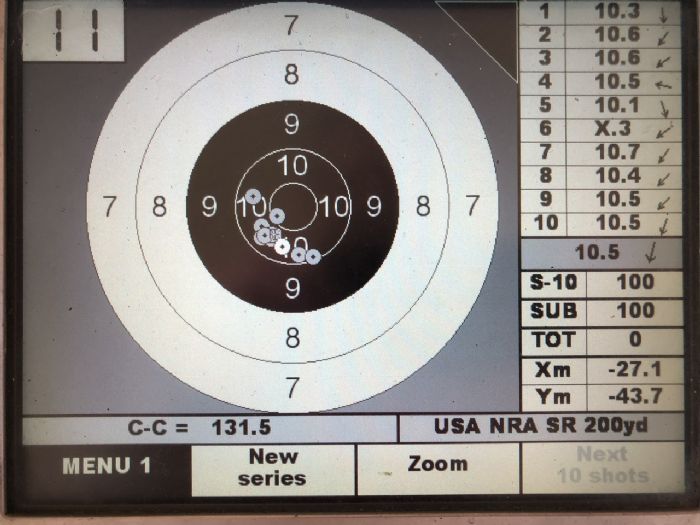 And finally, Group 3) cases partial length sized in the new Forster Bench Rest FL die: 40.0 gr Varget behind 174 SMK. I moved the front sight to the left and the rear sight up one click before I shot this group. It’s a bit more scattered than Group 2). 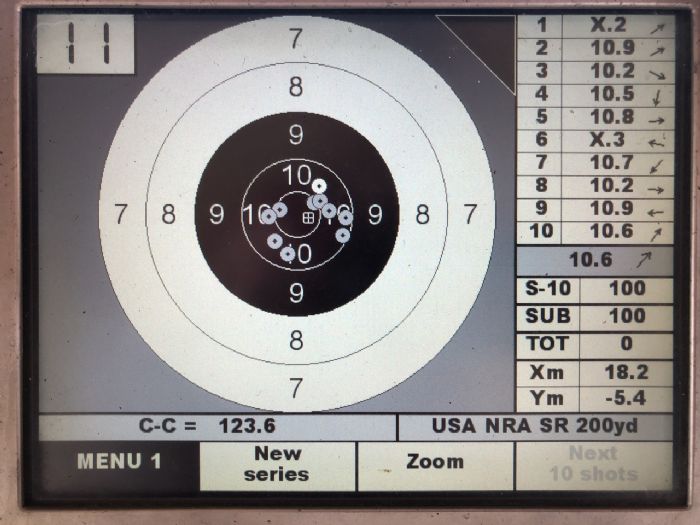 Here is another target with Group 3) loads, same as above. Note another flier at 10:00. But, a nice five shot cluster in the X ring.  Conclusion: I will no longer worry about bullet runout in the No. 4. It seems that the nose profile of the 174 SMK and the very long throat mitigate issues with bullet runout. Bullet runout most certainly made a big difference in my AR 600 yard line load with long pointy bullets (80 gr SMK) that are seated close to the lands. But, on this shot out barrel on my No. 4 with a whopping 1/2 inch jump to the lands, bullet runout does not seem to be a factor in 200 yard Service Rifle shooting accuracy. |
Posted By: Shamu
Date Posted: June 23 2023 at 3:41pm
|
Well researched! In an era of going by "feelings" its refreshing. It almost exactly duplicates my results from years back, when I go into an "accuracy craze". I think I posted the saga on here? That was when I stopped all the absolute custom loading & just started making good loads that shot well. My "Standard" loads, beat my "Custom Loads" by a respectable margin  I still do the "Once & done" steps, like flash hole reaming & primer pocket uniforming, & to me, "Partial Full Length resizing" but don't do the extreme steps. This may well not apply to the smaller & IMO more finicky 5.56/.223 reloading though. Partial F/L resizing used to be a standard thing to match hand loads to individual guns. IMO it was a skill that should not have been relegated to the "extreme accuracy nutters" segment of reloaders.  ------------- Don't shoot till you see the whites of their thighs. (Unofficial motto of the Royal Air Force) |
Posted By: britrifles
Date Posted: June 23 2023 at 3:55pm
|
Shamu, I suspect I’m just “reinventing the wheel” here, because it’s hard to find any factual evidence. No doubt in my mind that bullet runout is a big deal with some bullet types and some barrels. I struggled to get good 600 yard scores with my AR and I’ve finally resolved that issue, it was because of poor bullet runout. But, it seems to be a negligible variable in the No. 4 with the 174 SMK. Now, that could be because I’m shootings these loads in a barrel that has a lot of rounds thru it and the throat has been blasted away. On a new barrel, it may be a different outcome. I need to accept reality that this old shot out BSA 5 groove has served me well and it’s time to replace it. The days of 10 consecutive shots in the X ring are now gone. Today, my ten shot groups fired prone were 2.4 MOA and larger. Just a year ago, it was still shooting under 2 MOA with a high X ring count. I have a new Criterion and a new Lothar Walther barrel to choose from, so time to get on with the job before the next major match. In a scoped high precision rifle shot off the bench or bipod, I’d expect bullet runout to be important, but not with our Lee Enfield service rifles shooting in position with iron sights. Im convinced… |
Posted By: Shamu
Date Posted: June 23 2023 at 4:24pm
|
Oh absolutely! When I got into my accuracy kick with the
101% custom Rem 700 with the Shilen bull barrel & all the other
tricks it definitely made a difference! But I was trying to improve on 1/3 MOA! A whole different world.  ------------- Don't shoot till you see the whites of their thighs. (Unofficial motto of the Royal Air Force) |
Posted By: britrifles
Date Posted: June 25 2023 at 6:07pm
|
Not quite ready to put the concentricity gauge away yet. I’m going to run one further test. This time with my .308/7.62 loads for my DCRA No. 4 7.62 conversion. The rifle is a Faz 1956 No. 4 Mk2 with a Long Branch made and installed 7.62 NATO barrel. It’s a very good shooter, the most accurate No. 4 I have. It has approx 1500 - 2000 rounds thru it. The reloads I’m particularly interested in are loads I worked up for long range shooting, 800 and 1000 yards. These are long pointy bullets, and seated longer than the 2.80 inch magazine length so that they are within .020 to .030 inches from the lands of the rifling (175 and 168 TMK). Had some time to kill yesterday, so I measured the bullet runout on each of the 50 rounds I had loaded for three different long range test loads: Load 1: Lapua cases neck sized in Lee Collet Neck Sizer Die, 155 Palma MK seated to 2.81 OAL. Average bullet runout 0.0033 inches. Load 2: Lapua cases partial length sized in Lee Full Length Die, 175 Tipped MK seated to 2.935 OAL. Average bullet runout 0.0072 inches Load 3: Lapua cases neck sized in Lee Collet Neck Sizer Die, 168 gr Tipped MK seated to 2.950 OAL. Average bullet runout 0.0033 inches. Similar to the .303 British loads, the lowest runout values were obtained with the Lee Collet Neck Sizer die. Load 1 and 3 had the same average runout, with a minimum of 0.000 inches and maximum of 0.006 inches. Out of 100 rounds, only three had a run out of .006 inches. All three of these loads use Varget powder, with charge weights set according to the bullet weight. They are .308 Win published mid range loads, the maximum I’m comfortable with shooting in my No. 4 and strictly for the purposes of long range target shooting. The Lee FL sizer again gave the largest bullet runout, with a minimum of .002 inches and maximum of 0.011 inches out of 50 rounds loaded; 10 rounds have a runout of 0.009 or larger. I’ve recorded the runout on each round and I’ll be able to determine if it is a variable in individual shot accuracy, and accuracy of the load in general. I plan to go test these loads in the next week or two, and will shoot them at 600, 800 and 1000 yards along with a few sighters at the shorter ranges (100 and 300 yds). I have a Wilson .308 Bushing Type Full Length sizing die and a .308 Wilson In-Line Seater Die but have not tried them yet. That will be the next test. I’m expecting the accuracy edge on the three above loads to go to the 168 TMKs with cases that were neck sized in the Lee Collet die. But what comes in second place, I don’t know… |
Posted By: Shamu
Date Posted: June 25 2023 at 6:22pm
|
How much bullet full diameter is inside the case neck? I had a similar problem years back with 150 Gr Speers. To get good feeding, jump to lands & so on they had minimal neck engagement. It became a game of balancing choices, seat to lands stand off Vs case neck engagement. Then I just quit using the Speer bullets. ------------- Don't shoot till you see the whites of their thighs. (Unofficial motto of the Royal Air Force) |
Posted By: britrifles
Date Posted: June 25 2023 at 6:40pm
|
Shamu, I don’t recall exactly, but, this was considered when I set the OAL. It’s a trade off as you said. I’ve had good results with the 168’s and 175 TMKs at long range. I68’s were better, but I did not record if the cases were PL or Neck Sized, or new cases… Rule of thumb is to have one calibre of bullet diameter in the neck. But, at the lengths I’m seating these bullets too, I don’t think I achieved that. The secant ogive of the 168’s and 175 TMKs do make these bullets very long for their weight, IIRC, they still have a fair bit of bullet held by the neck. |
Posted By: Shamu
Date Posted: June 26 2023 at 10:43am
|
That was what I was wondering. What happens if you seat just deep enough to get one caliber in the neck? I ended up favoring that over OAL & the longer jump to the lands. ------------- Don't shoot till you see the whites of their thighs. (Unofficial motto of the Royal Air Force) |
Posted By: britrifles
Date Posted: June 26 2023 at 1:02pm
|
Yes, that is another variable in the load. I did some research on these long secant ogive bullets and the consensus is to seat them fairly close to the lands (around .020 off the lands). The advantage with that is it increases case airspace and reduces peak pressure. You can take advantage of this and increase the charge weight accordingly, but you better know what your doing here… My initial tests with these loads gave very satisfactory results (168 and 175 TMKs) at 800 and 1000 yds, i posted this over on the 7.62 Enfield Forum. Once I determine if bullet runout is a factor in long range accuracy, I’ll probably play with seating depth a bit. These loads however are fairly warm for a No. 4, and I’m mindful of not wanting to wear out this barrel doing this. I think shooting 150 rounds a year is OK, besides, my shooting days with irons are coming to an end, perhaps a few years left. I began this project to see how these DCRA conversions shoot out to 1000 yards, and to see how my own abilities compare with those that came before us. |
Posted By: A square 10
Date Posted: June 26 2023 at 7:31pm
| do you also check bullets for concentricity before loading them ? |
Posted By: britrifles
Date Posted: June 27 2023 at 3:37am
|
No, but since these are high quality match grade bullets, it’s highly unlikely they are a source any measurable runout. I don’t think the gage can be configured to check the bullet by itself. I did notice that bullet runout is typically 2x the runout of the case neck. But I think that can be explained by where the runout is measured: at the mid point of the neck along its length and on the bullet approx 1/8 inch forward of the neck. If the axis of the neck is slightly off at an angle relative to the case body axis, then the runout increases the further forward you measure on the cartridge.
|
Posted By: Goosic
Date Posted: June 27 2023 at 8:02am
|
(After the initial case prep has been done.) I have been taking once fired 7.62 Lake City brass and using a Lyman .243W full length resizing die to neck the LC cases down. Each case takes 4 short strokes of the ram to get the desired case formation with the case being rotated 1/4 turn with every throw of the ram arm. After the cases are full length resized I will use a 6mm bronze bore brush on an electric drill and score the inside of the neck. After that has been completed I will run each case through the .243W Lee Collet Neck sizer with a .002" undersized mandrel twice, rotating the case 180°. The brass then gets a 1 hour run through dry media. The final step after being polished has me running the case through the neck sizer one last time. The cases are then primed and loaded with 2.46g/37.9gr of VihtaVuori N540 using a Lyman 2.2g dipper and then scaled out with a trickle charger. The bullet of choice is the HPBT Lapua 6mm 90grn OTM Scenar-L. The case neck concentricity shows zero runout. The bullet seating tension expands the case neck outwards by .003" and allows me to seat the bullets out to 2.710" with zero to .0001" bullet runout. My oldest daughter asked me why it takes me so long to reload 50 to 100 cases. My response was to purposely try to make a question mark after I shot the cartridge case at a distance of 100 yards. The extra time involved with case prep and weighing out each charge is definitely worth the time and effort. The Jap made Weatherby has been taken to Bergers 1000 yard range and produces sub-moa groups consistently and I truly believe that it is due largely in part to the bullet selection, weighing out of each charge and what some would call unnecessary case prep work with me being the redundant component.
 After the fire formed cases are set to be reloaded, it is then that I use the Lee-Loader "Whack-A-Mole" from that point forward. After the fire formed cases are set to be reloaded, it is then that I use the Lee-Loader "Whack-A-Mole" from that point forward.   My daughters targets they shot at a distance of 200 yards for reference... My daughters targets they shot at a distance of 200 yards for reference... ... ... |
Posted By: britrifles
Date Posted: July 05 2023 at 8:37am
|
To close the loop on this post regarding effects of bullet runout on the No. 4, I shot my 7.62 reloads for my DCRA 7.62 I mentioned a few posts back. These were Lapua cases neck sized in my Lee Collet die, bullets seated with the standard Lee bullet seater (nothing special here). Average runout for the two different loads were the same, 0.0033 inches with a max of .006 inches. The two loads were with the Sierra 155 Palma MK and the Sierra 168 Tipped MK.
I measured and numbered each round and tracked its POI on the target. I could not find any correlation of POI and runout. I thought perhaps at the higher runout values of .005 and .006 might show up as wide shots in the group, but that was not the case. This is the 800 yard target with the 168 TMKs and the bullet runout values for each shot: 1 .003 2 .001 3 .003 4 .004 5 .003 6 .005 7 .006 8 .003 9 .002 10 .003 The two distinct clusters of hits are a result of a change in rear sight windage (PH 5c) by 4 clicks after shot #6. Shot #6 had a runout of .005 and was right in the middle of the cluster of five shots on the left, just outside the 10 ring at 9:00. Shot 7 had the highest bullet runout at .006 inches and it was an X ring shot. Shots 7 thru 10 had no sight changes, and these four shots were within an extreme spread of 4 inches at 800 yards (0.5 MOA group). Looking at shot # 7, 8 and 9, with runout variation of .002 to .006, that three shot sequence in the X ring was even smaller, perhaps 1/3 MOA apart. Note that the grid lines on the target photo represent a 1 MOA grid.  My conclusion is that bullet runout of up to .006 inches has no impact on long range shooting results with the No. 4 7.62 barrel. For me, the above result is about as good as I can do with irons regardless, and the elevation spread is likely 90% due to aiming imperfection. The lateral spread is aiming imperfection plus wind affects. I still have the 175 TMK loads to shoot, and these were partial length sized cases with an average runout of .007 inches, max of 0.011 inches; a bit more than double the runout of the above loads. I’ll see how these do next time I get out to the 1000 yd range. |
Posted By: Shamu
Date Posted: July 05 2023 at 9:01am
|
Great data & reporting. Yeah I quit worrying about tiny variations in run-out & jump to lands a while back now I prioritize bullet seating mostly as it seems to male the most difference. ------------- Don't shoot till you see the whites of their thighs. (Unofficial motto of the Royal Air Force) |
Posted By: britrifles
Date Posted: July 10 2023 at 7:35am
|
Just finished sizing the .308 Lapua brass that I fired in the 7.62 DCRA No. 4 last week. This is the first time using my new .308 Win Wilson Bushing Type FL Sizer Die. I’m quite happy with how this die works. The cases had been neck sized several times and with these moderately high power .308 loads, a fired case shows just a bit of resistance when chambering in the last 1/16 inch of bolt travel (space between bolt handle and receiver wrist). I could have necked sized these cases again, but wanted to try out the new die. I did not “full length size” the cases per se, but set the die position in the press such that the case shoulder was pushed back by .002 inches as compared to the fired case. I did this with the use of a Hornady Case Headspace Gauge, setting the case headspace to 1.626 inches (fired cases measured 1.628 inches). I confirmed by chambering the “partial length sized cases” that the bolt fully locked with only the slightest hint of very light resistance just before the bolt handle touched the receiver. That way, the case head is seated against the bolt head on firing and will minimize case stretch. Checking fired and sized case neck runout on the RCBS Casemaster gauge showed fired case neck runout < 0.001 and sized case neck runout < 0.002, and I’m quite happy with that. I like having the complete control to set neck tension. I sized the first 5 cases using a .334 inch diameter bushing, checked the neck ID with a pin gage and it was a bit small at .3035+, I think that’s more neck interference than desirable with a .308 bullet. The .335 bushing gave me a neck ID of .3050- with that size pin gage, giving a .003 inch interference with the bullet, about just right. Next step is to load these cases up with 168 grain TMKs using the Wilson In-Line Bullet Seater, measuring the force needed to seat the bullets then measure bullet runout. I’m not really expecting these loads to shoot any better than the previous loads with cases neck sized in the Lee Collet Die, but will be happy if they perform equally as well at Long Range.  Now, I’m not suggesting you guys need to go run out and get these dies, I did this to satisfy my own curiosity and to fix a significant bullet runout problem that was costing me points with my .223 Rem 600 yard load using the 80 grain SMK. That naturally made me curious if it might improve my 800 and 1000 yard results with the 168 and 175 TMKs in the No. 4 7.62 DCRA. |
Posted By: Goosic
Date Posted: July 10 2023 at 8:14am
Since you have been on this topic for awhile, I decided to truly look into the runout on all of my .243W cases and found that my best cases to work with are my resized to .243W, Norma .308W cases with my actual Lapua .243W cases coming in as a dismal 3rd place contender behind my resized Lake City brass. I started using my Lee Collet Neck sizer again but what I found very disappointing had everything to do with the "Offset" inside the case necks on the majority of the Lapua cases. My BR acquaintance is shipping me his case neck reamer but I am wondering if it is really worth the effort. My range is good for 300 yards but I do not shoot past 200 yards and my Weatherby is as accurate as they come. I'm going to use the reamer on a batch of 50 cases but anticipate little to no improvement over the unreamed cases. What say you on this Geoff?  I had my daughter shoot this group at 200 yards using the 25 yard slow fire pistol target because of how well the nice bright red center shows up in the scope. All the cases pictured are the unreamed Lapua cases... I had my daughter shoot this group at 200 yards using the 25 yard slow fire pistol target because of how well the nice bright red center shows up in the scope. All the cases pictured are the unreamed Lapua cases...
|
Posted By: britrifles
Date Posted: July 10 2023 at 8:31am
|
Not sure what to suggest Michael. Lapua is generally very good brass. In the sample of .223 and .308 new cases I checked, neck runout measured less than .001 inches. And yes, I think if the neck is out of alignment going into the Lee Collet Die, it will come out that way too since only the neck is touched by the die. I found that my DCRA Long Branch barrel chamber neck is slightly off center with the axis of case body. A new case measuring zero runout comes out after being fired at .001 inches. All the fired cases measured .001. So, neck sizing these in the Lee Collet Die also gave .001 neck runout. I think this is still very good, and nothing to worry about. My conclusions so far shooting the No. 4 .303 and 7.62 is that bullet runout as much as .006 is completely undetectable in the 7.62 out to 1000 yds and as much as .010 in the .303 was not detectable at 200 yards on the target. .010 however on my .223 at 600 yards was a definite problem for me and the Wilson dies solved that for me. Check the neck runout on some of your fired cases, if the neck of the chamber is concentric with the body area, the runout should be less than .001, since the fire formed cases should be the shape of the chamber (with a slight bit of spring back). |
Posted By: Shamu
Date Posted: July 10 2023 at 4:34pm
|
That sounds like a case for inside neck reaming, as opposed to outside neck turning? ------------- Don't shoot till you see the whites of their thighs. (Unofficial motto of the Royal Air Force) |
Posted By: britrifles
Date Posted: July 12 2023 at 5:06am
|
If the chamber of the rifle has a relatively small neck diameter and brass is particularly thick in the neck, neck turning may be necessary. Some match chambers are indeed tight. The easiest way to check this is measure the neck OD on fired cases as add .001. Compare that to the neck OD of loaded rounds. There must be some clearance when the round is chambered, at least a few thousands, to ensure the chamber does not restrict release of the bullet. All my LE’s have about .007 to .010 neck clearance with a loaded round, which is a fair amount.
Uneven neck thickness can affect neck tension, and consequently affect bullet velocity variation (standard deviation and extreme spread). It may also affect bullet runout to some degree. My 7.62 long range loads with Lapua brass was giving me single digit standard deviations in bullet velocity at the target, very good accuracy, so I see no need to turn necks. If chambers are on the large side, and you turn necks down, it will shorten the life of the case causing neck cracks to occur sooner. |