Strange Borescope Image
Printed From: Enfield-Rifles.com
Category: Enfields
Forum Name: Enfield Gunsmithing
Forum Description: Submit any how-to's or other gunsmithing suggestions here.
URL: http://www.enfield-rifles.com/forum_posts.asp?TID=13203
Printed Date: March 26 2026 at 8:18pm
Software Version: Web Wiz Forums 12.07 - https://www.webwizforums.com
Topic: Strange Borescope Image
Posted By: britrifles
Subject: Strange Borescope Image
Date Posted: February 13 2024 at 5:33pm
|
While we are talking borescopes and bore cleaning, thought I would share these photos. The rifle is a No. 4 Mk 2 7.62 DCRA Conversion. 1960s Long Branch 4 groove. I noticed this strange pattern in the grooves of the rifling the first time I borescoped it. Lands are perfectly smooth, no such marks. Not all grooves have this pattern of what looks to be etching of the steel. Keep in mind, this is highly magnified. There are four lands and grooves, and two of them have very little of this. One has almost none. The worst one runs for about 15 inches of the bore starting about 6 inches forward of the chamber. Had to turn the borescope camera light way down to be able to see it, as the bore has a very bright finish. Any thoughts on what this is? Does not affect accuracy at all, this is my best No. 4 shooter. Has about 2300 rounds thru the barrel. Got to pull out the T which has a CMk4 1950’s barrel, I think it has a similar feature. Almost like microscopic worms ate their way into the steel along the surface. 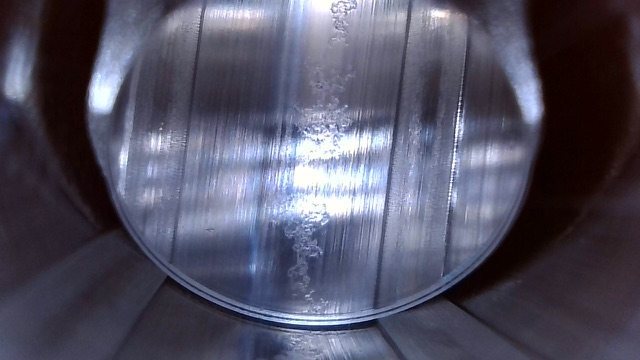 |
Replies:
Posted By: DarioPirovano
Date Posted: February 13 2024 at 5:44pm
| Same things that are in my no4 mk2 barrel |
Posted By: SW28fan
Date Posted: February 13 2024 at 5:49pm
|
I'll show the image to the metallurgy guy at work, but my best guess is corrosion ------------- Have a Nice Day If already having a nice day please disregard |
Posted By: britrifles
Date Posted: February 13 2024 at 6:03pm
|
I think so too, but didn’t want to discount some type of etching. The only bore cleaners that have been used on it up to the point I first saw it was Hoppes 9 and Sweets. Since then, I’ve used several others, Butches Bore Shine, Bore Tech Eliminator and C4 and JB. Never mix any of these together. Dad had fired perhaps 10 rounds thru this rifle after the conversion to 7.62, and perhaps without removing all the fouling and sitting in the basement for 25+ years, corrosion had started under the fouling.
|
Posted By: britrifles
Date Posted: February 13 2024 at 6:05pm
Here is one of the worst areas. |
Posted By: DarioPirovano
Date Posted: February 13 2024 at 8:00pm
| I think it is nothing to be worried for almost 70yrs old steel, just keep it oiled, maybe a JB treatment could reduce it… looks very light probably it’s pitting formation beginning |
Posted By: britrifles
Date Posted: February 14 2024 at 3:53am
|
This is a good example of why routine and effective barrel cleaning is important. I suspect this was caused by ineffective cleaning and long term storage causing corrosion under the carbon fouling. Dad would have likely used Hoppes 9 only, and that won’t remove the copper and hard carbon as I now know from borscope inspections. He only shot it once, but there would have been a lot of copper left in the bore being a new barrel. He likely oiled or greased the bore after cleaning, but that won’t do much for the areas covered in copper and hard carbon.
If you look close at the second pic, you can see numerous small black specs where the JB was not removed by the post-JB wipe with Kroil on a patch. These are probably the deeper pits. Wrapping a patch around a bronze brush with Kroil will probably remove the JB in these pits. |
Posted By: Zed
Date Posted: February 14 2024 at 4:03am
|
Looks like some surface corrosion has etched into it. I suspect it's been there a long time. ------------- It's nice to be important, but it's more important to be nice! |
Posted By: britrifles
Date Posted: February 14 2024 at 7:13am
|
Yes, it has to be that. I'd guess the depth is < 0.0005 inches, maybe only around 0.0002. It's not on the lands at all, I think that is because the lands clean up fairly easy when using a patch and jag (higher friction on the lands from the patch than in the grooves). He shot this rifle just once with the new replacement 7.62 barrel in 1966 (I found the page in his reloading data book), and then it sat unused until I got it around 2003. The corrosion had a long time to act on the barrel. When I got it, Dad did not remember ever having shot this rifle and I did not have a borescope back then. Visually the barrel looked perfect. I have a vague recollection of cleaning the bore before I shot it with Hoppe's and seeing some carbon/copper come out, and I thought that must have been from proof firing at Long Branch following the conversion. So I followed the barrel break in process using Hoppes and Sweets; and it's remained relatively free of fouling since then with just routine cleaning. This is the rifle I use for long range shooting (800 and 1000 yards), and it's shot some sub-MOA groups. Dad kept his rifles in the basement at home which was quite humid in the summer months. I remember at times we had a dehumidifier running. Winter would have been dry, especially once we installed a wood stove in the basement and used it to heat the house. |
Posted By: SW28fan
Date Posted: February 14 2024 at 2:03pm
|
The Metallurgy guy thinks it is the result of light surface rust that has been removed. He has seen this before when light corrosion has been removed. ------------- Have a Nice Day If already having a nice day please disregard |
Posted By: britrifles
Date Posted: February 14 2024 at 2:15pm
|
Thanks Paul, seems there is good consensus it is removed corrosion. Likely the JB that removed it, or past times when I’ve brushed the bore. It just looks odd under magnification. I just inspected the CMk 4 Long Branch six groove barrel on the T, and it looks very similar for about an 8 inch length of the barrel, also at the middle band location. The rest looks very good.  |
Posted By: Rossfield
Date Posted: June 16 2024 at 8:11am
|
The pits appear slightly "smeared" in the photo above this post; that is to say the edges appear slightly rounded over. I have seen the same effect on steel surfaces I have removed rust from with a wire wheel so I would conclude abrasive paste or brushing (stainless steel brush?) has done the same here. Were corrosive primers used on early production 7.62mm ammo I wonder? ------------- Treason doth never prosper; what's the reason? Why if it prosper, none dare call it treason. |
Posted By: Marco1010
Date Posted: June 20 2024 at 1:49pm
| Its pitting corrosion alright, typical pattern I see all the time on steel where there is corrosion under insulation on pipework. Will have formed from residual oxides in the forging process when the barrels were made. The buildup of fouling over the decades has to an extent stopped it being much worse than it could have been. More modern barrel forging methods tend to prevent this nowdays. |
Posted By: Shamu
Date Posted: June 20 2024 at 3:21pm
|
They are so light I very much doubt they'd effect accuracy. Sweets is a strong ammonia solvent. Might that have cause micro-etching from being in the barrel past the "10-15minutes" mentioned in its instructions? Maybe its me, maybe its the lighting from the bore-scope, but I see two things intermixed in the "worst area" image? 1:"Spiderwebs", etched into the surface. I say that because the interfere with the machining marks along the length by "breaking through" them. 2: "oily pools" laid on top of the bore metal, which appear to be laid on top of them just below the reflections of the bore-scope lights reflection?
 ------------- Don't shoot till you see the whites of their thighs. (Unofficial motto of the Royal Air Force) |
Posted By: britrifles
Date Posted: June 20 2024 at 4:33pm
|
Does not affect accuracy, this is my most accurate No. 4. My Dad had the rifle sent to Long Branch thru DCRA for the conversion. When he gave me the rifle, he didn’t think he had ever fired it, but in searching his shooting and reloading records, I found he had shot 10 rounds of Canadian Service Ball ammo thru it (mid 1960’s). Not very satisfied with how it shot (poor ammo, but he didn’t know that back then), he never fired it again. He would have cleaned the barrel afterwards, but that would not have removed any copper which is particularly bad for the first few dozen rounds on a new barrel, and this is where the fouling would be heaviest (where the pitting is). I do think it is pitting, likely in an area that the fouling trapped moisture. Dad kept his rifles in our basement which in the summer was quite damp. Nearly 40 years passed until I got the rifle. I followed a barrel break in procedure (thinking it was a new barrel), but did not have a borescope at that time. It’s never had a steel brush put into the bore, but I have used a bronze brush a few times. I can’t completely rule out Sweets, since I did use it early on, but always dry patched it out and followed by cleaning with Hoppes, then gun oil. There well could be some remaining Kroil on the surface, I think I took these images right after cleaning it with JB and Kroil. I”ll send this photo to one of our Manufacturing & Process engineers who specialize in corrosion and see what they say. |
Posted By: Shamu
Date Posted: June 22 2024 at 2:01pm
|
I didn't mean to give the impression they were oily patches, just that they looked like that to differentiate from the etched ones. ------------- Don't shoot till you see the whites of their thighs. (Unofficial motto of the Royal Air Force) |
Posted By: shiloh
Date Posted: June 23 2024 at 5:35am
|
A couple yrs ago I purchase a bayonet still wrapped and soaked with cosmoline. Was told it was WWI unissued. When I unwrapped it and thoroughly cleaned it the blade was perfect yet covered on both sides with the same mirco snail trails. Upon investigation I was told by a metal guy I know it was likely cause by micro moisture trapped under the grease and also could be from bacteria eating the grease. Them little bugs must excrete some powerful acid to etch the steel. Never say never I guess. I like the moisture explanation the best. |
Posted By: Shamu
Date Posted: June 23 2024 at 2:27pm
|
Wow, Spurred on by that I dug out my No9 Mk1 & My No7 LS bayonets, excavated my shadowless ring-light, a relic of my on CS & Forensics days, & took some macro pictures. These are much lower mag, about 15~20X but its all my current camera will do. Both show the "spiderwebs"although to the naked eye they look nice. These have been wiped & oiled & so on but no scrubbing, like a bore brush or J.B. paste, so they look dark, not bright. That reinforces the micro-rusting & scouring idea.  I guess its just a minute detail we never noticed till we had the high mag bore-scopes available. The No7 Mk1, Rows of them, just above the lower groove .  The No9LS, a few, scattered just above the lower groove again & more on two "groups, just above the bottom edge of the blade.  ------------- Don't shoot till you see the whites of their thighs. (Unofficial motto of the Royal Air Force) |
Posted By: Rossfield
Date Posted: June 25 2024 at 9:37am
|
This is why ferrous metal surfaces should be heated before applying oil or paint to drive out the residual moisture in the "pores" of the metal. Once the water is evaporated by heat the oil or paint can then get into those pores, and either bond better and/or inhibit the ingress/condensation of moisture from the air. ------------- Treason doth never prosper; what's the reason? Why if it prosper, none dare call it treason. |
Posted By: britrifles
Date Posted: June 25 2024 at 4:49pm
| Shamu, that looks like regular pitting, not the “trails” I see in the bore of several of my No. 4 rifles. I first thought of microbial corrosion, which occurs inside fuel tanks on aircraft (before they added the biocides in fuel and corrosion inhibiting treatments). It will be interesting to hear what my corrosion expert at work says, will sent him the photo next week. |
Posted By: Shamu
Date Posted: June 26 2024 at 11:31am
|
I think the differences you're seeing are because of very different magnification levels? The little circular patterns on the second image are made up of the same patterns you're showing, but I can't get a high enough magnification with the camera to show them better. My Jeweler's loupe shows them as being similar but I can't photograph through it. ------------- Don't shoot till you see the whites of their thighs. (Unofficial motto of the Royal Air Force) |
Posted By: britrifles
Date Posted: June 26 2024 at 12:17pm
| Yes, perhaps so. The problem too is the resolution on photos we can post here is not very good. |
Posted By: Shamu
Date Posted: June 26 2024 at 5:16pm
That too. ------------- Don't shoot till you see the whites of their thighs. (Unofficial motto of the Royal Air Force) |
Posted By: britrifles
Date Posted: July 02 2024 at 6:10am
|
I showed the borescope image on that Long Branch 7.62 barrel I posted here on this thread to our Materials and Processes engineer who specializes in corrosion and corrosion protective coatings. He recognized this as "filiform corrosion", a particular type of corrosion that only occurs under a coating or plating. There is some pitting there too; likely in adjacent areas that did not have any fouling. I believe in this case, the "coating or plating" was a combination of carbon and copper fouling. Moisture trapped under the fouling, or crept under it over many years of storage before I fully cleaned the barrel. The corrosion does not show on the lands, because the bore cleaning that my Dad did before he put it away likely removed the fouling from the lands; it's the grooves that did not get fully cleaned. Filiform corrosion is typically cosmetic, does not usually go very deep like pitting can. And, that's what it appears to be in this barrel. I also see some of this on the Long Branch CMk4 barrel on the No. 4 T, which was stored in the same environment as the DCRA 7.62. So, keep barrels free of fouling, particularly if you intend to store the rifle for some period. |
Posted By: Shamu
Date Posted: July 02 2024 at 12:14pm
|
That would have worked like a plating for sure. ------------- Don't shoot till you see the whites of their thighs. (Unofficial motto of the Royal Air Force) |
Posted By: RangerJohn
Date Posted: July 06 2024 at 8:35am
|
Gents, After firing my No. 4 for the first time, I checked the bore with my borescope and saw these striations starting at the breach and extending about 1/2 inch toward the front of the bore. Any ideas? I also spotted some what might be copper residue in a few places. Will do some more cleaning.  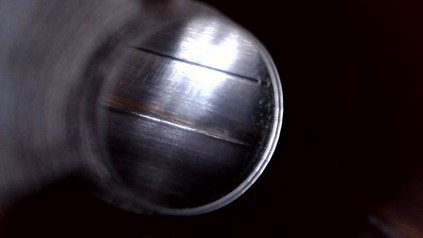 ------------- John S. Campbell |
Posted By: britrifles
Date Posted: July 06 2024 at 1:51pm
|
John, those are reamer marks from when the barrel was made. Fairly typical, barrels were not lapped. |
Posted By: Irish Blonde
Date Posted: January 17 2025 at 5:41am
|
Yup, barrel worms! As pointed out, ain't nuffin to worry about. Probably the better of the corrosion type to have. On another note, I've shot some terrible pitted bores, still have impressive precision non-the-less. |
Posted By: Drax
Date Posted: October 27 2025 at 4:02pm
|
Slightly off topic. I once condemned a well-used P14 barrel. When you looked down the barrel, there appeared to be defined rifling. Out of curiosity I sliced about 6" of it down the centre so I could have a close look at the bore. There was what looked like rifling, but when I aggressively rubbed at it with a steel brush it disappeared. The bore was smooth and what looked like rifling was actually copper deposit. ------------- Jobs not done until you've bled on it. |