Effect of Primer Selection on Muzzle Velocity
Printed From: Enfield-Rifles.com
Category: Reloading
Forum Name: Reloading .303 British
Forum Description: Enfield-Rifles.com accepts NO responsibility for any loads that may be used by persons reading this forum. USE CAUTION WHEN TRYING ANY NEW LOADS!!! ANY DATA DEEMED UNSAFE WILL BE REMOVED!!!
URL: http://www.enfield-rifles.com/forum_posts.asp?TID=13755
Printed Date: March 26 2026 at 8:19pm
Software Version: Web Wiz Forums 12.07 - https://www.webwizforums.com
Topic: Effect of Primer Selection on Muzzle Velocity
Posted By: britrifles
Subject: Effect of Primer Selection on Muzzle Velocity
Date Posted: January 13 2025 at 4:31am
|
After having very good success with using the CCI BR-2 Primer in my .308/7.62 Converted No. 4, I decided to run a test with the BR-2 in the .303. My go-to primer for the .303 has been the WLR for many years. I did not at all get the results I was expecting, velocities dropped considerably and standard deviations increased. Here is the results (all powder charges are Varget, PPU cases, 174 gr SMK seated to 3.07”), data collected with my Garmin XERO. All 10 shot groups. Charge Primer MV ES SD 40.3 WLR 2384 45 14 40.3 WLR 2380 47 15 40.3 BR-2 2340 105 34 40.6 BR-2 2357 53 23 40.6 BR-2 2354 53 20 40.9 BR-2 2382 86 26 40.9 BR-2 2385 89 26 The 40.3 gr BR-2 load with the high ES of 105 had one shot with a very low velocity. Deleting that shot brought the MV up to 2347, ES down to 78 and Std Dev down to 28. All charges were weighed to within +/- 0.05 grains on my RCBS electronic scale which I have checked with calibration weights. It would seem that the WLR is a hotter primer, equivalent to an additional 0.6 grains of Varget. My .308 Win loads are giving single digit standard deviations with 44.0 grains of Varget (168 gr TMK) out of the No. 4 DCRA 7.62 Conversion. It may be that the weaker BR-2 primer requires close to or at 100% load density to function well, particularly in cold/cool weather. Temperature was 40 to 45 degrees during the test. This was all related to my efforts to see if I can shrink the 600 yard groups in the No. 4 T. The T has a Long Branch CM4 six groove barrel fitted. |
Replies:
Posted By: Sapper740
Date Posted: January 13 2025 at 5:58am
| That's an interesting result Brit, there's always so many variables when handloading for accuracy. I wonder what you would find if you tested primers from different case lots? I had an excellent recipe worked up for my LB using fireformed Dominion brass with Hornady 150 gr. SST bullets over Varget and CCI LRP. From a rest it would shoot 1 MOA. I eventually used up the 1000 primers in the LB and several other .303s I was reloading for and started with a newer case lot, same primer. I was never able to achieve the same accuracy again. Funnily enough, I have a chrono but seldom check each load's velocity, something that's going to change now that I'm retired and have more time. |
Posted By: britrifles
Date Posted: January 13 2025 at 6:26am
|
So far, I've only used BR-2 primers coming from the same brick of 1000. I have a second brick, which is probably a different lot number, purchased several years apart I think. I went thru the target plot sheets I made with this test at 600 yards. There was a definite correlation of vertical point of impact on the target to the muzzle velocity. So, I need to work at shrinking the standard deviations, certainly to get it down in the teens if not single digit. My plan is to see if increasing powder charge will reduce standard deviation with the BR-2s. Also, will try seating the primers a bit more firmly, obtaining a slight amount of crush up. Reading others experience, this seems to be necessary with this primer. Of course, never good to change more than one variable while testing, otherwise you won't know which variable made the difference. |
Posted By: gilgsn
Date Posted: January 14 2025 at 2:24am
|
he!!o. A couple weeks ago I loaded a bunch of .41 Magnum rounds for my Ruger Blackhawk. I was getting short on large-pistol primers and used some from two different brands. At the range I was surprised to see an increase of 100fps (4-5/8 bbl) with one kind of primers. I remembered that I had some troubles seating them and told myself I would not buy that brand again... Recoil was sharp and the trigger guard dug into my index finger, drawing blood. Well, it turns out that the second box of primers I grabbed was actually large-rifle primers I use for .303 in my No5! Not making that mistake again! Primers can make a big difference, especially the wrong kind... Gil.
|
Posted By: britrifles
Date Posted: January 14 2025 at 5:42am
|
Worse if you had done that the other way around. LP primers have thinner cups than LR and can pierce at the higher rifle cartridge chamber pressures. |
Posted By: britrifles
Date Posted: January 14 2025 at 4:20pm
Some might ask “why worry about velocity Extreme Spread and Standard Deviation”? The answer is found in the target below. This was one of the 600 yard targets I shot while collecting the chrono data recorded in the first post above. It is one of the 40.6 grain Varget loads with the BR-2 primers.  A Vintage Sniper match score of 96-6x at the 600 yard stage is fairly good, but why the two low shots in the 8 ring (shot #3 and #4)? Well, upon reviewing the data, those 2 shots were the lowest recorded velocities of the ten shot string. And upon reviewing the data for the other 5 groups, low velocity shots always impacted low on the target. Same was the case for high velocities, they appeared high in the group. That might all seem obvious, but the vertical spread caused by a 50-80 fps velocity variation is more than I would have expected. And, this does not appear at 300 yards. I wonder if shooting this rifle off of a sandbag (rather than prone in the sling) is having a negative effect on muzzle jump, such that velocity variations are not affecting the angle of jump, or minimally affected. When shooting the No. 4 prone, we often find that the fast bullet leaves the muzzle at a lower angle of jump which has an elevation point of impact compensating effect at mid and long range (meaning slow and fast bullets impact the target at about the same elevation). Maj Reynolds wrote about this and had been involved in tests that determined the angle of jump while he worked at RSAF Enfield. I have more testing to do to close these groups up, and I won’t stop until this rifle holds the 10 ring at 600 yards. That’s a match winning rifle. I would like to live to see the day that a No. 4 T wins the US National Sniper Match, or at least one of the significant regional matches. |
Posted By: Shamu
Date Posted: January 14 2025 at 4:23pm
|
I'd say it depends on whether you're using the sling equally at the two different ranges? ------------- Don't shoot till you see the whites of their thighs. (Unofficial motto of the Royal Air Force) |
Posted By: britrifles
Date Posted: January 14 2025 at 5:28pm
| Not using a sling. This match is shot off of a sandbag rest in the prone position. I do have the option of shooting prone unsupported with a sling. |
Posted By: britrifles
Date Posted: January 17 2025 at 4:45pm
|
I completed a series of definitive tests today to try to isolate the cause of vertical dispersions at 600 yards with the No. 4 T. I had suspected that the reason was entirely due to variation in muzzle velocity. Today’s tests confirmed that suspicion. For the test, the basic load data is: PPU Case WLR Primer Varget (ADI AR2208) all charges weighed 174 gr Sierra MatchKing Five rounds each were loaded and fired with the following charge weights: 40.3, 40.6, 40.9, 41.2, 41.5 grains. All weighed on RCBS Range Master 750 Digital Scale checked for accuracy with calibration weights I fired one shot of each charge in sequence at the same target, recording muzzle velocity and plotted the point of impact carefully. Then repeated this in a round robin style test for a total of five shots of each charge weight. Overall, for the 25 shots, the velocity statistics were: MV 2417 fps ES 118.6 fps SD 29.4 fps That’s not actually too bad for 1.2 grain variation in charge weight. Here are all 25 shots on the target monitor shot on the US NRA Mid Range (MR) Target:  I then plotted the individual shot elevation (MOA) from the center of the target bull with a “0” value as the reference elevation against he recorded muzzle velocity. I did not change any scope elevation or windage settings through the course of the 25 rounds. Here was the smallest 5 shot group, 40.6 grains of Varget, under 1 MOA center to center. Elevation spread was under 1/4 MOA. Muzzle Velocity 2389 to 2427 fps. This was shots #2, 7, 12, 17 and 22 of the Round Robin 25 shot test. I made one plot sheet per individual charge weight load.  Perhaps not unexpected, there is a strong correlation of elevation point of impact on the target with muzzle velocity. But, oddly, most charge weights exhibited significant muzzle velocity variation. Here are the individual charge weights mean velocity and extreme spread: Charge MV ES 40.3 2379 53 40.6 2408 38 40.9 2414 55 41.2 2439 53 41.5 2446 32 The plot below shows all 25 shots and a linear trend line thru the data. The slope of the trend line shows a 0.3 MOA elevation rise for each 10 fps velocity increase. If I can keep the velocity Extreme Spread down to 30 fps, that would keep the elevation spreads to within the height of the X ring (1 MOA) with perfect aim. In practice, that should keep all shots within the height of the 10 ring which is my goal.  It’s quite clear to me that my trouble with 600 yard groups holding the 10 ring is because of excessive velocity variation, even when charges are all weighed. In the range of 2385 to 2420 fps appears to be a flat spot where elevation is not changing much with muzzle velocity. Elevation seems to jump up above 2460 fps, but I’d need more testing to prove that. This might be due to the barrel and rifle moving out of the accuracy node. Now to find and correct the causes of muzzle velocity variation. I need to get the Extreme Spread of muzzle velocity down to around 30 fps based on this data and target a mean velocity of 2400 fps to get on that flat spot. A 30 fps ES may be expecting too much from this barrel. I weighed all the fired and deprimed cases in order they were shot. There was no correlation of case weight with muzzle velocity. Next shoot I will do an another Round Robin test loaded to 40.6 grains but vary bullet seating depth. |
Posted By: Strangely Brown
Date Posted: January 18 2025 at 6:22am
|
A take on primers from across the pond: The 2019 Bisley Imperial threw a new light on primers for all the wrong reasons. It started with my own club's army open meeting with the issue of GGG 155gr destined for the miliary but issued for the May meeting, two months before the main Imperial meeting and the Queens Prize. Shooters started to notice extractors being broken on such rifles like Swings, Barnard's, Gruenig+Elmiger and others. Whilst the NRA were aware of this it wasn't until GGG delivered the ammunition for 2019 Imperial that the fireworks started; we're talking broken extractors, and lots of them! I did a search a couple of hours back on a Facebook page which caters for Bisley shooters and found one post from a shooters who had 9 extractors break on him during the whole meeting! It was also noted that some shooters were experiencing 11 O'clock flyers. The final source o the problem after much experimenting was declared to be overly hot primers, some estimates put it at 20% of the quantity purchased. It's rather frustrating here in the UK that primers are still in short in supply although I have managed to get a 1000 Magtech recently and am only using the few RWS (Ruag) I have for competitions. Geoff, another great post of yours, although I had to read it twice to fully understand what was going on! ------------- Mick |
Posted By: britrifles
Date Posted: January 18 2025 at 7:09am
|
Mick, I think we underestimate the effect primer choice has on both velocity and accuracy. I’ve never paid any attention to it, nor noticed any significant effect until tuning my long range load for the DCRA 7.62. I assume the extractors were broken trying to extract a stuck case? I can’t imagine any other reason. Of course, a stuck case is a very good indicator of an overloaded cartridge. Nothing seems as simple as one would think. I really should have put this last post I did on the ladder test on the T to a different thread, as it was not really a test of primers. But, one wonders if primer consistency is a factor here of my large muzzle velocity deviations (at the same charge weight). One does of course expect velocity to go up with increasing powder charge, but what I experienced was large velocity variances at the same charge weight that are causing vertical dispersions at the target of 2 MOA, sometimes as much as 4 MOA! I’ve heard some long range shooters weigh primers, but I just can’t imagine that would be necessary to get ES down to 30 fps. Same for weighing bullets. |
Posted By: Mayhem
Date Posted: January 18 2025 at 4:05pm
I've noticed an increase in V0 in my 6.5x55 when switching from CCI #200 primers to Winchester LRP. I don't have my notes with me at the moment but I believe it was around 80 - 100 fps on average. From memory, I was using 39.8gn of ADI AR2209 and 140gn Hornady ELD-M. Yes, I know - It isn't an Enfield 
|
Posted By: britrifles
Date Posted: January 19 2025 at 5:04am
|
I redid the Shot Elevation Point of Impact (POI) vs Muzzle Velocity plot so we can see each of the 5 different Varget charge weights as indicated in the chart legend. I’ve also reset the vertical axis scale so “0” aligns with the vertical center of the target bull. The various horizontal lines represent the heights of the X, 10, 9 and 8 ring on the US NRA Mid Range (MR) Target.
Note the 40.6 grain load produced the tightest vertical spread, under 1/2 MOA. The dashed line is a linear trend line thru the five data points. Could well be a fluke and I need more shots to prove it out. A trend line thru these five shots shows no change in elevation POI with increasing velocity. That’s exactly what we want in a mid to long range load. So that will be the basis for further testing with bullet seating depth.  |
Posted By: Zed
Date Posted: January 19 2025 at 12:31pm
|
Geoff. It is very interesting and educational to read your posts on reloading! The 40.6 load looks very good. I hope all the hard work pays off in this seasons competitions! ------------- It's nice to be important, but it's more important to be nice! |
Posted By: A square 10
Date Posted: January 19 2025 at 12:38pm
|
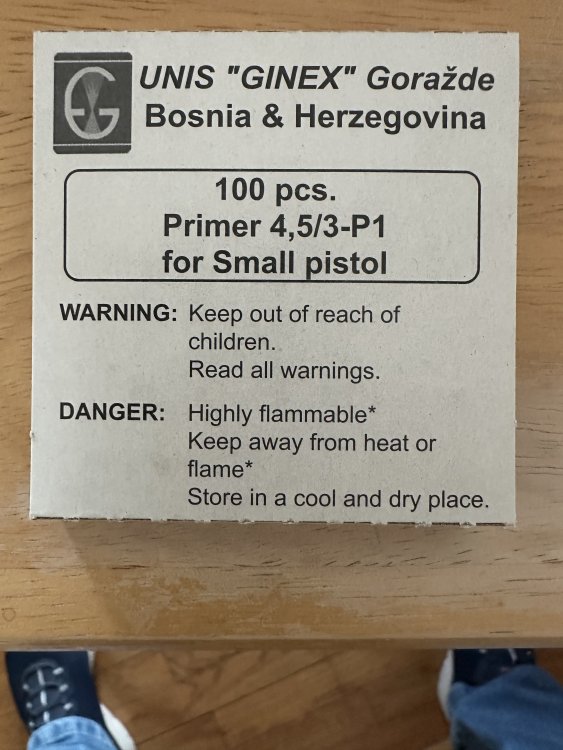
has anyone tried these primers in the proper selection of coarse ? Anyone tried these? I picked up 1300 for $65.00 out the door at my LGS [posted by someone on my SASS site]
https://forums.sassnet.com/uploads/monthly_2025_01/IMG_0159.jpeg.4b10630cedaa72a6b03013dd52fe4247.jpeg" rel="nofollow"> |
Posted By: Strangely Brown
Date Posted: January 19 2025 at 12:58pm
I've not seen these in the UK, although given the proximity of Bosnia to the Ukraine that's hardly surprising. ------------- Mick |
 A square 10 wrote:
Posted By: A square 10
Date Posted: January 19 2025 at 5:10pm
|
ya , im surprised there are any available , but a lot of folks on another site say they can get them readily , came back to add they most all said they worked great but were harder like the chedites
|
Posted By: britrifles
Date Posted: January 25 2025 at 3:11pm
|
I completed the bullet seating depth test today on the No. 4 (T). Conditions were clear, temps 43-47 deg F with light and variable winds. Shot off the bench with a front bag rest and rifle held into the shoulder. Load: PPU Case, neck sized with two reloads WLR Primer 40.5 grains Varget (ADI AR2208) all charges weighed 174 gr Sierra MatchKing Cartridge Overall Length from 3.050 to 3.070 in .005” increments 6 shots of each increment in COAL. There was virtually no correlation of MV to COAL: COAL MV ES # Shots 3.050 2407 48 6 3.055 2406 56 6 3.060 2393 102 6 3.065 2392 52 6 3.070 2420 100 6 These are some high extreme spreads in velocity, particularly 3.060 and 3.070 COAL. 3.060 had the slowest shot at 2350 fps and the 3.070 COAL had the max velocity at 2490 fps. Excluding these two shots gives the MV and ES as follows: COAL MV ES # Shots 3.050 2407 48 6 3.055 2406 56 6 3.060 2402 75 5 3.065 2392 52 6 3.070 2405 24 5 I had larger vertical POI spreads on this test than on previous tests at the same muzzle velocity. I don’t know why. Perhaps variable bullet jump at the same velocity is different than variable charge weight at the same velocity. But, the trend of increasing elevation with increasing muzzle velocity is still there, as are large muzzle velocity Extreme Spreads despite weighing every charge. These are some of the largest ES values I have seen. Hard to make any firm conclusions here, but the 3.05” OAL showed the lowest elevation spread. This happens to have been my standard .303 match load for many years. 3 of 6 shots were within the height of the X ring with two more just outside the X ring height (open triangles in the plot below).  I’m beginning to suspect the barrel is the cause of the large muzzle velocity extreme spreads. Although it has less than 2000 rounds through it, there is significant pitting in the grooves. I’m tempted to screw on a new CBI barrel and see how it does. |
Posted By: Shamu
Date Posted: January 25 2025 at 3:51pm
|
Do you crimp? ------------- Don't shoot till you see the whites of their thighs. (Unofficial motto of the Royal Air Force) |
Posted By: britrifles
Date Posted: January 25 2025 at 4:13pm
No, never shown before to be an advantage. Not to me anyway. |
Posted By: Shamu
Date Posted: January 25 2025 at 6:48pm
|
Have you ever tried reducing the expander ball slightly by polishing with a very fine abrasive? It increases neck tension which might help with your variations? You don't intentionally remove anything just buff it to a mirror shine. The removal of high spots from the machining does shrink it a G.B.H. though. I chuck it in a power drill & use Green ScotchBrite. Its one of my little accuracy tricks. ------------- Don't shoot till you see the whites of their thighs. (Unofficial motto of the Royal Air Force) |
Posted By: britrifles
Date Posted: January 25 2025 at 7:05pm
Yes, I have done that on my FL dies. These happened to be neck sized cases in a Lee Collet die. I’ve experimented with different sized mandrels and expanders as well (-0.001, -0.002). Once I started annealing case necks, I went back to a standard size expander and mandrel. Something suddenly changed today, had trouble with lateral spreads too even though there was little to no wind. Lateral zero was off by 3 minutes. I wonder if the scope graticule has come loose, sure hope not. I check the mount thumb screws during the shoot, they remained tight. Pads not loose either. Might remove the scope and shoot with aperture sight. |
Posted By: Shamu
Date Posted: January 26 2025 at 11:12am
|
When was the scope last serviced? I had a Hensoldt Ferro ZF24 that had a reticle that always "settled down" after a few rounds when adjusted. It has a similar adjustment system where you back off a lock spin the turret & then tighten clamping the knob & internal mechanism together. My other identical scope had no such problems. It turned out the actual adjustment mechanism lube had dried massively forming a thick grease! It was so thick the spring opposite it had to be "jiggled" by recoil to actually move the internal tube fully! ------------- Don't shoot till you see the whites of their thighs. (Unofficial motto of the Royal Air Force) |
Posted By: britrifles
Date Posted: January 26 2025 at 11:33am
|
Funny you should ask that Shamu. I just check the scope graticule movement by carefully (lightly) clamping the scope and mount in a vice and sighting out the window at the top of a tree about 1/2 mile away. The windage movements (clicks) are very positive and repeatable, and return to “0” after several L/R 10 minute adjustments. I then tapped on the scope to see if there was any graticule movement and there was none. This gave me the opportunity to check parallax, and it is definitely parallax free at that distance. I can detect a slight amount of parallax error at 100 yds, perhaps 1 MOA at most at the extreme edge of the view thru the eyepiece. I’m quite relieved to see this, worried the scope was nackered.  My Dad made that vice in High School, about 1947. He made the sand casting molds too and had a local foundry pour them. Wished he had stamped his name and date into the base.  I’m beginning to suspect I’m “over cleaning” this barrel. The grooves are somewhat pitted, and perhaps it needs some carbon build up to smooth it out and settle the barrel vibrations down. This might reduce bullet velocity variations too. For years, my routine has been Hoppes 9, but I recently changed to C4 which is taking the bore down to bare steel every time. Looking back thru the target plots, groups opened up after the first time cleaning down to bare steel. Although such a cleaning routine works on new match grade barrels, perhaps not so on old pitted service grade barrels. This cleaning is with just Hoppes, and I’ll see how it shoots next time out. |
Posted By: Shamu
Date Posted: January 26 2025 at 4:38pm
|
I wasn't about to mention that but it IS a valid thought. Why it would be mainly vertical makes me doubt it somehow? ------------- Don't shoot till you see the whites of their thighs. (Unofficial motto of the Royal Air Force) |
Posted By: britrifles
Date Posted: January 27 2025 at 3:56am
|
Well, truth be told, I’m seeing larger lateral dispersions too, particularly on this last test that had a whopping 140 fps ES. But I’ve been ignoring these during the tests looking for the cause of vertical spreads. I just borescoped the barrel after soaking in Hoppes 9 since Saturday afternoon, it is quite dark with carbon. But, it feels smoother pushing patches thru than it does after cleaning to bare steel with C4. I’m going to shoot the rifle a few more times letting the carbon harden up. If it doesn’t improve, I’ll replace the barrel. One other thing I’ve noticed. High velocity shots go high, but they also go right. Low velocity shots go low-left. It’s quite noticeable. Either the bolt locking lugs don’t have even contact or the scope affects the way the action bends under load. The scope mount is quite stiff and screwed to the left side of the action body, so there could be a tendency for the action to bend towards the right (pointing the muzzle to the right). The amount of deflection would be proportional to the thrust load on the bolt. |
Posted By: britrifles
Date Posted: January 27 2025 at 8:07am
|
I've plotted up the Horizontal POI spreads vs muzzle velocity. This confirms my suspicion that POI shifts right as MV increases. But I now see that the 3.050 inch Cartridge Overall Length produced the smallest group in both horizontal and vertical spreads. I suspect because of neck tension on the bullet, or this bullet does better with more jump to the lands. I'll add the plot to this thread when I get home.
|
Posted By: britrifles
Date Posted: January 27 2025 at 2:58pm
|
Here are the horizontal shot spreads vs Muzzle Velocity on the bullet seating depth test I did last Saturday. The plot of vertical spread vs muzzle velocity is shown above. Winds were 1 to 3 mph (variable direction), even at 600 yards, not much effect on horizontal spreads, less than 1 minute.
You will see that I did not get the rifle zeroed up before this test, the MPI is about 1 minute left. However, only 3 of 30 shots were outside of just over a 2 minute horizontal spread, so perhaps not all that bad, even for a No. 4 T. Load: PPU Case, neck sized 2x WLR Primer 40.5 gr Varget, all charges weighed 174 gr SMK OAL from 3.05 to 3.07 in .005” increments, six shots at each increment. What surprised me was the very large velocity Extreme Spread (140 fps). Note the trend of horizontal POI moving right as velocity increases, especially at the extreme minimum and maximum muzzle velocity. Ive seen this before with this rifle, high shots usually go right as well, which costs more points lost on the target. I suspect it is the action flexing more at higher pressures. The smallest vertical and horizontal spread was with the 3.050 inch cartridge overall length (1.4 MOA horizontal and 1.80 MOA Vertical). But extreme spreads in all three parameters (muzzle velocity, elevation POI and horizontal POI) were large compared to past shooting results. All that I did differently was to completely remove all fouling from the bore before this shoot. The grooves in this barrel are quite pitted (photo below) and perhaps the carbon helps to smooth bullet travel, lessen velocity variations and lessen barrel vibrations. This time, I cleaned with Hoppes 9 so next shoot will start with a fair bit of fouling remaining.  A deteriorating barrel always first shows up at long range, then progressively works towards short range. This test was at 600 yards. If leaving some controlled amount of fouling in the bore does not reduce group size, a new barrel will be fitted. I don’t see how else I can reduce the velocity extreme spreads with my loading methods. And I know now that this is the cause of wide groups and poor scores with this rifle.  |
Posted By: Zed
Date Posted: January 29 2025 at 4:18am
|
Geoff, is the No4T T bedding standard or modified? I ask, because I recently had a look at my No4mk1. The pressure of the fore end on the barrel had slackened off. This rifle is the air dropped 1944 Maltby. I adjusted the fore end to get about 5 lb of upward pressure at the muzzle. I also adjusted the fit at the Knox form, removing a high spot on the wood. It has tightened up the group nicely. I tested it last Weekend with the remaining rounds of the last test. It seems to like 40 grains of N202. Only 50 m test, but I shot 8 rounds of the 40 grains load. 7 of which made a 1"square group and the 8th off to the left , which I think was me. Standard sights and front bag support. So I have decided to shoot it at the ISR in February instead of the Fulton's No4mk1/2.
------------- It's nice to be important, but it's more important to be nice! |
Posted By: britrifles
Date Posted: January 29 2025 at 4:51am
|
Shaun, this forend has a barrel bearing at the middle lightening slot in the forend, just behind the sling swivel band. The slot was filled with wood and a hardwood bearing block glued in. I’ve measured the barrel pressure on the bearing, but can’t remember what this was. The work was done by the DCRA Armorer in the 1960’s. I’ve shot some very good groups with this rifle, approaching 1 MOA at 300 yards. 600 yard groups are larger, 2 MOA at best. I believe the scope and mount affects the muzzle “jump”. The mount is quite stiff. Maj Reynolds wrote about a trial carried out by the Small Arms Inspectorate at Enfield in 1945 on 24 No. 4 T rifles to ascertain the affect the telescope and mount had on the angle of jump: Without Scope Fitted 4.5 to 12.5 Minutes With Scope Fitted -2.0 to 4.75 Minutes Clearly, the scope does have an affect. I don’t know how much jump would be necessary for the rifle to show positive compensation, but it would have to be a positive (muzzle moving upward) value. The test shows some rifles had a negative angle of jump (muzzle moving down as the bullet exits the barrel). None of this should affect muzzle velocity though. I still don’t have a good explanation to offer for why I’m getting large extreme spreads. But I am hoping that leaving some carbon fouling in the grooves will settle it back down to where this rifle was shooting before. 2 MOA at 600 yds May be as good as it gets with this barrel. |
Posted By: britrifles
Date Posted: January 31 2025 at 12:43pm
|
Heading back to the range tomorrow. Will shoot the T again and see if I can determine if the scope and mount affects muzzle “jump” and “compensation”. I will do this by shooting at 200 yards, with and without the scope fitted and shoot two different loads, 40.0 gr and 41.5 gr of Varget. The angle of “Jump” is the bullet angle of departure from the barrel relative to the direction the barrel is pointed before the shot is fired. Barrel vibration and action body flexure is what causes “jump”. While I can’t precisely measure that angle, I can determine the difference in angle of jump by shooting two different loads of different velocities with the scope and without. I can also see if the rifle shows any positive compensation with or without scope. If there is compensation, fast bullets will hit the 200 yd target at a lower POI compare to slow bullets. This figure illustrates how compensation works, an article written by Maj EGB Reynolds in the American Rifleman in 1969:  The difference in elevation POI between the two loads and with/without the scope will be different if the scope does indeed affect jump. In reviewing last weeks tests on bullet seating depth, I realized that the last 10 shots of the 30 round test were quite good, even though they were five different bullet seating depths (OAL from 3.05 to 3.07 inches in .005 inch increments). Those ten shots had an elevation spread of just 1.35 MOA at 600 yds, well under the height of the MR target 10 ring. Perhaps this barrel does need some fouling to group well. |
Posted By: Shamu
Date Posted: January 31 2025 at 5:03pm
|
Ask a hunter  They'll tell you they use a fouling shot or sight for a "cold, clean Bore" because the first round is the money shot!  ------------- Don't shoot till you see the whites of their thighs. (Unofficial motto of the Royal Air Force) |
Posted By: britrifles
Date Posted: January 31 2025 at 5:40pm
|
It seems to take much more than a single fouling shot with this barrel, more like 30 to 40 rounds after being cleaned down to bare steel. I’ve only found two products that clean to bare steel, JB bore paste and Bore Tech C4. C4 takes everything out except for the fairly thin layer of hard carbon in the throat. JB takes it all out. This barrel has pretty bad pitting in the middle 1/3 of the bore and that’s the area where I think some fouling helps, but it needs to build up and get ironed smooth by successive bullets going down the bore. At least, that’s what I think is going on based on borescope observation and grouping results. |
Posted By: Shamu
Date Posted: January 31 2025 at 7:35pm
|
True, but that first one is the biggest change. ------------- Don't shoot till you see the whites of their thighs. (Unofficial motto of the Royal Air Force) |
Posted By: britrifles
Date Posted: February 01 2025 at 4:30am
Oddly, I’ve never found this to be the case Shamu. And that experience is with numerous rifles and many thousands of rounds. For example, here is the plot sheet of the first ten shot group with the T last Saturday. The bore had been cleaned down to bare steel with C4. I shot this group as a “warm up” at 300 yds prior to running the bullet seating test at 600 yds. First shot was nearly dead center. The first flier did not appear until shot #6. And it was the highest velocity in the string, shot #2 was the lowest. The second ten shot string at 300 was about the same, although a higher velocity ES of 70 fps. I then shot one ten round string at 600 to confirm scope settings prior to shooting the 30 round bullet seating test. The barrel didn’t settle down until the last 10 shots of the 30 round test, a total of 50 rounds.  This was the third 10 shot string shot last Saturday, at 600 yds. Note the similar shot #6 flier. This occurs about one in 10 to 20 shots with this rifle. It’s usually the highest velocity shot in the string, but this time it was the third highest. I shot this group to test the effect of pulling the rifle firmly into the shoulder vs a very light pull. I alternated shots with a firm pull and light pull. I saw no correlation of muzzle velocity or POI between a firm and light pull. No sling, shot off a front bag rest. Occasional shots in the 3 MOA diameter 9 ring at 600 are going to occur with these rifles. Very few vintage sniper rifles and shooters can hold the 600 yard target 2 MOA 10 ring for 10 shots. But it’s those 8 ring shots I’m trying to eliminate. I’m gonna get there one day…  |
Posted By: Zed
Date Posted: February 01 2025 at 10:17am
|
I would be well happy with a target like that Geoff! Hopefully I will improve this year, but I think I need retirement to really find the time for practice. ------------- It's nice to be important, but it's more important to be nice! |
Posted By: Shamu
Date Posted: February 01 2025 at 12:37pm
|
I must admit I've never deep-cleaned a bore to that extent, so maybe there's a "brake point" between clean & dirty somewhere? ------------- Don't shoot till you see the whites of their thighs. (Unofficial motto of the Royal Air Force) |
Posted By: britrifles
Date Posted: February 01 2025 at 2:54pm
|
Success today. I’ll write a detailed post tomorrow. But, the conclusion is that this barrel must be well FOULED to shoot. 600 yard groups shrunk and Velocity ES and SD’s dropped as the round count went up, SD’s got down to single digits.
I’m considering not cleaning the bore at all for a while and see how long it takes for groups to open back up again. Sometimes we must persevere in our root cause investigations and tests to find out what works and what does not. Shot my best score at 600 yds today with the T. This rifle wants to group, just takes a bit of persuasion. If I had set the proper caliber on the monitor, this would have been a 99-4x. It’s set for .223 rather than .30 Cal. I know this rifle can be a winner in the Vintage Sniper Matches.  |
Posted By: Strangely Brown
Date Posted: February 01 2025 at 3:01pm
I would not have believed that a fouled barrel would have made that much difference Geoff; you perseverance has certainly paid off! ------------- Mick |
Posted By: Shamu
Date Posted: February 01 2025 at 4:59pm
|
You've got it. Good work. ------------- Don't shoot till you see the whites of their thighs. (Unofficial motto of the Royal Air Force) |
Posted By: britrifles
Date Posted: February 01 2025 at 5:53pm
|
Funny how we cling to long held beliefs. Ive always believed in keeping barrels scrupulously clean. But, that was the wrong thing to do with this barrel! |
Posted By: britrifles
Date Posted: February 02 2025 at 3:14am
|
Lots to unpack from yesterday’s tests. First, the conclusions from the “compensation” test at 200 yards.
Two different load fired to obtain different mean velocities: Load 1 - 40.0 gr Varget, MV = 2332 fps Load 2 - 41.5 gr Varget, MV = 2451 fps From Strelok, bullet drop predictions at 200 yards between these two loads is 1.3 inches, 0.65 MOA. I shot each load at 200 yards with the scope removed, sighting with the Mk I aperture sight with the following measured results at the target: Load 1 Elevation MPI = 2.0 inches below target vertical center Load 2 Elevation MPI = 2.0 inches above target vertical center Elevation rise with scope removed from 118 fps mean velocity increase = 4.0 inches (2.0 MOA) The ballistic bullet drop difference between these loads accounts for 0.65 MOA of the above 2 MOA with a net difference of 1.35 MOA. Therefore, the jump is affected and the rifle without the scope has negative compensation. I then shot each load at 200 yards with the No. 32 scope fitted with the following measured results at the target: Load 1 Elevation MPI = 0.50 inches above target vertical center Load 2 Elevation MPI = 1.75 inches above target vertical center Elevation rise with scope fitted from 113 fps mean velocity increase = 1.25 inches (0.62 MOA) The ballistic bullet drop difference between these loads accounts for the 0.62 MOA elevation rise with the scope fitted. Therefore, with the scope fitted, there is no change in angle of jump as bullet velocity increases. CONCLUSIONS: 1) This rifle does not exhibit positive “compensation”; without the scope, faster bullets leave the muzzle at a higher angle of departure, not lower. With the scope, the angle of jump is unchanged by bullet velocity changes. 2) The No. 32 Scope and mount alters action body stiffness such that it mitigates the effect of bullet velocity variations at short range. This is the reason that this rifle shoots tighter groups at 300 yds compared to 600 yds. 3) This rifle has a barrel bearing between the sling swivel band and chamber reinforce which must affect barrel vibration and is the likely reason it does not possess positive compensation that the standard stocked No. 1 and No. 4 rifles possessed. While “compensation” is highly desirable for long range, it comes at a cost of larger vertical spreads at short range. Mick may know the answer to this, but I believe competitors were permitted to use different rifles at different ranges, perhaps stocked up differently, in Bisley SR(b) matches. |
Posted By: Strangely Brown
Date Posted: February 02 2025 at 3:37am
Indeed! Reynolds mentions in his book, The Lee Enfield Story that Robin Fulton used a No.1 rifle for the final stages of the Queens Prize in 1958. Robin had used a No.4 in the early stages. (page 187) Robin Fulton was the winner that year. ------------- Mick |
Posted By: britrifles
Date Posted: February 02 2025 at 5:10am
|
I thought that was the case Mick. Now, for the chrono and group/score results yesterday with the T. I shot two basic loads, with two different cartridge OAL as follows: 1) 40.0 gr Varget, 3.05 inch OAL 2) 40.3 gr Varget, 3.05 inch OAL 3) 40.3 gr Varget, 3.07 inch OAL All loads used a neck sized PPU Case, WLR Primer and 174 gr Sierra MatchKing. Temp varied from 49 to 62 deg. Clear skies, winds 2-4 mph from 6 O’Clock. All groups are 10 shots, resting the fore-end on a sand bag per CMP Vintage Sniper Rules. Rifle held firmly into shoulder, no sling. Here was the 300 yard group on the US NRA Short Range Target. I’ve shot better (smaller group), but a score of 100 is as good as it gets.  The column marked “C-C (MOA)” is the group extreme spread in minutes of angle measured from bullet centers of the widest two shots. Some of these groups would have been smaller because I made scope elevation and windage changes to move the group to the center of the target. In general, the rifle was grouping under 2 MOA during this test.  Groups 1 & 2 with the Mk I Aperture Sight Groups 3 thru 9 with No. 32 Scope Groups 1 thru 4 - Load 1), 40.0 gr Varget Groups 5, 7 and 9 - Load 2), 40.3 gr Varget, 3.05” OAL Groups 6 & 8 - Load 3), 40.3 gr Varget, 3.07” OAL Observations/Conclusions 1) Velocity ES and SD does not settle down until about 50 rounds are fired. Even longer if it has been cleaned to bare steel. 2) No obvious difference between 3.05 and 3.07 seating depths, slightly lower mean velocity for 3.07. 3) Velocity ES begin to creep up after 60 rounds, but not significantly and had no adverse effect on score. 4) The rough grooves are likely the cause of large velocity spreads and consequently large group extreme center to center spreads. Carbon fouling mitigates this. 5) The grouping capacity of this rifle and ammunition is around 1.5 to 2 MOA if fired for smallest size group rather than for score (i.e. not making any sight adjustments). 6) This rifle shoots well enough to win CMP Vintage Sniper Matches if I do my part. I suspect Shamu is right, there may be a sweet spot with this barrel in terms of how much fouling shoots best. For the next while, I will only do a “light clean” after shooting; a few patches wet with Hoppes 9 and Kroil mix, let soak overnight and patch out dry next day. Store muzzle down with bore wet with the Hoppes 9/Kroil mix. |
Posted By: Shamu
Date Posted: February 02 2025 at 12:22pm
|
That sounds like a working plan. ------------- Don't shoot till you see the whites of their thighs. (Unofficial motto of the Royal Air Force) |
Posted By: britrifles
Date Posted: February 03 2025 at 4:50am
|
I’m surprised how dramatic of an improvement this made. I had some tight clusters of 8 or 9 of the 10 shots on those 5 ten shot groups at 600 yards. Sight adjustment or one flier opened the group up to what I show in the summary table above. Had a bit of trouble with the rifle slipping on the front bag rest as the striker was released. Several of these 600 yard groups had 8/10 shots within 1 MOA. It takes a firm hold on the rifle in this shooting position. It wants to group…  |
Posted By: Mayhem
Date Posted: February 03 2025 at 4:06pm
|
Excellent thread Geoff - really appreciate the time taken to document and analyse your data. ------------- .303 - Helping Englishmen express their feelings since 1889 |
Posted By: britrifles
Date Posted: February 03 2025 at 4:37pm
|
Thanks Darren. While this thread pertains to my No. 4 T, it applies to any Lee Enfield with pitted barrels. Or perhaps any military service rifle with a pitted bore. My experience with many other rifles has shown that clean barrels shoot better than those that are let go and build up fouling. This has been the singular exception in my many years of shooting, it seems to need a fair bit of carbon in the grooves. In talking to my 94 year old father yesterday who gave me the rifle, we think perhaps he had fired some corrosively primed surplus Mk 7 service ammunition many years ago and may have not cleaned accordingly. The Snipers of WWI and II had to deal with corrosively primed ammunition by cleaning the bore very soon after being fired, otherwise corrosion would start and adversely affect accuracy (as I now well understand). I wonder if they went and took some “fouling shots” before going out on a sniping mission? Not too likely. Certainly they did not get to take a few “fouling shots” before making the one shot that counted… The accuracy standard of the T was to put 6 out of 7 shots in a 10 inch circle at 400 yards. I can better that, but it needs 50 fouling shots after a deep cleaning! |
Posted By: britrifles
Date Posted: February 04 2025 at 9:25am
|
Had to add this, from the British Army 1946 Sniping Pamphlet: SOURCES OF ERROR IN THE RIFLE 1. A neglected barrel will cause increased friction and, therefore, decreased accuracy. A sniper should take pride in maintaining his barrel in a spotlessly clean condition. Once neglected, the original polish of the bore can never be fully regained. 2. An oily barrel has much the same effect as a neglected one, at any rate for the first two or three shots, which are the ones that count in war. 3. Oil in the chamber has a worse effect than in the barrel, since it will continue to give bad results for many rounds. Its effect is to prevent the cartridge from gripping the sides of the chamber, which alters jump, and also causes abnormal pressure on the bolt and action of the rifle. 4. Oil on the face of the bolt may also alter the normal jump. There are 14 listed sources of error, the bore condition being listed as #1 and #2. I never quite understood #4, perhaps if excess oil dripped onto the cartridge in the magazine? The snipers had to contend with corrosive ammunition, which could quickly ruin a barrel. Their life and mission success depended on an accurately shooting rifle. |
Posted By: Shamu
Date Posted: February 04 2025 at 11:36am
|
A squaddie mistakenly over oiling everything, including the bolt face, "to prevent rusting"?  ------------- Don't shoot till you see the whites of their thighs. (Unofficial motto of the Royal Air Force) |
Posted By: britrifles
Date Posted: February 04 2025 at 12:09pm
Yes, presumably. But how does that affect jump? Perhaps if there is so much oil on the bolt face it drips into the chamber if the rifle is held muzzle down for a while as may be the case when carrying? But excess oil on the bolt body would do the same thing. |
Posted By: Shamu
Date Posted: February 04 2025 at 5:10pm
|
I'm thinking of Torque, or lack of it, at the breech face when firing? ------------- Don't shoot till you see the whites of their thighs. (Unofficial motto of the Royal Air Force) |
Posted By: Mayhem
Date Posted: February 04 2025 at 5:35pm
|
I have heard people talking about oil increasing chamber pressure but I cannot recall the details or even if it was educated opinion or just a WAG. An oil film will create a small (very small) non-compressible space between two otherwise directly mating surfaces. I wouldn't have though a film of oil between the bolt face and the head of the case would be sufficient to cause issues with firing pin protrusion but I do recall a guy at the range last year who was having issues with light primer strikes and he was instructed to disassemble and clean his bolt. The consensus was oil inside the bolt causing the issue. Once cleaned and reassembled, he had no further issues. Now primer seating depth could have been the cause but who knows. Just throwing it out there! ------------- .303 - Helping Englishmen express their feelings since 1889 |
Posted By: britrifles
Date Posted: February 04 2025 at 6:03pm
|
Oil in the chamber does indeed increase bolt thrust loads, on the order of 25% or more. The method of proofing the LE action was to oil the proof round. The barrel was proofed with a dry round. It’s the procedure the British have used for over 100 years to measure chamber pressure, the axial crusher method. There have been measurements taken by this system of pressure measurement with both dry and oiled cartridges, so it is a known fact. Oiled or wet cartridges result in a significant change in bullet point of impact because of increased elastic distortion of the action under the increased bolt thrust. I never considered there could be any torque on the cartridge case. Perhaps it’s possible if the bullet engages the rifling before the case releases the grip on the bullet? Seems doubtful to me. Problems of light primer strikes are usually related to primers not fully seated or weak firing pin springs. But, oil on the bolt head could get onto the cartridges in the magazine, although this specifically states the bolt face. Perhaps the 18.5 tons per sq inch chamber pressure acting on the bolt face by the cartridge case vaporizes the oil into a mist that then gets onto the next cartridge in the magazine? All these lessons were learned many years ago, it’s just that they have been forgotten. |
Posted By: Sapper740
Date Posted: February 05 2025 at 2:47am
| On the subject of oil in the chamber and on rounds, there is an interesting anecdote regarding Sgt. William Carey who was one of Canada's top snipers during The Great War. Sgt. Carey put a Warner and Swasey equipped Ross MkIII to good use during the war. He not only won a sniper's duel with a German sniper by the fact that he was able to get a quicker 2nd shot off as they both simultaneously missed with their first shots, due to the quicker action of the Ross, he also wrested control of the Front in his area from the Germans. Sgt. Carey fired 200 rounds in rapid succession decimating the German troops to his front and when asked later how he was able to keep the already discredited Ross going he replied that before every engagement he dumped a full bottle of oil into the rifle's action. His practice may have helped his rifle to survive one of the severest tests the Ross rifle ever experienced. |
Posted By: britrifles
Date Posted: February 05 2025 at 3:51am
|
I’ve not heard that story before. The front locking lugs of the Ross must be quite strong to take the additional thrust load. It was designed for the .280 Ross, a more powerful cartridge than the .303. Being a front locking lug design, there would be no change in jump due to the oil in the chamber that the LE action experiences.
As long as the rifle action was kept clean, it would be a very effective sniper rifle, more accurate than the LE. |
Posted By: britrifles
Date Posted: February 08 2025 at 5:48am
|
And now for the next installment of this saga …. I shot the T again yesterday, repeating the tests comparing the WLR to CCI BR-2 primers, the subject of this thread. The story took some twists and turns and centers around assessing the condition of an old military barrel and how to get the most from it. The reason I repeated this test was because I realized I had completely removed all fouling from this barrel with Bore Tech C4 prior to doing the first test and it lead to a false conclusion. Never change more than one variable at a time. Conditions yesterday were quite good, temp 60-65 deg F, winds 4 to 6 mph from 4 to 8 0’Clock (shifting direction quickly). All groups are 10 shots, fired off the bench with a sand bag under the forend and the rifle butt held into the shoulder. My back is still giving me trouble, so I did not shoot prone. C-C is the group size measured bullet hole center to center extreme spread in minutes of angle. Basic Load Data: PPU Case, neck sized 3 times 40.3 gr Varget, all charges weighed 174 Sierra MatchKing 3.07” OAL  Groups #1 thru #5 - WLR Primers Groups #6 thru #8 - CCI BR-2 Primers The rows identified as AGG/AVG are the Aggragate velocity data and average group size and score of the rows above. The velocity data is not an average of the MV, ES and SD values of the individual 10 shot strings, they are recalculated from the larger two or three 10 shot strings sample size, so more statistically meaningful. The first group fired below. Had the incorrect elevation set on the scope, first shot high in 8 ring.  Conclusions 1. Match grade BR-2 primers give a slight reduction in mean velocity (approx 15 fps) over WLR with no apparent improvement in accuracy (reduced group size) in this barrel. 2. Velocity Extreme Spreads with WLR primers are 40 to 50 fps in this barrel providing it holds some carbon fouling and gives acceptable vertical spreads at 600 yds for the CMP Vintage Sniper Matches. If all fouling is removed, the ES increases to 70-100 fps and strings groups badly. 3. The barrel appears to “foul out” at around 70 - 80 rounds giving large velocity ES. The last group was very scattered due to the large velocity extreme spread (ES), I believe caused by fouling build up in the bore. There were three shots with very low velocities just over 2300 fps and they hit low on the target. Discounting those, the group would have been around 2.5 MOA and velocity data for the Aggragate of the first two ten shot strings in more inline with the WLR primer data. The sniper matches are just 10 rounds at 300 and 10 rounds at 600 yds, with unlimited sighters for 5 minutes for the two shooter team. It seems this barrel can hold accuracy well beyond that number of rounds. Finally, it’s interesting to compare these results to the accuracy standards of the No. 4 T with telescope fitted when accepted from Hollands and Hollands. Maj Reynolds in his book The Lee Enfield Rifle provides the following: 200 Yards, seven out of seven shots into a 5 inch circle (i.e. 2.5 MOA) 400 Yards, six out of seven shots into a 10 inch circle (also 2.5 MOA) This is a pretty tough standard for a WWII service sniper rifle, one wonders if special or selected Mk 7 ammunition was used, it had to be because this exceeds the accuracy standard of Mk 7 ammunition. While my rifle surpasses the standard at 200 and 300 yds, average group sizes at 600 yards are larger than 2.5 MOA (for ten out of ten shots). Some of this is undoubtedly due to wind, but elevation spreads occasionally exceed 2.5 MOA for ten shots. My next shoot will use the same basic load above with WLR primers and bullets seated to 3.05” OAL. |
Posted By: Zed
Date Posted: February 08 2025 at 12:08pm
|
Great shooting Geoff. Enjoying reading your testing and methods. ------------- It's nice to be important, but it's more important to be nice! |
Posted By: britrifles
Date Posted: February 11 2025 at 6:29am
|
Just for the record, I slugged the bore of the C Mk4 Long Branch made barrel that is on the T. It is a six groove, RH 1:10 twist made in 1958. It was made to the same external contour of the original barrel and supposedly made with BREN gun barrel rifling tooling. Being six groove rifling, it's easy to measure land and groove diameters from the lead slug. The lands are narrower than the grooves (Enfield rifling has equal width lands and grooves and is LH twist). Bore Dia 0.3035" Groove Dia 0.3145" A 0.3030+ pin gage passes thru the bore to within 1/2 inch from the muzzle. A few other spots down the bore where the gage was dragging lightly on the lands. A 0.3035- pin gage enters the bore to 4.5” from breech face. I don't know how common (or uncommon) these barrels are, or if they were used in the last Long Branch production No. 4 Mk I* rifles (1949-1950) or only spares.  |
Posted By: britrifles
Date Posted: February 15 2025 at 6:13am
|
I concluded this series of load development tests with the No. 4 T yesterday. What started out as simply a test on substituting primers from WLR to CCI BR-2 Primers ended up taking a different path which also looked at charge weight, bullet seating depth and effects of barrel fouling accumulation. Yesterday I shot five 10 shot groups with the following load: PPU Case - neck sized 3 times WLR Primer 40.3 gr Varget - all charges weighed on RCBS 750 Rangemaster 174 gr Sierra MatchKing 3.05” OAL I had also worked the bolt lug bearing surface contact by stoning the long rib lug such that the short lug also showed contact when locking the bolt. One ten shot group was fired at 300 yards followed by four 10 shot groups at 600 yards. This was done off the bench with a front bag rest and rifle held firmly into the shoulder. Weather conditions were part cloud, 58 deg F, winds at 4 to 6 mph at 9 O’Clock (full value).  The bottom row identified as “AGG/AVG” is the velocity data for the 600 yard 40 shot Aggragate, average group extreme spread Center to Center and average score. While the extreme spread was a bit higher than the 3.07” OAL loads with WLR Primers, the SD was about the same. If I exclude the one extreme slow and fast shots, the SD was down to single digits in those two groups and an overall Aggragate SD of just 11.6 fps. That’s very encouraging if only I could find the reason for these extreme slow and fast shots and eliminate that issue.
Group #3 had a very low velocity shot at 2350 fps (slowest of all 50 shots) and group #5 had the highest velocity shot at 2438 fps. The high velocity shot in Group #5 impacted the target high in the 7 ring, the remaining 9 shots grouped at just 1.6 MOA, see below:  The best 600 yd group size and score was Group #4, just over 2 MOA with the lowest muzzle velocity Extreme Spread. There are three shots nearly in the same hole at the edge of the 10 ring at 2 O’Clock. Shot #3, low in the 9 ring, was the slowest shot in the ten round string.  CONCLUSIONS 1) Muzzle Velocity statistics (MV, ES and SD) were not significantly affected by bullet seating depth, nor was group size and score. I will load to 3.05” OAL from here on out. 2) This rifle groups well at 300 yds, but opens up disproportionately to the range at 600 yds (I.e. about 2 MOA extreme spread at 300 yds and 3 MOA extreme spread at 600 yds). This is due to a slight negative, or at best, a neutral “compensation”. 3) The larger groups sizes at 600 yards are attributed to variations in muzzle velocity, not so at 300 yds. 4) Most importantly, I’ve learned to NOT ERROR CHASE these high and low shots, that has indeed cost me points at 600 yards. Trust the scope elevation settings for the range. These high and low shots are all due to muzzle velocity variation. |
Posted By: Shamu
Date Posted: February 15 2025 at 9:45am
|
Yep you've got it ------------- Don't shoot till you see the whites of their thighs. (Unofficial motto of the Royal Air Force) |
Posted By: britrifles
Date Posted: February 16 2025 at 12:32pm
|
This experience has confirmed much of what I already knew regarding what it takes to fully assess accuracy of handloads. Now with also good muzzle velocity data, it becomes a very useful method to not just assess accuracy, but an approach to seek improvement. The endless pursuit of “perfection”. You cannot assess accuracy of your handloads by shooting a few three, or five shot groups. You also can’t get reliable muzzle velocity statistics from this small of a sample. You need multiple 10 shot groups to which you can get average group sizes and Aggragate velocity data statistics. I’d say 50 rounds is minimum for both purposes. The problem now is the cost of doing this amount of testing and shooting is making this approach unaffordable. It’s laughable when you read in gun magazines group sizes of various loads or commercial ammunition based on averages of three five shot groups. The results are meaningless. |
Posted By: britrifles
Date Posted: February 28 2025 at 2:45pm
|
Well guys, I hate to have to do this, but I’m rebarreling the T. I’ve tried every trick I know to get this rifle to shoot at 600 yards and it just won’t. Hundreds of rounds down range over the last two months, tweaking loads as I’ve described in this thread. When I think I’ve got it, the next time i shoot, it throws fliers into the 7 ring. This is the last resort. Big Regional Match in two weeks and I don’t want to let my partner down in the Vintage Sniper Match. It still shoots very well at short range, 100 to 300 yds, but at 600, it’s 3 MOA at best. Today I shot the largest 600 group ever with this rifle, a whopping 30 inches, 5 MOA. No way is this even close to being competitive. At some point you have to accept reality, for the definition of insanity is to keep trying the same thing and expecting different results. And I’ve been flirting on the edge of insanity with these tests. Hate to part this rare barrel from the action body, but it’s not original anyway. It’s a Long Branch C Mk 4 six groove RH twist, made in 1958. It was installed by Sqn Ldr Dave Reynolds, DCRA, in 1965 for Dad. It would still be suitable to install on a rifle being used in the CMP 200 yard Vintage Military Rifle Matches. Doesn’t take me long to strip the No. 4, about 15 mins. First time this butt stock has been off in a very long time. And sure enough, per Skennerton and Laidler, the rifle serial number is stamped into the front of the butt stock where it fits into the butt socket of the action body. I’ve not seen that before.  I’m frankly scarred to death to put the barreled action to the receiver wrench. I’m sure that barrel is on tight, and the last thing I want to do is twist the action body. And, I don’t want to apply heat either as the scope mount pads are soldered on. I’ve got a new CBI barrel to install, and I’ll do the same thing as I did my Fulton No. 4, will not do the final chamber ream if all measures good. Essentially a “Match” chamber this way, and minimum throat length. Hopefully I will be reporting good news tomorrow morning. |
Posted By: Strangely Brown
Date Posted: February 28 2025 at 2:51pm
|
Sometimes Geoff you just have to do what your heart tells you is the best option...good luck! ------------- Mick |
Posted By: britrifles
Date Posted: February 28 2025 at 3:04pm
|
Thanks Mick. As I said in my PM to you, it’s a shame. This barrel shoots so well at short range, 1 to 1.5 MOA out to 300 yds. But at 600, it’s 3 to 5 MOA and that’s not at all competitive here in the vintage sniper matches. Stay tuned. |
Posted By: Doco Overboard
Date Posted: February 28 2025 at 4:56pm
|
Are you going to have to remove the front pad to get your action wrench on it? When I looked I thought what a shame to have to separate the existing components because it was passed down from your dad. It made me think I wonder what would happen of you restocked it temporarily and made another trial to determine if there would be any differing results. So much work already maybe that would give another bit of insight that would otherwise be left undetermined once everything became dismantled? Ive just been following along and thinking out loud is all, because of the history you mentioned. |
Posted By: britrifles
Date Posted: February 28 2025 at 5:15pm
|
Doco, It was a difficult decision, and worthy of discussion with my 94 year old father before I commenced the job, out of respect and our deep friendship. I kept him advised of my progress (perhaps better stated as “lack of progress”) to get this rifle to shoot better at 600 yds. I did think about attempting to restock it. But the bedding is in such good condition I can’t see how it could be improved. The forend is very snug on the action body, it takes a wood block and mallet to carefully separate it from the action. This forend does not have the standard muzzle bearing, the barrel bearing is between the chamber reinforce and the sling swivel band and expertly done by Dave Reynolds. If I did this, my first step would be to remove the current barrel bearing and set it at the sling swivel band (mid-band bedding), but there is a risk here of damaging the forend in the process. This is something I will consider in the event a new barrel does not give me the results I expect. I have found however, that this bedding method is much better for short range than it is for mid to long range as the rifle does not show indications of any positive compensation as a LE does with muzzle bearing or mid-band bearing. If I’m careful, no damage will be done to the barrel in removal, so it could be reinstalled on this action body, or another, at a later date. Crossing my fingers that the barrel breaks free of the action without undue strain. This will be my fourth time replacing a No. 4 barrel. I don’t believe I will need to remove the front scope mount pad to fit the action wrench, but that will be confirmed in the morning. |
Posted By: Doco Overboard
Date Posted: February 28 2025 at 5:33pm
|
That's good, that you got to talk about it with your dad. I would consider the endeavor, nothing more than an evolution towards overall excellence. Bet he knows that! Ill be watching for updates and to learn something as the project progresses.
|
Posted By: britrifles
Date Posted: March 01 2025 at 3:13am
|
Doco, I’m hoping I won’t have to change the barrel bearing. It’s made of hardwood, inletted into the forend. No way to get that out without destroying it. It’s positioned at the middle lightening slot which has been filled with a wood plug. This gives a bearing at about 8 inches forward of the chamber reinforce shoulder.  My Fulton No. 4 is bedded just behind where the T forend bearing is located, it is centered between the middle and rear lightening slots, 5 inches forward of the chamber reinforce shoulder. Then finally, my DCRA 7.62 barrel bearing is forward of the T bearing location, at the middle sling swivel band, about 11 inches forward of the chamber reinforce shoulder. These different bearing positions must alter the barrel harmonics. From my testing, middle band bearing does give very effective positive compensation at mid to long range (between 600 and 900 yds). I’ve proven this with chrono data and plotting elevation POI against muzzle velocity. The bearing points further aft seem to show neutral or even slightly negative compensation which gives tighter groups at short range but larger elevation spreads at long range. I have one other very odd forend arrangement. This is a second No. 4 DCRA 7.62 I have and was one of the early experimental rifles when the DCRA shooting team members were attempting to reduce the large elevation POI dispersion of the 7.62 at short range in the early/mid 1960’s. The forend barrel channel is completely filled in with glass fibre and the barrel is bedded along most of its length. I’ve shot this rifle and indeed it is very accurate at short range, out to 300 yds, but have not fired it beyond that range yet. This is an interesting subject (to me anyway). A lot of effort was spent to find ways to tame the barrel vibrations of the No. 4 to make it a better Target Rifle. Some of this is discussed in Roger Wadham’s book “The 2012 Complete Book on Lee Enfield Accurizing”. |
Posted By: britrifles
Date Posted: March 01 2025 at 5:15am
|
WEW!!! Glad that’s over! Well, that was the easiest barrel to remove from a No. 4 I’ve ever done. Scarred the crap out of me just before I started to apply pressure to the 4 foot receiver wrench extension. I was just getting a good position to really lean on it, applying about 25 to 30 lbs and it turned free. In fact, I thought maybe the barrel turned in the barrel vice, like it usually does the first time, but nope. Here are the aluminum bushings on the chamber reinforce and the action body. Ready for the powdered rosin. No trouble and did not foul with the front scope pad.  Chamber reinforce clamped in the barrel vice and action wrench with heavy steel pipe extension.  I’ll ultrasonically clean the action body, then fit the new barrel. I use the CBI barrels that come with breeching washers to get the correct underturn (15-18 deg). I suspect the barrel that was on it had less than that, but I will check it.  I’m not thru the woods yet, the big question is will the scope still be culminated to the bore and have sufficient range of adjustment in the elevation and windage drums. Then there is also the bedding fitting check, hoping I won’t have to mess with it. Also have to load ammo for tomorrow’s break-in and range test. |
Posted By: Doco Overboard
Date Posted: March 01 2025 at 7:50am
|
Good news! Didn't even have to remove the pad! Not every one is as tight as the last, and some are no more tight than a lug nut. Some are a real bear to loosen. I never fit a CBO no 4 barrel but nearly every one I have, particularly the Krag/03 barrels are always a little smidge larger in diameter by a few thou. Even the p14-17 barrels which is an advantage I think for old or worn stocking. I don't know if they figured that into their manufacturing process or what I'm almost sure that's the case.
|
Posted By: britrifles
Date Posted: March 01 2025 at 1:47pm
|
UPDATE Ran into a few snags this morning, but now have been overcome. The first thing was that even with the thinnest breeching washer, the underturn on the action was excessive, 25 deg approx. no way I was going to try and torque that up. The second thing was headspace was very short. Indexing the barrel to the action body without the breeching washer, the bolt was a fair distance away from fully locking on the 0.064 GO gage. And, I did not want to ream that chamber any further, the throat is already fairly long as it comes 0.01 short chambered. So, I called my gunsmith bud, he dropped everything he was doing and I brought it over to him. We had to machine the shoulder of the chamber back by 0.005 inches, then machined the back of the breech face by 0.0048 inches. These barrels have a small protruding area around the chamber that is cut back in the process of doing the headspace final finish reaming. I now have the breeching up operation completed. Headspace is just a whisker short of the 0.064 GO gage. Right where I want it. Reassembling the rifle now. Plan is to head to the range tomorrow and break the barrel in and get the scope indexed to the 300 and 600 yd targets. Should have a range report tomorrow. That new barrel bore feels so smooth pushing a patch thru it, not at all like the old barrel. And I still have to load up ammo… |
Posted By: Zed
Date Posted: March 01 2025 at 2:25pm
|
Great job on the replacement barrel Geoff. Looking forward to seeing the results. ------------- It's nice to be important, but it's more important to be nice! |
Posted By: DarioPirovano
Date Posted: March 01 2025 at 3:05pm
| Nice job!! Can you post a couple of pictures of the bore? |
Posted By: Shamu
Date Posted: March 01 2025 at 3:19pm
|
Great news. ------------- Don't shoot till you see the whites of their thighs. (Unofficial motto of the Royal Air Force) |
Posted By: Mayhem
Date Posted: March 01 2025 at 3:43pm
|
Excellent news Geoff. Looking forward to the range reports. ------------- .303 - Helping Englishmen express their feelings since 1889 |
Posted By: britrifles
Date Posted: March 01 2025 at 4:24pm
|
Dario, the bore looks excellent. I did take some borescope pics and I’ll upload them later. I’m busy loading up ammo at the moment. This is going to be a tight chamber, new cases fit fine, but none of my fired brass in any of my No. 4 rifles will chamber. After I got the rifle together, I tried to chamber a round, and quickly realized I forgot to take the edge off the back of the chamber right at the breech. The chamber has quite a sharp edge here and needed to be chamfered to smooth the feeding of cartridges. I was able to do it with a dremel thankfully, did not feel like taking the rifle all apart again and remove the barrel. |
Posted By: britrifles
Date Posted: March 02 2025 at 4:26am
|
Here are a few borescope pics of the new CBI barrel. I also took a measurement of the CBTO length and OAL for a 174 gr SMK to just touch the lands. The throat is longer than I would like, with a 174 gr SMK seated to 3.050 OAL, the bullet has to jump 0.100 inches to reach the lands. This is why I did not ream the chamber as is typically done on a new barrel. I’ll contact CBI about this. First pic is at the front end of the chamber neck, transition to the bore (full groove diameter).  About 1 inch down the bore, end of the throat:  About 2 inches down the bore:  |
Posted By: Strangely Brown
Date Posted: March 02 2025 at 6:29am
Great looking bore Geoff! I dare say we're all wondering what difference (if any??) that jump will make, fingers crossed for you! ------------- Mick |
Posted By: britrifles
Date Posted: March 02 2025 at 12:24pm
|
Just got back from the range, began the process of breaking in the new CBI barrel in the No. 4 T. Weather conditions not at all conducive to getting 300 or 600 yard zero’s. Temp was 41 deg with very gusty winds, generally from the north, but on the range the direction changed rapidly anywhere from 4 0’Clock to 8 O’Clock. Wind speeds all over the place. I started out at 200 yds, boresighted the rifle first on the target. Had to adjust the scope windage considerably. Even then, the first shot was low right in the 7 ring. Made a scope adjustment and next 5 shots hitting the X ring, or just outside of it (10.9). I then cleaned the bore with Bore Tech Eliminator. Very little copper. The wind picked up while I was cleaning the bore, the next 3 shots just to the left of the X ring.  I shot two more groups at 200 yds, then a 300 yard 10 shot group with one flier to the right from a bad wind call, but a pretty good elevation spread of 1.6 MOA. So far, so good. The last group was at 600 yards. I debated even bothering to shoot at this distance due to the very gusty conditions, but at least I would have an idea how the elevation spread would be. I was pleasantly surprised, just a 1.3 MOA vertical spread. That’s probably the best this rifle has done at 600 yards. The wide lateral spreads are certainly due to the conditions today. Our CMP National Match Record Holder in the Vintage Sniper Matches was there today, we walked over to chat when I was setting up, looked at the range flags and said “Ain’t no way I’m shooting in this wind” then went home.  To top it off, I found the X ring with my last shot. And, the chrono data showed a very nice ES of just 26 fps with SD of 9.0. I expect this to only get better as the barrel breaks in. I’ll try and get out at least once more before the spring matches in two weeks. Overall, quite pleased with the results. The scope elevation only changed by 1 minute, but the windage changed by 12 minutes. The “0” setting actually came more towards the optical center of the range adjustment, so I now have 21 minutes left and 24 minute right adjustment. |
Posted By: Strangely Brown
Date Posted: March 02 2025 at 12:35pm
|
I don't know who's more relieved Geoff, you or me! ------------- Mick |
Posted By: Shamu
Date Posted: March 02 2025 at 1:17pm
|
26 is very respectable! ------------- Don't shoot till you see the whites of their thighs. (Unofficial motto of the Royal Air Force) |
Posted By: britrifles
Date Posted: March 02 2025 at 1:41pm
Mick, I know you’ve been living thru the drama for a while now! Of course, I wish I had done this sooner rather than experience the frustration and expense of shooting 700 rounds over the last 2 months! The cost of reloading components spent far outweighed the cost of a new barrel! |
Posted By: britrifles
Date Posted: March 02 2025 at 1:50pm
Yes, a huge improvement considering the last two months I’ve had ES values approaching 100 fps and vertical spreads as much as 5 MOA. I’ll continue to monitor this, I found with my other CBI barrel accuracy just got better during the first 200 rounds. Vintage Sniper Match is in just over 2 weeks… |
Posted By: DarioPirovano
Date Posted: March 03 2025 at 12:22pm
|
Geoff you should try longer a longer bullet like Lapua scenar L in that barrel, if I remember correctly they make .311 bullets. That bore looks very good!! I like it. When one of mine worn out I’m probably going to get one. |
Posted By: britrifles
Date Posted: March 03 2025 at 2:22pm
|
Dario, is that the .303 Cal (.310 dia) 200 grain FMJ Boat-tail? Although 0.10 inches is a fair bit of jump, the 174 gr SMK tangent ogive does not seem to be bothered by this. The bullet jump in the old BSA barrel on my Fulton No. 4 got up to 0.31 inches before groups started opening up. |
Posted By: Strangely Brown
Date Posted: March 03 2025 at 2:32pm
The only .311 I can find on the Lapua website is a 123gr FMJ bullet which apart from the weight would put you much farther off the lands. ------------- Mick |
Posted By: britrifles
Date Posted: March 03 2025 at 3:00pm
I found the same Mick. I did see the Lapua Scenar L, but in .308, not .310 or .311. |
Posted By: Zed
Date Posted: March 04 2025 at 4:06am
|
Looks like you are on to a winner with this rifle Geoff. I bet your Father will be very proud of you can get on the podium with his old rifle! That would be a fabulous achievement! We are all looking forward to seeing the next competition! ------------- It's nice to be important, but it's more important to be nice! |
Posted By: britrifles
Date Posted: March 04 2025 at 5:15am
|
Thanks Shaun. Our team (sniper match is shot in teams of 2) was just one point off of 1st place at the last match in November. That was with the old barrel of course. I'm hoping I don't screw it up at the spring match, which is 2 weeks from today. Then there will be the D-Day match in June too... Though winning is pretty cool, my real objective is to beat out those 1903A1 Springfields with the 8x Unertl scopes, which are generally considered the most accurate sniper rifles of WWII. And, they do shoot! |
Posted By: DarioPirovano
Date Posted: March 04 2025 at 7:57am
|
I meant that bullet, i said the wrong thing. In a new bore I believe a .310 bullet will work good |
Posted By: Shamu
Date Posted: March 04 2025 at 10:35am
|
I recently gifted Doco Overboard with a couple of boxes of heavy (200 & 215) Gr bullets as he likes the single shot Martini rifles. I thought he might get better use out of them than I would. I don't know how far he got with them though. ------------- Don't shoot till you see the whites of their thighs. (Unofficial motto of the Royal Air Force) |
Posted By: Doco Overboard
Date Posted: March 04 2025 at 1:28pm
Aah yes, the heavies some were inspired with some H4350 and produced quite the authority. More to come on those missiles for game taking in the upcoming months. |
Posted By: britrifles
Date Posted: March 26 2025 at 3:41pm
|
I’ve recently posted a write up on the results with the rebarreled No. 4 T at last week’s sniper match on the Competition/Match Forum. I thought I would include here the data recorded on the Garmin XERO during the match. The CBI Barrel now has 222 rounds thru it and it seems to be settling nicely. The muzzle velocity Extreme Spreads and Standard Deviations are half (or even lower) than the old barrel. This translates into much tighter vertical POI spreads at 600 yds, a very good thing if you’re shooting in matches at mid and long range. Below is the Mean Velocity (MV), Extreme Spread (ES) and Normal Distribution Standard Deviation (SD) for the two 10 shot groups, the first shot at 300 yds and the second shot at 600 yds during the Match, values in feet per second: MV ES SD 2397 27 8.2 2404 32 11.1 I never worried about ES and SD’s before. Not until I proved to myself that muzzle velocity has a direct correlation with elevation POI at the target, particularly at 600 yds and beyond. Up to 300 yds, it seems good scores can be obtained even with ES over 50 fps. Not so at 600 yds. To get elevation spreads down to 1 MOA, I needed ES values to be less than 30 fps. There is an interesting exception to this. Some No. 1 and No. 4 rifles show a characteristic to self “compensate” at the target for large muzzle velocity variation which I have written about on this Forum. Unfortunately, the T did not show positive compensation, but my No. 4 DCRA 7.62 clearly did. |
Posted By: britrifles
Date Posted: April 20 2025 at 8:20am
|
Update A member on this forum planted a seed in my brain to re-measure the barrel underturn angle on my recently CBI rebarrelled No. 4 T sniper. Although it’s been shooting quite well, it’s not as good as I had hoped. This I attributed to a longer than expected throat length. But, now I’m not so sure. So, off came the barrel this AM. I’m getting pretty quick at doing this, takes me less than an hour to fully strip the rifle and remove a barrel. This barrel came off far too easy just with a firm hit at the end of the 13” action wrench with the palm of my hand. Didn’t even have to use the 3 foot pipe extension on the wrench. My suspicions were right, this barrel has far too little underturn in the hand tight position. This time to check it, I used a digital angle gage. I first leveled the action body on a bench checking it across the top of the charger bridge and on a close fitting drill bit inserted thru the rear sight axis pin lugs, both giving the same angle. Then, with the gage sitting on the Nock’s Form, I measured just 9.6 degrees. Far too little. Reynolds states that 18.5 deg is necessary for satisfactory results. I removed the 0.037 breeching washer and fitted the 0.039” thick washer. Now have 18.5 deg underturn. Photo 1, across the charger bridge, action body leveled:  Photo two, across the chamber reinforce Knocks Form with the 0.037” thick breeching washer that was installed:  Photo 3, now with the 0.039” thick breeching washer:  Maj Reynolds would approve! I’m curious to see if this affects POI on the target and if it improves accuracy at 600 yds. |
Posted By: Strangely Brown
Date Posted: April 20 2025 at 8:55am
Geoff, I think we would all agree on that one! ------------- Mick |
Posted By: britrifles
Date Posted: April 25 2025 at 1:30pm
|
Got to the range today to test fire the T that I recently removed the new CBI barrel to check the “breeching-up” angle with a digital Angle Gage. The breeching-up angle is the angle of underturn when the barrel is hand tight on the action body relative to the vertical position when fully torqued and aligned (typically known as “indexed” here in the US). See previous posts. To summarize the previous post, I found that the barrel did not have sufficient underturn, less than 10 degrees. I went up two sizes (+0.002” thicker) in breeching washer to get 18.5 deg of underturn. The effect of the tighter barrel was to move the group MPI up by a bit more than 1 minute. And it shrunk the group considerably. Here is the first 300 yard group fired with the thicker (0.039”) breeching washer. 7 of the 10 shots grouped at just over 1/2 MOA. That’s quite remarkable, but I am not at all expecting this rifle to consistently hold a minute of angle, but the improvement is noticeable.  It was quite windy today, so 600 yard groups were a bit scattered horizontally within the black 7 ring aiming mark of the Mid Range Target. |
Posted By: Strangely Brown
Date Posted: April 25 2025 at 2:20pm
I missed this passage when I first read your post Geoff; I was too busy looking at the group size in the image. What a huge difference! ------------- Mick |
Posted By: DarioPirovano
Date Posted: April 25 2025 at 11:24pm
| I am speechless, congrats |