I need some help with a Long Branch
Printed From: Enfield-Rifles.com
Category: Enfields
Forum Name: Info for New Enfield Owners
Forum Description: Are you new to Enfields? Check out some of the how-to's submitted by our members!
URL: http://www.enfield-rifles.com/forum_posts.asp?TID=13851
Printed Date: March 26 2026 at 2:51pm
Software Version: Web Wiz Forums 12.07 - https://www.webwizforums.com
Topic: I need some help with a Long Branch
Posted By: NavyGeo
Subject: I need some help with a Long Branch
Date Posted: February 22 2025 at 4:02pm
|
he!!o everyone, new member here. I'm an old USN Chief Petty Officer, a former Peace Officer, and a former Fire Fighter. Nowadays I fix stuff, and help out at a small farm. I purchased a very inexpensive 1943 Long Branch via GunBroker because...well...I collect guns no one else wants. I knew it would not have a bolt and that other parts were missing. While waiting for it I did some reading and came to the understanding that this is a No. 4 mk I SMLE. I found a "No. 4" stripped bolt for sale on GunBroker, and purchased it. I can slide the bolt into the receiver but the orientation causes the bolt handle to be at "three o'clock" instead of "twelve o'clock" when inserted. This prevents the bolt from being able to close. Do I need to find a Canadian-made bolt? Is my 1943 Long Branch NOT a No. 4 mk I? Or did the seller of the bolt not properly identify it before offering it for sale? Here are a few photos: 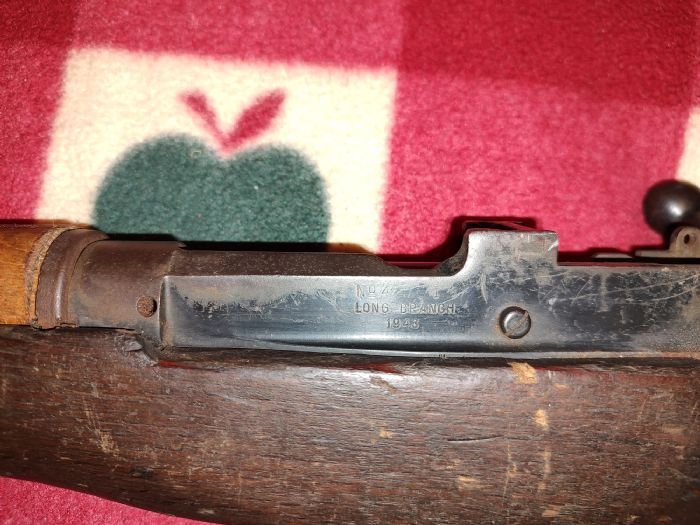   ------------- Collector of guns no one else wants. |
Replies:
Posted By: SW28fan
Date Posted: February 22 2025 at 6:44pm
|
he!!o The bolt heads come in different sizes to adjust headspace. There could be another issue come you show us a picture of just the bolt. I was in the Navy from 81-85 on an old Charles F Adams Class DDG ------------- Have a Nice Day If already having a nice day please disregard |
Posted By: NavyGeo
Date Posted: February 22 2025 at 7:56pm
|
SW28fan, I served on the Belleau Wood 85-88. The bolt only goes in one way due to the very long lug that's at 12. The bolt handle makes contact with the back of the receiver before this lug clears the area enclosed by the stripper-clip guide. Because of this I can't turn the bolt. It seems like the bolt is for a different SMLE. ------------- Collector of guns no one else wants. |
Posted By: britrifles
Date Posted: February 23 2025 at 3:27am
|
A few things. First, there is no cocking piece at the back of the bolt, probably no striker (firing pin) either. The bolt handle looks wrong for a No. 4. Something looks wrong at the bolt head too (is there a bolt head)? Take a few photos of the bolt, you may have a bolt body for the No. 1 SMLE and not the No. 4. They are not interchangeable. The action body needs to be cleaned really well, especially the areas where the bolt locking lugs engage and the bolt raceway. Looks like years of accumulated crud. Also missing the rear sight. |
Posted By: Sapper740
Date Posted: February 23 2025 at 4:56am
| Welcome to the forum and thank you for your service. First up, let's clean up the nomenclature a little: the SMLE is the predecessor to the No.4 rifle so your rifle, being made at Long Branch is a No.4 Mk I*. The * is important as the method of inserting and removing the bolt is slightly different. To ease manufacture No.4 MkI * rifles had the depressable "button" removed and a simple gap in the bolthead groove machined. I don't know if the difference would prevent a No.4 MkI bolt from being placed into battery on a No.4 MkI * rifle as I've never tried that. I'll give it a shot later today and report my findings. |
Posted By: Honkytonk
Date Posted: February 23 2025 at 7:09am
| Just a thing that caught my eye. The safety lever looks like an older style than I've seen on my No4's. |
Posted By: NavyGeo
Date Posted: February 23 2025 at 7:51am
|
he!!o, and thank you each for your inputs so far. The bolt was sold to me "stripped"; there is no front piece, cocking piece, or any other parts other than the bolt body. I've taken some more photographs which I hope will help all of you help me! The title of the GunBroker advertisement was "Enfield SMLE No.4 stripped Bolt"; there was no further amplification within the 'item description' portion of the advertisement. 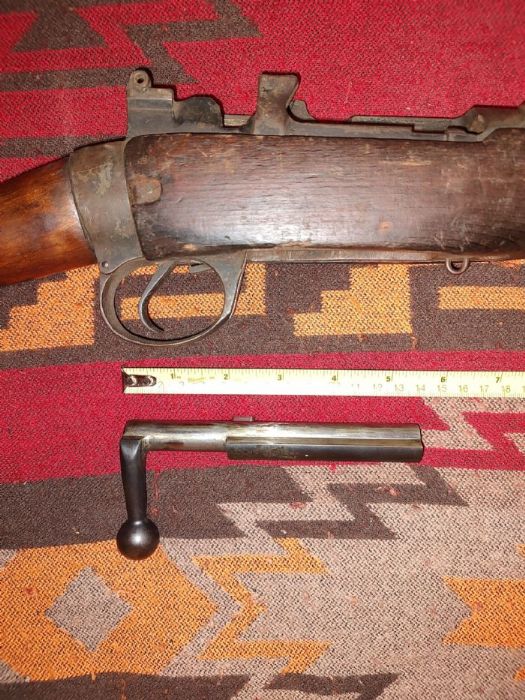 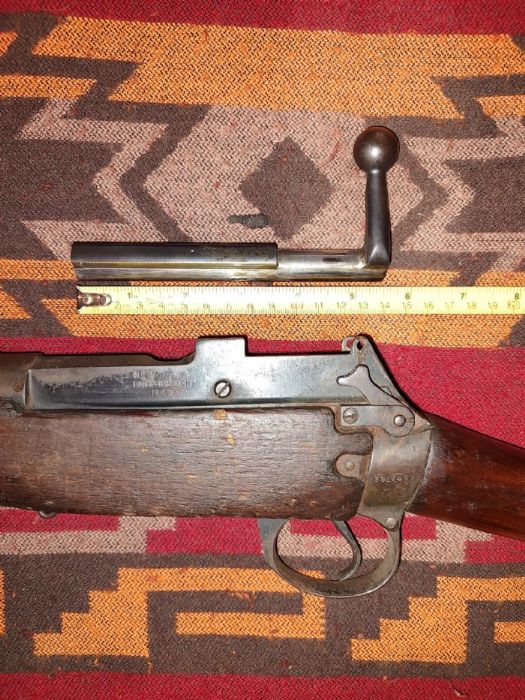 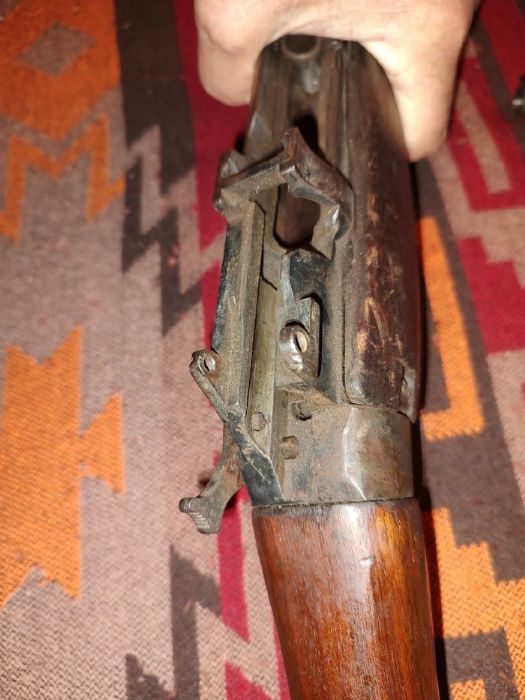 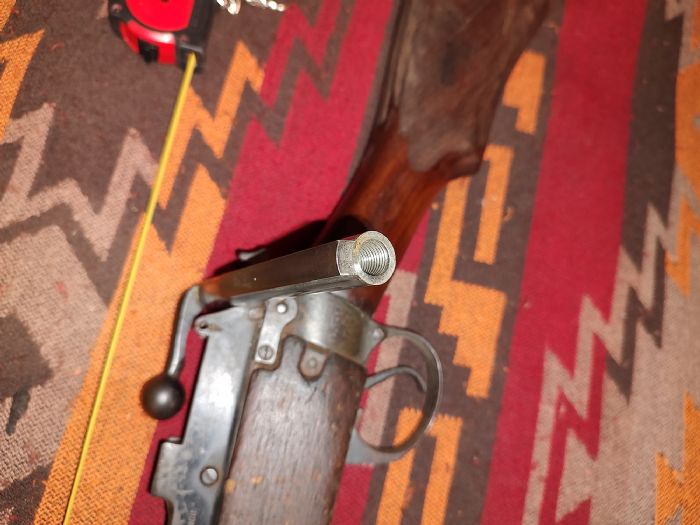 The safety lever simply rotates a horizontal pin with a cutout under the bolt, which would appear to act both as a safety and to prevent bolt removal. ------------- Collector of guns no one else wants. |
Posted By: DisasterDog
Date Posted: February 23 2025 at 7:58am
| The solid rib points to it being a MkIII bolt. |
Posted By: Zed
Date Posted: February 23 2025 at 10:58am
|
That is very odd. I think we need to get some accurate measurements from a selection of our members rifles and compare. The only thing that Looks like a possibility from these photos, that I can see. The long lug doesn't seem to have that slight bevel on the leading edge of the contact surface. Could it be that the bolt was not finished properly? It's a long shot, but something isn't right. ------------- It's nice to be important, but it's more important to be nice! |
Posted By: Shamu
Date Posted: February 23 2025 at 12:40pm
|
The Nomenclature can be confusing which may explain whats going on. The NO4 Mk(1, 1*, or 2) are NOT SMLE's I'd avoid using that term particularly when ordering parts if I were you. I have a no4 & a SMLE (aka No1 MkIII) I can pull the bolt from the SMLE & see what happens when I try it in a No4 Give me a day or two
------------- Don't shoot till you see the whites of their thighs. (Unofficial motto of the Royal Air Force) |
Posted By: Shamu
Date Posted: February 23 2025 at 1:59pm
|
OK, pics: First the good news, we've identified the problem.  Now the bad news you have a No1 Bolt & it won't fit in a No4 rifle  I took the bolt for one of my SMLEs, removed the head & tried fitting it to my No4 Mk2, It wouldn't even begin to enter with the head fitted. Removing the head it exactly replicated your problem. Stopped short & bolt handle wouldn't roll down fully.  Couple of views of the 2 bolt types, No1 at top, No4 below.   ------------- Don't shoot till you see the whites of their thighs. (Unofficial motto of the Royal Air Force) |
Posted By: britrifles
Date Posted: February 23 2025 at 3:51pm
|
Yup, that’s what I thought, it’s a No. 1 (SMLE) bolt body. See if he will take it back. You will need to find a No. 4 bolt with all the associated bits to make the complete bolt assembly. The bolt will need fitting to the action and checked for headspace. |
Posted By: NavyGeo
Date Posted: February 23 2025 at 4:40pm
|
Well that's a bit of a setback, but I am ever positive. Thank you all who've helped so far. Oh, and if anyone has any bits-n-pieces I can use I would appreciate a word. I'm sure the rules would prefer such communications not be in this thread/forum, but I figure a PM is ok. Again, thanks! ------------- Collector of guns no one else wants. |
Posted By: NavyGeo
Date Posted: February 24 2025 at 8:32am
|
Some good news. It looks as if I can get some of the parts I need from Liberty Tree, Numrich, and SarCo. Thanks to SW28fan for making that suggestion! Not knowing much of the history of my particular piece, I will look for either old-issue ammunition or I'll reload with black powder. I do that for my rescued Winchester 94 in .32 Winchester Special. It was a ball of rust when I rescued it from a barn in Alabama years ago. It runs black powder just fine. ------------- Collector of guns no one else wants. |
Posted By: Enfield trader
Date Posted: February 24 2025 at 2:45pm
| It a Long Branch made safety lever |
Posted By: Enfield trader
Date Posted: February 24 2025 at 2:48pm
| No difference in the bolt - bolt heads are a little different due to the No4 MKI* bolt head it removed at the cut out of the rail. The bolt heads for that take down type is chamfered where the bolt head slides in the rail. |
Posted By: Honkytonk
Date Posted: February 24 2025 at 2:50pm
| Thanks! Did not know that. Did all Longbranches have that style? |
Posted By: Enfield trader
Date Posted: February 24 2025 at 2:50pm
| Send me a PM |
Posted By: britrifles
Date Posted: February 24 2025 at 3:41pm
I don’t think this is correct. The threads on the bolt for the bolt head are different, and are recessed into the end of the bolt body for the No. 4. The length of the long rib lug is different. The distance between the long lug and bolt handle is different. I was not able to lock a No. 1 bolt body into my No. 4 just like the OP found. |
 Enfield trader wrote:
Posted By: Enfield trader
Date Posted: February 24 2025 at 4:59pm
| My reply was no different between a MkI or MKi* No4 bolt |
Posted By: britrifles
Date Posted: February 24 2025 at 5:49pm
| Sorry, I thought you were comparing the No. 1 and No. 4 bolts. And you are correct, the bolt heads have the leading and trailing edges of the rail slot chamfered so that the bolt head can jump the slot in the rail without fouling. No other difference. I’m not even sure the bolt heads are identified by a different mark. When I fit a new bolt head to a Mk I*, I add the chamfer with a Dremel tool. |
Posted By: Shamu
Date Posted: February 24 2025 at 6:01pm
|
On this thought be careful when building up a bolt. The SMLE threads are different from the No4 ones! You can use a No1 cocking piece, firing pin lock screw & striker in a No4 bolt, BUT they must ALL be No1 parts because of the thread differences. I don't think any other parts are interchangeable though. ------------- Don't shoot till you see the whites of their thighs. (Unofficial motto of the Royal Air Force) |
Posted By: Enfield trader
Date Posted: February 24 2025 at 6:38pm
| I haven’t seen different designations for the bolt heads |
Posted By: A square 10
Date Posted: February 24 2025 at 7:58pm
|
"......ea enclosed by the stripper-clip guide. ,,,,,," ahhhhhhhhhhhh tony alert , please use correct nomenclature - its a charger guide , the strippers are in the strip clubs dancing on poles , they have no place on a proper enfield
|
Posted By: britrifles
Date Posted: February 25 2025 at 3:24am
You can certainly do that, but be aware that much of the .303 Mk 7 service ammunition is corrosively primed. And as far as I know, there is no Rosetta Stone for determining which are non-corrosive and which are not, so best assume it is corrosive primed and clean accordingly. Black powder is also an option, but unless you just like all the smoke and mess, use nitrocellulose loads. The No. 1 and No. 4 rifles were never used with black powder, only the very first long Lee Metford. Your best bet for reloading is to get new PPU cases and load .311 - .312 diameter jacketed bullets. Medium burn rate rifle powders such as IMR 4064, 4895, Re 15, Varget, N140 and many others are suitable for the .303 British. |
Posted By: NavyGeo
Date Posted: February 25 2025 at 7:30am
Well, I can honestly say that I observed a wild Stripper with an Enfield in a show in Vancouver, B.C. many years ago as a young...stripper-oriented...sailor! I'm sure it was a de-militarized one of course...but she knew the Order of Arms quite well!
------------- Collector of guns no one else wants. |
Posted By: NavyGeo
Date Posted: February 25 2025 at 7:34am
Thanks very much for some pertinent ammunition information! I was actually looking at some inexpensive Ishapore ammunition until you posted this. I'd rather find spent casings, prime them with good primers, then load them with the IMR. I used to have a Lyman and a Hornaday loading manual from the early '70s. I'm sure they'll have some loads. My goal is to stay well above "Squib" level and well below "Max-Pressure" level so as not to stress my Long Branch. ------------- Collector of guns no one else wants. |
Posted By: Honkytonk
Date Posted: February 25 2025 at 12:12pm
| Might wanna hold off on used really old loading data. Powders have made some "improvements" over the years and the same make/model powder now with old loading data weights might create excess breech pressure. |
Posted By: britrifles
Date Posted: February 25 2025 at 1:05pm
^^^^^ THIS And, you can get current load data online. The Hodgdon website lists load data all the powders they distribute, including IMR, Winchester, Accurate and Ramshot. Most all powder manufacturers have a website with rifle load data. |
Posted By: NavyGeo
Date Posted: February 25 2025 at 1:17pm
|
Thanks honkeytonk and britrifles. I hadn't thought of the difference in modern smokeless vs. vintage smokeless. ------------- Collector of guns no one else wants. |
Posted By: Rossfield
Date Posted: April 09 2025 at 8:56am
|
Do not try to fire the rifle until the new bolt has been properly lapped in to the lugs in the receiver. I
built myself a somewhat crude but effective machine to accomplish that
task, but it can be done by hand. Put a fired case in the chamber and
find a coil spring about the same diameter as the bolt or a little
smaller. I use a piece of plastic inserted into the bolt body threads a
guide for the spring. The purpose of the spring is to provide equal
backward thrust on the bolt while by hand you work the lever up and down
until the lapping compound you put on the recoil lugs shows that the
contact on all four surfaces is even and as large as it can be. My
machine does the up and down part for me. After
the bolt is lapped in, HS gauges will be needed also. Lap the bolt
head face on a suitable flat with emery paper, then fit and test the
squareness of the bolt face to the rear face of the no-go HS gauge with
blue or a permanent marker etc. You need full, even contact across the
face of the bolt and the face of the HS gauge. This will show whether
the bolt head is square to the chamber. The
bolt head should not turn past the long recoil lug more than 12 degrees,
but of course there is some leeway in that, depending on how effective
you want your primary (as the bolt handle is lifted) extraction to be. ------------- Treason doth never prosper; what's the reason? Why if it prosper, none dare call it treason. |
Posted By: britrifles
Date Posted: April 09 2025 at 10:57am
|
Is anyone aware of any surviving production engineering drawings or assembly process/procedures of Lee Enfield rifles that might put some light on the subject of obtaining equal bolt lug contact and bolt head squareness? Or any "instructions to armorers" on this? I've always assumed this is a requirement, but never seen it addressed in any armorer's maintenance/repair instructions I've seen. We do know that bolt bodies are stamped with the serial number fitted to the rifle, so we assume that must mean they had to be "fitted" to that particular rifle action body. But, I doubt bolt heads were checked for squareness to the back of the barrel; and if they were, doesn't necessarily mean they are square to the bore as a headspace gage can tip inside the chamber until it seats flat on the back of the barrel. |
Posted By: A square 10
Date Posted: April 09 2025 at 11:20am
|
Posted By: Shamu
Date Posted: April 09 2025 at 11:52am
|
There are "fitting instructions for armourers (sp)" from back in the day that mention this. The Canadian manuals also detail the process. Let me dig through my manuals & see if I can copy/paste them.
------------- Don't shoot till you see the whites of their thighs. (Unofficial motto of the Royal Air Force) |
Posted By: Rossfield
Date Posted: April 09 2025 at 12:11pm
|
Good questions. The squareness check is the method Peter Laidler taught me and since he was a long-serving British armourer I take that to be the service method. The original factory process is one of those questions someone should have asked the people that worked there when they were still around to ask. I haven't noticed anything in the wartime films that suggests the methods used, but could be I just didn't notice when I saw those films. ------------- Treason doth never prosper; what's the reason? Why if it prosper, none dare call it treason. |
Posted By: Shamu
Date Posted: April 09 2025 at 2:53pm
|
Copied from elsewhere. I think this covers it in detail. "Notes from Peter Laidler (from 2007) The notes primarily relate to the No4 rifle but the methods are specifications are the same. First things first. Bolts could only be fitted at Field and Base workshops because they were the only ones that had a 'GAUGE, Inspectors, Bolt'. This is a brand new, calibrated bolt. Still in white metal and marked as such. If my memory serves me right, the slot in the long/top locking lug is machined right through to identify it. So that's the reason if you have ever seen one. This bolt is bare. Clean the locking lug surfaces of the rifle and put a smear of 'engineers blue' marking dye onto the corresponding locking surfaces of the inspectors bolt. Insert this bolt RIGHT FORWARD, rotate it closed, then draw it backwards and forwards a couple of times to mark the mating locking surfaces of the rifle. Push it forwards, unlock and remove. Examine the locking surfaces of the rifle. The blue witness marks should be evident. This ensures that whatever wear that has taken place on the rifle locking surfaces has taken place equally. If its not, then I'm afraid that the rifle is unserviceable. BUT, that's not quite the end of the story because you won't have this 'Gauge, Inspectors, bolt' but it's only right that I tell you. Now for a little secret. If you have ever bought a rifle that has a sploge of red paint on the left side, adjacent to the internal left side locking lug, then you now know that the rifle was condemned for 'worn locking lugs'. If you are going to fit a second hand or new bolt, then do the same thing. If the dye pattern is one sided, then stone the high surface of the bolt until BOTH locking lugs bear evenly against the locking surfaces of the corresponding surfaces in the body. BUT DO NOT ATTEMPT to stone the rifle to get a bolt to fit (you can only get to the right hand surface in any case ....). The rifle body is induction hardened at these points to a depth of .004 - .006" but we have found it deeper. Now that you have got the bolt fitting, with the locking surface bearings matched, it's time to fit a bolt head. Any one will do. Screw it into the bare bolt and test the CHS against the .064" GO and .074" NO GO gauges. Disregard the numbers on the bolt head or treat them as a bit of a rough and ready guide but not as the bee all and end all of life as we know it! Once you have got a fitted bolt, with CHS, we'll come onto bolt head overturn. The bolt head should not overturn the long/top locking shoulder by more than 16 degrees but if you have a No4T or L42, it should not overturn buy more than a 'few' degrees. Mine were always 'in line' through selective fitting but you won't have a big tray of bolt heads to select from! The reason for this is because over a 'few' degrees (it doesn't define 'a few' but use 2 or 3 as your MAX), the recoil is taken on the bolt head and bolt threads. That is OK, but on an accurate No4T and L42, we want the recoil to be taken on the face of the bolt and transmitted radially, down through the bolt head and onto the front flat surface that mates up to the bolt head. Got it? Now we have a correctly fitted bolt AND bolt head AND CHS. That wasn't painful was it? During the week, we'll go into striker protrusion, bolthead lift and anything else. But before we do, I want you to get your strikers and roll them along a flat surface (overhang the collars of course) and sift out the bent ones because they're going to cause you trouble. It's always the 1/4" BSF threaded end that's bent and you can only TRULY straighten them if you have access to a lathe. ------------- Don't shoot till you see the whites of their thighs. (Unofficial motto of the Royal Air Force) |
Posted By: britrifles
Date Posted: April 09 2025 at 3:26pm
|
Thanks Shamu. Have you ever seen this in any actual technical orders/instructions to armorers? I wonder if this was really done during wartime production, it takes quite a bit of hand work. On two of my No. 4 rifles that I checked for equal lug contact, both having the original bolts, both of them showed very little contact on the short lug. I wonder if that was intentional as this is the weaker lug. |
Posted By: NavyGeo
Date Posted: April 25 2025 at 8:11am
|
he!!o everyone. First, thank you all for providing suggestions, advice, and outright education. Second, I've been able to source everything this gun is missing with the exception of a magazine. The bolt is not Canadian, but it functions. I attempted to use wood filler on the 'practice checkering' areas of the stock; that didn't do much for the appearance. I'm reaching out to some leatherworkers on line in the hopes that one of them will make me a 'wrap' to cover up all that ugliness. I would rather do that then replace what I believe is a period-correct(if not outright original fit) stock. I'm also looking into finding some heavy duck canvas that I could use to make my own cover. Once I have this old Service Rifle back together I'll post some photographs in a new thread. Rick ------------- Collector of guns no one else wants. |
Posted By: Shamu
Date Posted: April 25 2025 at 12:13pm
|
I remember reading it in one of my old period original pamphlets. (I have a bunch of them as .PDFs) But I cant find which one. Was it done in service? No idea. If it was it would be a base workshop task I'd imagine though. If actually find the paragraph in the right pamphlet I'll post it.
------------- Don't shoot till you see the whites of their thighs. (Unofficial motto of the Royal Air Force) |