Culling Cartridge Cases
Printed From: Enfield-Rifles.com
Category: Reloading
Forum Name: Reloading .303 British
Forum Description: Enfield-Rifles.com accepts NO responsibility for any loads that may be used by persons reading this forum. USE CAUTION WHEN TRYING ANY NEW LOADS!!! ANY DATA DEEMED UNSAFE WILL BE REMOVED!!!
URL: http://www.enfield-rifles.com/forum_posts.asp?TID=14124
Printed Date: March 26 2026 at 2:51pm
Software Version: Web Wiz Forums 12.07 - https://www.webwizforums.com
Topic: Culling Cartridge Cases
Posted By: britrifles
Subject: Culling Cartridge Cases
Date Posted: August 25 2025 at 9:45am
|
In an effort to reduce muzzle velocity Extreme Spread (SD) and Standard Deviation (SD), I've been setting aside cartridge cases that gave large velocity deviations (either low or high muzzle velocities) recorded by my Garmin Chrono. These shots without exception resulted in high and low POI on the target at 600 yds. This seems to have improved the ES with corresponding reduced elevation spreads at 600 yards. I've not found any improvement by sorting cases by weight. But I am seeing significant reductions in ES and SDs by doing the above. I had a 10 shot group this weekend with an ES of just 18 fps and SD of 6 fps. That's the lowest I've ever recorded on my .303 handloads (for 10 shots). Gone is the occasional very large ES values of 100 fps. 50 fps is now the highest I recorded since culling the brass. I've now set aside about 15% of the batch of 200 cases I was working with. Has anyone else tried this approach, and has it worked for you? 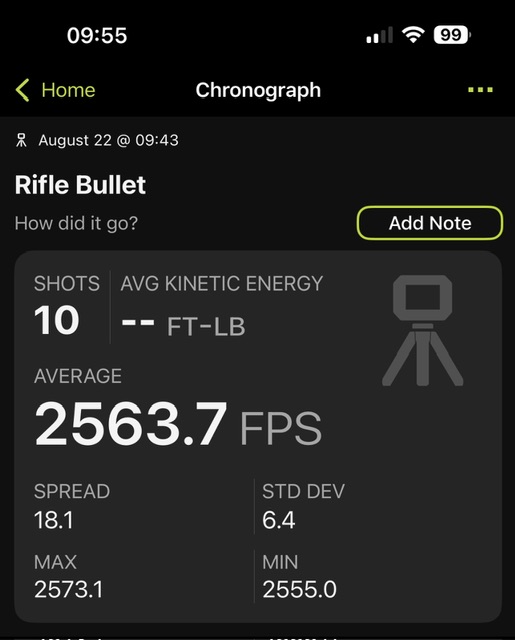 |
Replies:
Posted By: Shamu
Date Posted: August 25 2025 at 10:46am
|
Maybe check volume by water? ------------- Don't shoot till you see the whites of their thighs. (Unofficial motto of the Royal Air Force) |
Posted By: britrifles
Date Posted: August 25 2025 at 11:04am
|
Good thought, I will check that. I'm guessing that since they all have the same external dimensions (neck sized only for last 7 firings) and all very close in weight, may not be much difference in internal volume.
|
Posted By: Shamu
Date Posted: August 25 2025 at 3:01pm
|
I did this a while back when someone was going on about HXP I think being very variable. I weighed a bunch then wet tested for volume with tap water & a drop of dish detergent per quart to minimize the meniscus. Let me see if I still have the records. Yep! Rating .303 British cases by manufacturer for critical specs. These are the average from 5 sample cases.
The tests produced a bit of interesting myth busting again (“Thinner than normal” American made cases & thinner rimmed cases from Rem. & Win.), & a couple of inconsistencies. I expected case weights to be the exact inverse of case volumes, but it wasn’t so. I expected so I wouldn’t be as concerned with the volume results as I would with the weight, rim thickness & variations in those 3 areas.
Case weight. Remington lightest @ (161.04 GR). Win 2Nd. @ (168.0). S&B 3Rd. @ (180.62). PPU 4th. @ (182.38). HXP Heaviest. @ (184.62).
Case volume of water. Win smallest @ 53.28 Gr. HXP 2Nd. @ 53.78 Gr. Rem 3Rd. @ 54.6 Gr. PPU 4th. @ 55.54 Gr. S&B largest @ 55.95 Gr.
Rim thickness. S&B Thinnest with 0.0555”. Rem 2Nd. With 0.0586”. HXP 3Rd. with 0.0600”. Win 4Th. With 0.0607”. PPU Thickest With 0.0608”.
Case to case variations. Weight: Win lowest @ 0.4 GR. Rem next @ 1.5 Gr. PPU 3Rd with 4.1 GR. HXP 4 Th. With 11.3 Gr. S&B last with a whopping 18.3 Gr.
Volume: HXP lowest with 1.2 Gr. Rem 2Nd at 1.8 Gr. Win 3Rd. at 2.7 Gr. PPU 4Th. At 3.1 Gr. S&B highest @ 3.9 Gr.
Rim thickness variation. PPU, Win & Rem in a dead heat for least variation @ 0.0030” between. HXP 2Nd at 0.0045” S&B 3Rd. with 0.0050”.
------------- Don't shoot till you see the whites of their thighs. (Unofficial motto of the Royal Air Force) |
Posted By: A square 10
Date Posted: August 25 2025 at 7:04pm
| one has to be p[icky when reloading |
Posted By: Sapper740
Date Posted: August 26 2025 at 5:14am
| It's always the Delta that has been considered the enemy of accuracy. Smaller differences in case volume or weight has been always been the Gold Standard for decades. Without getting into the finer details such as primer hole consistency, case mouth concentricity, or neck tension one would think that HXP is a good candidate from what Shamu has found. I've only just recently fired enough of the recent batch of surplus Greek ammunition to bother reloading so it will be interesting to see how some of the accurate recipes I've worked up fare in HXP brass. |
Posted By: britrifles
Date Posted: August 26 2025 at 6:55am
|
To get a statistically meaningful distribution, you probably need to take a sample of at least 20 cases, especially to get some idea of the extreme spread of variations in weight, volume, neck thickness, etc. For grins, I'll check the case weight and volume on the 20 or so PPU cases I put aside (those that gave high and low bullet velocity). They have been neck sized 7 times now (since the last P/L resize) so external dimensions should be very close to being the same. I'll need to first trim them to the same length in order to measure volume. I will also reload the cases I put aside again to confirm that it is the cartridge case that caused the large bullet velocity spreads. I can try and predict which cases will give low velocities and which cases will give high velocities based on weight and/or volume measurements. If I can, then it would be possible to screen these cases out by taking these measurements. |
Posted By: Shamu
Date Posted: August 26 2025 at 2:28pm
|
Yes, I agree its a small sample. But it was based on what "spare brass" from each brand I had available so I standardized it at 5 just to be consistent. The big surprise was the volumes not matching the weight differences. Thicker case less volume thinner case more. Thinking about how cases are made I wonder where the variations come from. They all start out as a brass disk, then they're progressively drawn out, trimmed back ,drawn out again, primer hole punched & primer pocket swaged, necked down then trimmed to Max OAL. I couldn't decide if progressive drawing die wear, or initial plug thickness/volume determined the variations. ------------- Don't shoot till you see the whites of their thighs. (Unofficial motto of the Royal Air Force) |
Posted By: britrifles
Date Posted: August 26 2025 at 5:56pm
|
I weighed 10 PPU cases that I had put aside that caused high or low muzzle velocity and vertical fliers at 600 yds after trimming them to the same length. The empty case weight spread (max - min) was 4.9 grains. That’s a fair amount. I then weighed the same cases filled with water and subtracted the empty weight. Max spread was just 0.8 grains of water. That seems quite good and considerably less than the spread of empty case weight. I don’t think we can tell anything by weighing cases. I plan to let the chrono and target decide which cases cause fliers. |
Posted By: Zed
Date Posted: August 27 2025 at 3:45am
|
There are so many variables! After resizing the brass, do you clean it to remove the lubricant? I was thinking that a difference in residual lubricant in the neck, could affect the launch of the projectile, as would a change in neck tension. Also if the thickness of the brass around the neck is different, it will alter the tension. I think you could easily go nuts chasing every variable, but it's very interesting to see your experiments and results. ------------- It's nice to be important, but it's more important to be nice! |
Posted By: britrifles
Date Posted: August 27 2025 at 5:54am
|
Agree Shaun. Cases that get F/L or P/L resized are tumbled to remove the lube. I've been using a wet tumbler for the last few years. I neck size the .303 cases with a Lee Collet die, so no lube required. After 8 to 10 neck sizing reloads, I then do a P/L resize to bump the shoulder back a few thou. My plan is to reload these 30 cases I've set aside and see what ES and SD they produce. If I'm right, those 30 cases will have an ES of around 100 fps and confirm my suspicions. |
Posted By: Shamu
Date Posted: August 27 2025 at 9:04am
|
Sounds like a good test. ------------- Don't shoot till you see the whites of their thighs. (Unofficial motto of the Royal Air Force) |
Posted By: britrifles
Date Posted: August 27 2025 at 5:15pm
|
I weighed the remaining 15 cases (empty and filled with water) in the previously culled batch of 30 cases. The extreme spreads of the 30 cases were: Case weight empty 7.9 gr variation Volume (weight of water) 1.3 gr variation I’d guess that the variation in height of the meniscus might account for 0.3 gr, so really the volume variation was probably just 1 grain. That is surprisingly very tight considering nearly a 8 grain variation in case weight, which must primarily come from rim thickness variations (hard to measure). All cases had depth uniformed cut primer pockets and flash holes reamed and de-burred. So, it’s back to plan A, there is no practical way of determining which cases will cause large muzzle velocity variations except by loading them, firing and recording velocity. |
Posted By: A square 10
Date Posted: August 27 2025 at 10:10pm
| i always cull mine when i reload - even tho mine mean far less in the big picture than yours do , multiple inspections in the process and all single stage so there are a lot of steps in the process |
Posted By: Shamu
Date Posted: August 28 2025 at 9:54am
|
That tallies with what I found. There seems to be no direct correlation between case weight & capacity! ------------- Don't shoot till you see the whites of their thighs. (Unofficial motto of the Royal Air Force) |