Smallest size for "the O-Ring Trick"?
Printed From: Enfield-Rifles.com
Category: Enfields
Forum Name: Enfield Rifles
Forum Description: Anything that has to do with the great Enfield rifles!
URL: http://www.enfield-rifles.com/forum_posts.asp?TID=14413
Printed Date: March 26 2026 at 4:31pm
Software Version: Web Wiz Forums 12.07 - https://www.webwizforums.com
Topic: Smallest size for "the O-Ring Trick"?
Posted By: Rick
Subject: Smallest size for "the O-Ring Trick"?
Date Posted: February 07 2026 at 11:33pm
|
A local guy who inherited a Lee Enfield was put in touch with me. He's done some reading to help himself get up to speed on the rifle. He's bought some commercial ammunition and intends to fire it with an O-ring above the rim to help with brass longevity. From what he told me, his rifle has a tight enough chamber that whatever O-rings he bought are too thick in cross-section so that he can't turn the bolt down to complete chambering the rounds with whatever size of O-ring he's attempting to use. I haven't seen either the rifle or the O-rings he's trying to use nor the ammunition. Anybody who uses O-rings with a relatively tight chamber have a size they use that is small enough that their rifle chambers the rounds once the O-ring is in place? We do have numerous open stock hardware stores around here that carry lots of O-rings.
|
Replies:
Posted By: Sauron
Date Posted: February 08 2026 at 9:52am
|
I would think 5/16" outer diameter ought to work, no? Why not just bring a spent case to your local auto parts store and eyeball it with the guy at the counter? Best, |
Posted By: Shamu
Date Posted: February 08 2026 at 9:52am
|
Get a bag of the hairdressers ones, they're a perfect fit.
------------- Don't shoot till you see the whites of their thighs. (Unofficial motto of the Royal Air Force) |
Posted By: Doco Overboard
Date Posted: February 08 2026 at 11:17am
|
I would use orthodontic elastics. They come in all sorts of differing sizes. 1/8th to about 3/8's diameters. And about 3-4 dollars for about a hundred of them.
|
Posted By: paddyofurniture
Date Posted: February 08 2026 at 12:02pm
| Good to know. |
Posted By: Rick
Date Posted: February 11 2026 at 10:09pm
Well, if they were okay with you bringing the rifle in along with the case to see if the case will chamber with the O-rings you're selecting from, that might work. I will pass on the hairdresser and orthodontist suggestions to buddy. He has a house full of the young Estrogen Mafia, so he may already have a source he wasn't aware of.
|
 Sauron wrote:
Posted By: Zed
Date Posted: February 12 2026 at 3:45am
|
To be honest, I've never bothered using them. If the head space is good, and you are reloading for one rifle, there's no need. You just resize the neck and bump back the shoulder if they get hard to close the bolt on. If you barely pass the "Field" gauge, then maybe it will help keep it centred on first firing. But even then I don't think it's worth the effort. Better to correct the headspace! ------------- It's nice to be important, but it's more important to be nice! |
Posted By: Rick
Date Posted: February 12 2026 at 8:56am
Headspace can be well within spec - even if you're using a more permissive "Field" gauge - and you are still going to get unnecessary stretching of your unfired brass when you first fire it. Or if you full length resize, continued stretching of the case until it prematurely fails. If you don't want that damaging stretching to occur at first firing, that can be prevented. I always start with new unprimed brass so I go the route of first creating a false shoulder so the brass is supported and centered at the false shoulder at the front as well as at the back against the bolt face. My rifle is a 1950 Long Branch that was unissued since manufacture. It has very tight headspace measurements and a very tight chamber. Despite that, look at the difference between where a formed false shoulder sits on the neck versus the factory shoulder on a piece of virgin brass awaiting the forming process: https://postimages.org/" rel="nofollow"> 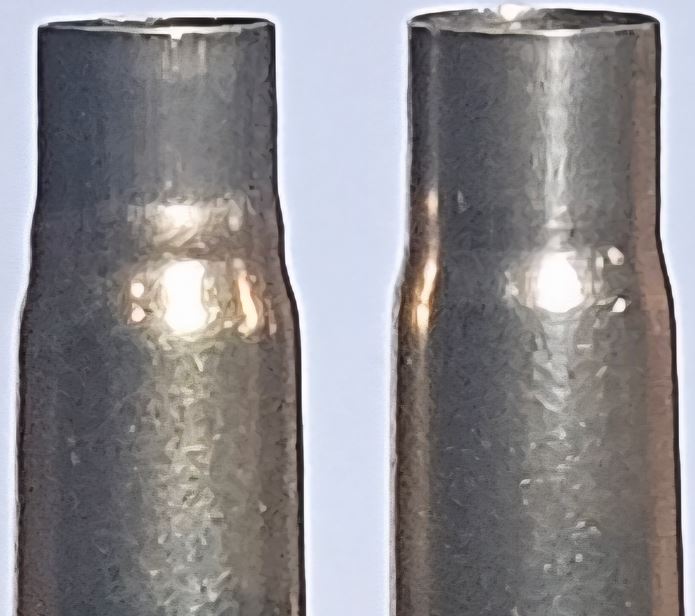 A set of verniers measures the beginning of that false shoulder as roughly .15" ahead of the shoulder on the unmodified brass. That's how far virgin brass in a very tight chamber is going to stretch forward on first firing if you don't use techniques to prevent it. You will see far worse with a worn surplus Lee Enfield - meaning far more case stretch. In his case, he bought factory ammunition. Few would pull the bullets and dump the powder in order to create that false shoulder and then finish by reloading the powder and bullet. I certainly wouldn't. So the O-Ring method is easy to minimize the damage that is done at that first firing of commercial ammunition.
I would agree with resorting to changing bolt heads and perhaps bolts as well as your first priority if the only gauge the rifle would pass was a FIELD gauge. Depending on the number on the bolt head in the case of a No. 4 rifle. If it's a "3" AND the only gauge it will pass is a FIELD gauge... that rifle is almost certainly done. And if it's a "2" and that gauge, that rifle is in sketchy territory as a rifle you hope to shoot a lot. Several texts and British armourers who are still alive have pointed out the armourers in third line maintenance in REME facilities never used a FIELD gauge. Or a #3 bolt head to return rifles to military service. When they were working on or FTR'ing a rifle, if they couldn't get it to properly headspace with GO-NOGO gauges using some combination of bolt and a #2 bolt head at the biggest, they considered the rifle's body to be worn out. If it was a rifle that came to me from my parents generations, I would keep, value, and shoot such a rifle. And few shooters will fire enough rounds to take a rifle that just gets by on a FIELD gauge even worse where headspace is concerned. But if I were going shopping for my first Lee Enfield, unless a rifle had some particular value, I wouldn't bother looking at anything having a "3" bolt head in use.
|
Posted By: Shamu
Date Posted: February 12 2026 at 9:46am
|
Technically that's not "Headspace"!  Anything further from the back end of the rim to 0.074" in front of it is "a Generous Chamber"  ------------- Don't shoot till you see the whites of their thighs. (Unofficial motto of the Royal Air Force) |
Posted By: Zed
Date Posted: February 12 2026 at 9:56am
|
Agreed, using a 3 bolt head to get inside the Field gauge, is telling us there's not much left in the receiver and bolt. However using a 3 bolt head to get the headspace down to 0.067" is worthwhile. One problem, if you have multiple.303 rifles, is keeping track of what case goes with what rifle. It means separate storage for the fired brass from each rifle, plus for the prepped brass for each rifle. Plus cleaning and prepping for each individual rifle. Having turned up at the range with a box of ammo that the bolt won't close on, because I picked up the box for a different rifle! Then I gave up on the idea. Prepping loads for 3 different rifles in the Service Rifle competition ( my wife completes with a No 4 Mk1/2.) can get even more time consuming. So currently I size the brass for the smallest chamber. Then it'll fit all the rifles. All the rifles have good headspace. I prepped 150 cases last weekend, should be loading them this weekend. Competition starting in March. Maybe when I retire, I will have time to do it for each one. ------------- It's nice to be important, but it's more important to be nice! |
Posted By: Shamu
Date Posted: February 12 2026 at 10:00am
|
Oh yes, absolutely. I actually have 3 setup tool heads for the Dillon RL 550b! One for each rifle.  ------------- Don't shoot till you see the whites of their thighs. (Unofficial motto of the Royal Air Force) |
Posted By: Rick
Date Posted: February 13 2026 at 9:08am
If that particular rifle had some sort of special collector or personal attachment, then I'd go for that - probably wouldn't be fired all that often by the owner. I worked on such a rifle many years ago for one of the local old timers (i.e. somebody younger than me now) who was devastated when Dominion ceased selling their heavy .303 British load. He knew in his bones that nothing less than a heavy bullet out of the trusty .303 British could reliably kill the local swamp donkeys he had been putting in the freezer for 50 years. I loaded .30 caliber 200 grain partitions after setting up cases, loaded a 100 rounds for him, and he went away to happily continue firing a few shots each year to shoot his moose until he was gone. The groups weren't that great, but the open base of those Partitions obdurated well enough to keep those bullets where they needed to go at the distances he was hunting moose and elk at. Stuff like that is worth it as long as the rifle is safe to use and rarely fired. For a person who intends to regularly be on the range with a Lee Enfield, that owner would be far, far better off putting that worn out rifle on the sales block and starting afresh with a different rifle. With the price of reloading components these days, putting another couple of hundred dollars into another rifle that at least has a great bore and headspace, never mind exterior physical condition, puts the shooter way ahead in the game.
As with all aspects of the reloading/shooting game, if there's more positives than negatives for that method, obviously that works for you. I don't have multiple .303s, but I do have numerous rifles where there are different loads that there are unique for the brass. The cleaning and prepping prior to loading is no different for any of that brass. For the Long Branch, there's the brass that is only used with mild cast bullet loads of about 1,000 fps for roaming the back 40, taking on bull gophers on walk 'n shoot pasture safaris. Loads like that are good for introducing kids to centerfire rifles as well (they start with the disadvantage that the stock is far too long). Then there's the performance cast bullet loads that are good enough for fullbore practice or competition in cast bullet matches. And then there's the centerfire brass. The same thing goes for my .35 Whelen and my wife's .358 Winchester. So there's similar instances of wanting to keep brass separate. The way I deal with it is mark from a machinist's paint pencil placed on the case. The citric acid case cleaning doesn't affect them and they usually last through the life of the case. Even if they all got dumped together it wouldn't take long to sort them out. There's probably other methods for segregating cases for different rifles or different uses in the same rifle. For me, I want the best out of each rifle for the intended purpose rather than the convenience of one resizing/loading process fits all. But if one size fits all provides the best grouping capability in all individual rifles without the additional step of precisely fitting the cases for each rifle, then I would probably do it the same way that you do.
|
Posted By: Rick
Date Posted: February 13 2026 at 9:21am
I have had my XL 650 practically since they were first announced while I was an obsessive PPC competitor. But I have always had a mental block about reloading centerfire rifle in it, other than the high volume 5.56mm loadings. All the fullbore 5.56 stuff gets processed through the Co-Ax, one at a time. I did go the extra mile of buying an aftermarket tool head that is set up with set screws to precisely hold the head in place. (I never bothered doing a before and after test to see if it actually improved the grouping ability of the load I was using). I just can't shake the belief that if I want precision results out of a rifle with reloads, it has to be a precision, one step at a time, handloading process. I am pretty sure I am wrong about that, but it is a mental block. Could save myself a lot of time if I was turning out my 22-250 loads for sod poodle trips on the Dillon, rather than one at a time on the Co-Ax. Two hundred shots a day over a few days amounts to a lot of ammunition and a lot of time standing in front of a reloading press. And a Lee Enfield isn't in the same ball park as a quarter MOA custom barrelled varmint rifle.
|
Posted By: Shamu
Date Posted: February 13 2026 at 11:04am
|
I hear you. I admit I de-prime & clean primer pockets off press because of the Dillon's primer system. Somewhere on here a ways back,probably in "reloading" I did a comparison test between "match loaded",& "Standard-loaded" ammunition. Base on those test results I felt confident enough to, use the 550b for reloading the .303. BTW the Dillon's head is designed to "float". Some 200yd targets in support of my contentions.     ------------- Don't shoot till you see the whites of their thighs. (Unofficial motto of the Royal Air Force) |