Dads treasure
Printed From: Enfield-Rifles.com
Category: Enfields
Forum Name: Enfield Rifles
Forum Description: Anything that has to do with the great Enfield rifles!
URL: http://www.enfield-rifles.com/forum_posts.asp?TID=14502
Printed Date: March 26 2026 at 1:20pm
Software Version: Web Wiz Forums 12.07 - https://www.webwizforums.com
Topic: Dads treasure
Posted By: Omp1973
Subject: Dads treasure
Date Posted: March 24 2026 at 7:40pm
So is it strange that the receiver serial (D) prefix doesn’t match the number on the bolt handle nor the one under the bolt ? This Lithgow is immaculate so I’m pretty suspicious. No import makes I can find . 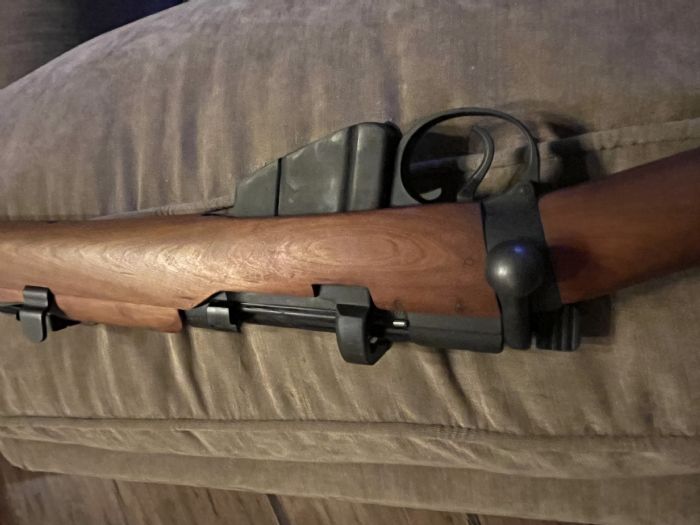
|
Replies:
Posted By: Shamu
Date Posted: March 25 2026 at 9:32am
|
UNDER the bolt handle is not a Serial Number. That is on the rear face of the bolt handle. Its an "Assembly Number" kind of temporary in-house Serial to keep bolt & receiver together during manufacture. ------------- Don't shoot till you see the whites of their thighs. (Unofficial motto of the Royal Air Force) |
Posted By: Zed
Date Posted: March 25 2026 at 11:30am
|
An immaculate rifle with a mismatched bolt is not normal! Are you sure that there isn't a small JJ Co stamp on the RH side of the receiver, between the bolt and the charger bridge? I ask, because J Jorinco Co bought up most of the Lithgow stock and parts, which were then imported to the USA. So while some of the rifles were complete and all original, others may have been completed after importation. Either that or someone has swapped the bolt, by accident or deliberately. ------------- It's nice to be important, but it's more important to be nice! |
Posted By: Omp1973
Date Posted: March 25 2026 at 11:44am
| I will take another look but I have been unable to find any importer stamp . |
Posted By: Shamu
Date Posted: March 25 2026 at 11:51am
|
^^^ This too. A small correction to Zeds post. The importer was J.J. Jovinio & Company, NYC. Their stamp was "JJ&Co NY". That would be the pre 1968 import marking. It may be alternatively found in the cutout for the lower hand-guard at the breech end, just behind the rear sight, or even hidden inside the opening in the nose-cap on the part of the barrel visible.  Is there a DIFFERENT prefix, or just no Prefix? That would be pretty normal! my Minty one has no letter prefix on the bolt handle but the digits of the number match. I've spoken to The Lithgow Factory Museum & they tel me this was normal.  A "D" prefix would be a 1941~42 manufactured Possibly at the Orange Arsenal plant & those will have some "OA" markings. The barrel, receiver rear face of the bolt handle & possibly the nose-cap's bayonet boss & magazine floor-plate, should all have matching ones or buyer beware.
 ------------- Don't shoot till you see the whites of their thighs. (Unofficial motto of the Royal Air Force) |
Posted By: Omp1973
Date Posted: March 25 2026 at 7:20pm
|
Craaaapppp. Just found the JJ Co behind the rear sight!!! So is this worth anything ? It’s absolutely beautiful, and is there anything I should do to “fix” it to make it a shooter ? Bolt and action do match . Barrel is pristine . Thanks for the help on this one , I don’t have the heart to tell my dad it’s not a “un issued” SMLE . |
Posted By: DisasterDog
Date Posted: March 25 2026 at 9:21pm
They also stamped on the RH charger bridge base, behind the rear sight (by the HV stamp), or occasionally on the muzzle end of the barrel inside the RH nosecap “window”. The metal finish does have that kind of “JJCo black” look to it, but better pics are needed all around to make any determination.
|
 Zed wrote:
Posted By: Omp1973
Date Posted: March 26 2026 at 4:32am
| Yes, without a doubt it’s a JJ Co import . Upon further inspection the bolt and receiver ring match . I saw the assembly number and was focused on that . |
Posted By: Omp1973
Date Posted: March 26 2026 at 8:23am
|
Pictures! Can anyone decipher what the markings here are ? 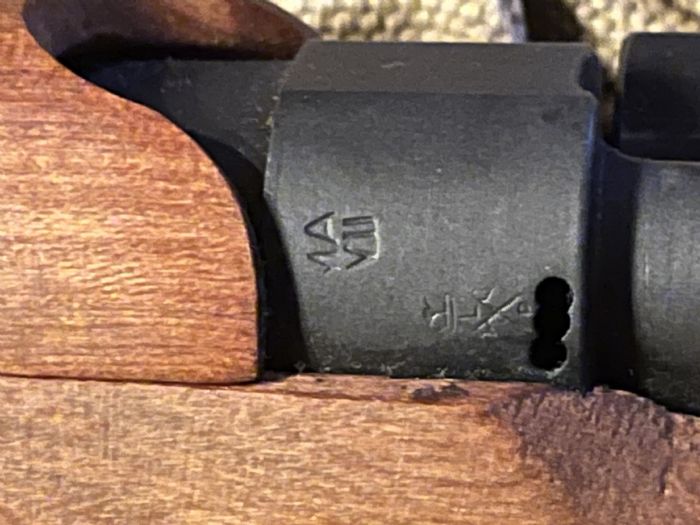 |
Posted By: Shamu
Date Posted: March 26 2026 at 8:58am
|
The MA is the code for Lithgow's main factory. As opposed to one of the annex factories Like Orange Arsenal. VII indicates the breech is the one for current Mk VII (7) ammo. The other one is a proof-mark. Now, OK Its a Jovino IMPORT. That does not mean it's a Jovino "Bitster" thrown together in NYC by drunken monkeys! It may be a genuine Lithgow built SMLE simply IMPORTED by Jovino's. Things to check: & some responses to my checks from a Aussie Owner familiar with Lithgow made rifles. "Items
addressed below in red:The
rifle arrived at the LGS so I was able to handle & check it out
personally. No
pics as yet & I have to wait till maybe next Thursday, (which
means Saturday), to pick it up because of the distance. & the 3
day wait is now 2+3 "working" days one for the FFL &
the other for me.
Go figure!
Good things: The recoil plates ARE fitted I could see them with a flashlight & a bit of a contortion. Tick! The wood is nowhere as dry looking as it appears in the pictures I was sent. Tick! There's more visible grain coloration than shows in those pics. Tick! The matching assembly numbers are on the bolt handle bottom & left upper rear of the receiver. Tick! The bore looks "minty" Tick! The bolt face, while not "unfired", is only lightly marked. Tick Bolt overclocking is tight, maybe 2~3 degrees only. Tick! Striker protrusion looks about right, couldn't measure though.Tick! Stock fit to butt socket is good with tight & full contact. Actually all the wood to metal looks good. Tick! I can not find a "JJ&Co" stamp anywhere even with a light & a lupe Tick! Dubious things: Odd semi-matching serial #! The bolt serial #, doesn't look like it ever had a prefix, or suffix letter, & the receiver's "B" prefix looks separately stamped from the digits. Not unusual. I've seen rifles that never left Australia with similar abbreviated serial numbers. The thinking seems to have been what are the chances of A12345 body having a B12345 bolt mismatched at unit level? Matching fonts are good to see. However it seems to match the stamps used on the wrist for: M A LITHGOW S.M.L.E. The bayonet boss seems more "rounded" than my 1914 BSA. Its is unnumbered. The slightly different profile to the older rifles is not unusual. Most people never notice because they don't have another rifle to which they can compare it. Possibly due to updated tooling at the Lithgow factory? Also you're comparing to a 1914 BSA rifle and there were slight differences in non critical measurements. Unnumbered nose caps are also not unusual in rifles that had replacement parts in the latter half of WW2 as far as I can tell. Your "best friend" will quote British Army lore about the nose cap being fitted to the rifle but he makes no allowance for the reality of what was happening half a world away and under very different pressures 15 years after British Army armourer's notices were written in 1931. There are no embossed marks of any kind on the butt stock. except the Slaz 44 (crown) 3 S on the bottom of the wrist. I don't see a serial # on the fore-stock wood or the rear-sight base. My 1917 rifle doesn't have a serial on the rear sight base either. Only on the rear sight arm for the windage rear sight along with the seven point Lithgow star. Seller admits its been restocked & refinished. The finish is a nice deep black Park semi-matte one. Not the greenish-gray I'm used to seeing with South African (Savage) ones I wonder where the stock embossing was done? At the Lithgow factor before shipping, or at the M.D. or Unit when received & allocated to a unit & added to stores? That makes sense with just the Slaz 44 (crown) 3 S being the only markings. That would have been applied before leaving the Slazenger factory to go to Lithgow or M.D. stores. At least the Park colour is correct for a late WW2 production from Lithgow so that's a nice nod to the original. In WW1 and '20s '30s Lithgow applied all of the stock/rack numbers before the rifle left the factory. In WW2 rifles I have seen the other markings have been applied by M.D. armourers as they were received. The font is slightly different.
So, when are you sending it on to me?" OK the "recoil blocks" Little brass pads screwed into the front faces of the recoil shoulders inside the stock. The protected the slightly softer Ausssie "Coachwood" stocks. NOT all HAD them, but its a good thing if yours does. To see: Remove the magazine & invert the rifle. Look up into the magazine well & to the rear. SA slim flashlight will be a BIG help. you should just see them bottoms of the square brass blocks peeking out from behind the action.
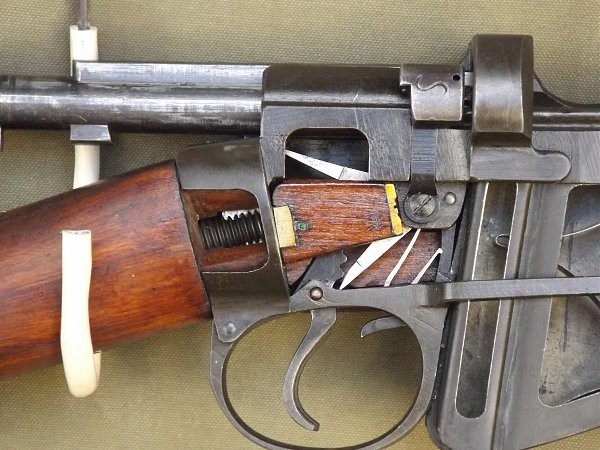 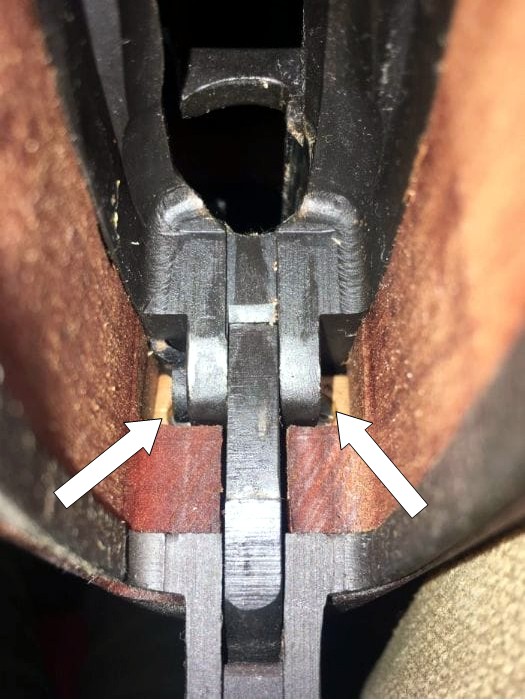 ------------- Don't shoot till you see the whites of their thighs. (Unofficial motto of the Royal Air Force) |
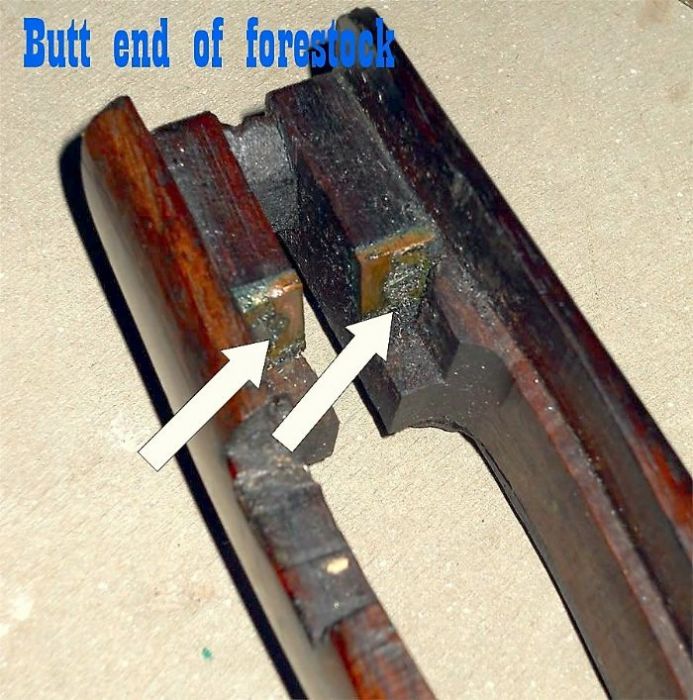
Posted By: Homer
Date Posted: March 26 2026 at 11:37am
| Definitely looks like a jovino assembled rifle from the photos. I wouldn’t tell him. |
Posted By: paddyofurniture
Date Posted: March 26 2026 at 12:01pm
| Mum's the word. |
Posted By: Shamu
Date Posted: March 26 2026 at 1:08pm
|
I'm curious, what features he's described lead you to that conclusion? Personally, I'm not thinking we have enough detail to make that determination? ------------- Don't shoot till you see the whites of their thighs. (Unofficial motto of the Royal Air Force) |