No4 & No5 Bolt Head Sizes (Update)
Printed From: Enfield-Rifles.com
Category: Enfields
Forum Name: Enfield Rifles
Forum Description: Anything that has to do with the great Enfield rifles!
URL: http://www.enfield-rifles.com/forum_posts.asp?TID=5019
Printed Date: March 26 2026 at 8:18pm
Software Version: Web Wiz Forums 12.07 - https://www.webwizforums.com
Topic: No4 & No5 Bolt Head Sizes (Update)
Posted By: Alan de Enfield
Subject: No4 & No5 Bolt Head Sizes (Update)
Date Posted: February 07 2012 at 5:11am
|
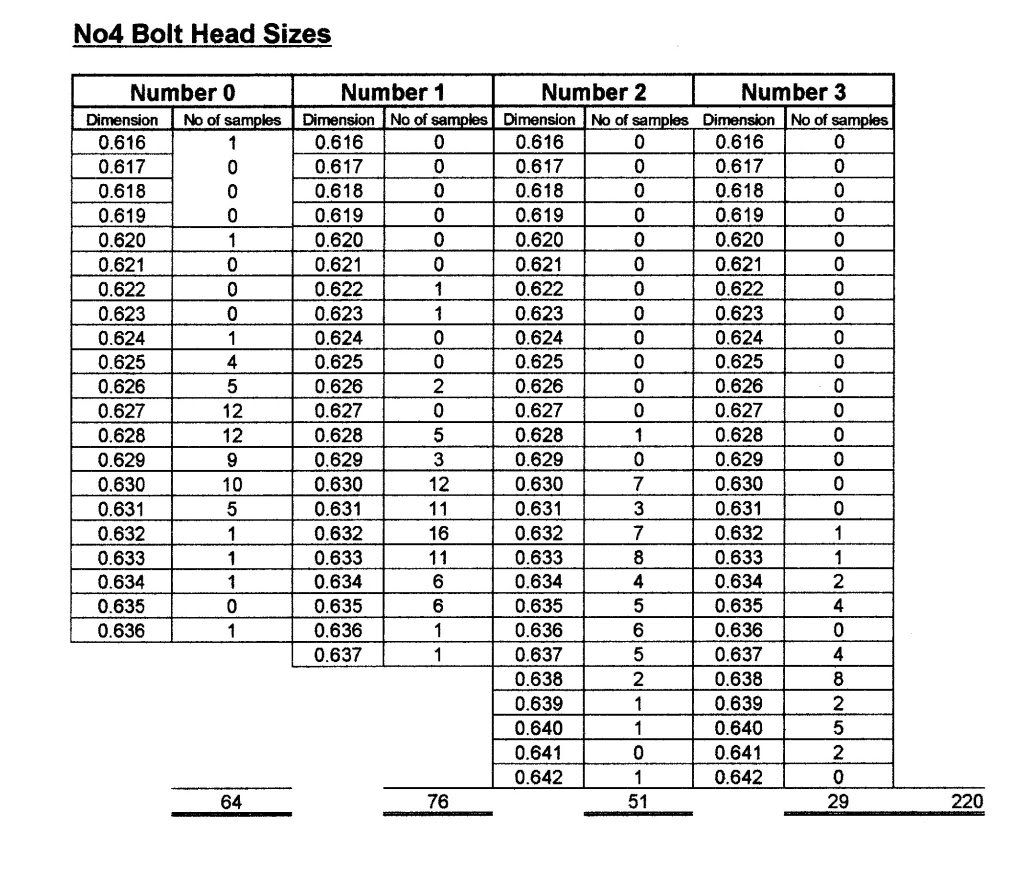
As some of you may remember I have been compiling a spreadsheet of bolt head sizes for a few years now, and, now having the dimensions for 220 bolt heads I thought it was time for an update. As you will see (and has been stated on numerous occasions) it is no use at all simply saying "I need a Number 3 bolt head" when (for example) a 0.632" up to 0.636" bolt head can be a number 0, a number 1, a number 2 or a number 3. Tradition has it that the bolt head "numbers" fall within the following dimensions : I hope you can see from the spreadsheet that this is not necessarily correct. Note : I use the term "NUMBER" and not "SIZE". Disclaimer - these bolt heads have been measured by several people using different measuring 'tools'. There is no way that these statistics would be taken as 'accurate' for QC purposes but I believe they show enough guidelines for us to be very careful when we are buying a 'new' bolt head.
------------- Its not what you've got thats important, its what you hav'nt got, but still want, thats important. |
Replies:
Posted By: A square 10
Date Posted: February 07 2012 at 5:37am
| interesting data , see your point , to what do you attribute this ? |
Posted By: Alan de Enfield
Date Posted: February 07 2012 at 7:08pm
I cannot answer the question
All of the 'official' doumentation I have does not show a 'starting size' and simply states "No1 to No3 increase in length by increments of 0.003"
I can only guess (assume) that each manufacturer started their 'base line' (number 0) from a different point.
It may be an interesting exercise (if anyone has enough bolt heads) to repeat the exercise with bolt heads from a single manufacturer ------------- Its not what you've got thats important, its what you hav'nt got, but still want, thats important. |
 A square 10 wrote:
Posted By: Canuck
Date Posted: February 08 2012 at 2:27am
| So, if I were looking for the proper range of bolt head sizes for my guns at a gun show I would need to bring along a caliper gauge to measure each and every one, assuming the bolt heads I do have were not giving me proper head spacing? |
Posted By: Shamu
Date Posted: February 08 2012 at 5:18am
|
There has been a suggestion that there was indeed a fixed dimension (+/- tolerances) for the # heads from the factory(s), but that field expedient fitting by unit armorers caused the surviving fitted heads to have a wide range of dimensions. Somewhere I have the documentation on the exact lengths of the various #'d heads as the factory supplied them & this seems to suggest the field modifying is a plausible version. If I can dig it up I'll post the info here. ------------- Don't shoot till you see the whites of their thighs. (Unofficial motto of the Royal Air Force) |
Posted By: Alan de Enfield
Date Posted: February 08 2012 at 7:14am
Thanks for the offer. Peter Laidler has today looked up the 'specification' given to the manufacturers and has informed me as follows : No 0 = 0.629" +0 / -0.002" No 1 = 0.632" +0 / -0.002" No 2 = 0.635" +0 / -0.002" No 3 = 0.638" +0 / -0.002" What does confuse me is that there are many, many examples ABOVE the sizes quoted. I would have expected that any "field expedient fitted" ( ie ground down to fit) would have been BELOW the minimum size. It would be interesting to see if your documented dimensions are the sames as Peter's ------------- Its not what you've got thats important, its what you hav'nt got, but still want, thats important. |
Posted By: A square 10
Date Posted: February 09 2012 at 11:13am
| it does give pause to the thought that each mfgr had their own standards , but , that flys in the face of the LOC but i can see where you arive at that conclusion based on your accumulated data , i do not have access to near enough samples to dispute your results , and welcome any info |
Posted By: Canuck
Date Posted: February 09 2012 at 12:10pm
| Is there an available listing for the manufacturers and their marks? |
Posted By: Alan de Enfield
Date Posted: February 09 2012 at 4:32pm
The rifle manufacters generally made their own bolt heads so the markings are the usual (Savage) S, (Longbranch) LB etc. ------------- Its not what you've got thats important, its what you hav'nt got, but still want, thats important. |
Posted By: Shamu
Date Posted: February 09 2012 at 9:37pm
|
I got the same info as he did. The only thing I can say is that to carry weight a theory must explain all the facts. This leads to the inevitable conclusion that either the specs are incorrectly quoted somewhere & the wrong info just keeps getting repeated as fact, or someone wasn't doing good QC, or that some were built up & ground back down. I subscribe to the "Once you have eliminated all that is not possible, what remains is truth, no matter how unlikely!" school of thought. ------------- Don't shoot till you see the whites of their thighs. (Unofficial motto of the Royal Air Force) |
Posted By: guntek2112
Date Posted: January 27 2016 at 4:48am
|
what is a U stamped bolt head designate, my measurement is a .634 with a micrometer, I did not see any in the chart and cannot remember where I saw it, maybe in gunsmithing school 38 years ago! ------------- Tom Kivlehan Gunny USMC Retired 2112 |
Posted By: maxwell smart
Date Posted: January 27 2016 at 8:16am
|
I think that the "U" relates to the type of material that the bolthead is made of. All that I have seen with this mark are for No 1 rifles; it is not related to size/length of bolthead. |
Posted By: guntek2112
Date Posted: January 27 2016 at 8:25am
|
OK, thanx ------------- Tom Kivlehan Gunny USMC Retired 2112 |
Posted By: Gerrit
Date Posted: April 07 2019 at 11:35am
| I have recently converted my No4 Mk1 to an EPPS. Before the conversion I only used old factory PMP ammunition in my rifle without any problem. Since the conversion to EPPS I also started reloading new cases from Hornady. As the orignal intention of the EPPS was to increase case life, I did not expect case seperation due to a head space problem. The old PMP cases never indicated any problem. By the way, I have a #2 bolt head on my rifle. Fortunately I still had some of the old PMP cases with me. After a quick measurement of the Hornady and old PMP rim thicknesses, I realised that the old PMP case rim is 0.13 mm thicker than the Hornady rim. Looking at the different bolt head sizes discussed and the difference between the #2 and #3 heads for the max. 8 samples taken, calculate to 0.127 mm, more or less confirm why my PMP does not have a problem. So I ran off to my local dealer to get some new PMP cases to solve my problem. Before actually buying the PMP cases I also had its rim measured, only to find out its the same as the Hornady. Problem not solved. I have not actually measured my #2 bolt head, but now I know I need a #3, 0.13 mm longer than my #2 head. I need to be very specific when replacing my bolt head. |
Posted By: Goosic
Date Posted: April 07 2019 at 5:29pm
| Gerrit. Welcome from Phoenix. Your first line states that you just had the rifle converted to Epps. Is this a newly manufactured barrel chambered to fire the Epps round? Or,did they re-rifle and re-ream the chamber area of the original barrel? You first need to have the headspace checked by a professional gunsmith who is familiar with the No4Mk1 Enfield before you make an assumption that you need a new bolthead. Case separation could be due in part to an overly enlarged chamber. The No4 chamber is originally designed with a generous chamber area to allow for battlefield conditions and re-reaming it just makes it that much more generous. The case can only expand so far before it bursts. Alot of people claim headspace this or headspace that so I'll just swap out the #0 for a #1 and all will be good. Have you fired a round and then tried to extract it slowly, checking for any resistance? Where is the case separating at? Is it splitting the case laterally or is it splitting the case a 1/4" above the rim line? Here's another one Gerrit. How many times have the reworked cases been reloaded? The six questions I have a asked of you need to be addressed before you decide to buy a #3 bolthead only to find out your cases are still separating. Just an FYI Gerrit. The Epps was found to work better in a P-14 due to an increase in velocities and pressure. A reduced powder charge for the Lee Enfield action was mandated by Epps himself. When a chamber is reamed out for the Epps cartridge sometimes more metal gets removed then anticipated. The combined reshaped chamber and case itself wil tend to initially get you a few case separations before it gets better. |
Posted By: Gerrit
Date Posted: April 08 2019 at 1:29pm
|
Thanx Phoenix. My rifle is still the original 1942 Lee Enfield No4 Mk1, same barrel and just rechambered to epps by a good gunsmith. I am aware that the Lee Enfield cannot be loaded to the extent of the P14, so I am realisticaly conservative when loading. My seperation is about a 1/4 inch from the rim, and only occur after about 4 to 5 firings from the cases. I can only compare the old PMP cases fired from the same rifle with the modern cases, which indicate to me there is a difference in rim thickness. The bolt head and rim combined must be a good fit to eliminate the head space problem. Even when I fire form the old PMP cases to the epps shape, I do not see any deformation on the cases where I get seperation on the new stuff. The slightly thicker rim of the older PMP cases are definitely better.
|
Posted By: Shamu
Date Posted: April 09 2019 at 8:32am
|
A lot of modern ammo is thin walled & has thin rims as well. Can you get Prvi Partizan brand there? If so switch to it, or if you can find it Greek HXP stamped brass. Its Way way closer to spec.
------------- Don't shoot till you see the whites of their thighs. (Unofficial motto of the Royal Air Force) |
Posted By: Goosic
Date Posted: April 09 2019 at 9:23am
| Gerrit. You mentioned that you are using Hornady brass. I would consider something else such as what Shamu suggests. I purchased 200 Hornady cases awhile back. Loaded everyone to exacting specifications,starting 1 grain above minimum charge from my data sheets. Fired everyone from the same rifle that has correct headspacing,no chamber issues that I am aware of,and in an almost pristine condition. 1/3rd of those cases split apart 1/4" above the rim. Hornady reps maintain that I loaded the cases past maximum charges. I cut a case in half,length wise. A very thin wall as opposed to Privi cases which is pretty close to the original ammo. It is not a headspace issue. The cases are separating from the combined fireforming, resizing,and the chamber space. Remember my specific question about the case splitting 1/4"above the rim? That is a specific area where the .303 case splits more often then not. Alot of the splitting is the thinwalled brass but,it also has to due with the chamber area. |
Posted By: Gerrit
Date Posted: April 09 2019 at 10:58am
| I visited my gunsmith today for some advice. He does have a few old #0 to #2 heads in his shop, but no #3. I assume that more Lee Enfield .303s needed the longer #3 head to compensate for the modern cases. On close inspection of my head, it does look like about a 1.6 mm washer is fitted to the face of the main heae unit. My #2 head measure 16.16 mm (0.63622 inch) but is also not constant when measured at different places around the circumference. I would then need a #3 head of 16.3 mm to fix my problem. |
Posted By: Zed
Date Posted: April 09 2019 at 11:27am
|
I would suggest asking him if you could measure the #2 bolt heads that he has in stock. Due to the variation in actual size; you may get lucky and find a longer #2 head. The bolt head should be one piece; there should not be anything added on, such as a washer. However there can be a mark appear on the front face caused by the primer if you get a gas leak around edge when firing. ------------- It's nice to be important, but it's more important to be nice! |
Posted By: Shamu
Date Posted: April 09 2019 at 3:24pm
|
There was an (unofficial & IMO dodgy) "fix" where shim material was braise or silver soldered to the bolt head to "make it longer". I wouldn't trust it frankly. ------------- Don't shoot till you see the whites of their thighs. (Unofficial motto of the Royal Air Force) |
Posted By: Goosic
Date Posted: April 10 2019 at 7:41pm
These are ones I have. The top one that has an actual L stamped on it was refaced by myself to fit my No4 7.62x51. Notice the difference between my #2 and my shortest #3. A mere .002" in difference. I have a #2 currently in a rifle that is .636,which is bigger then two of my #3's. Do as Zed suggests and have your gunsmith measure all of his #2 boltheads. Even if he finds one .001 longer then the one you have is an improvment.
|
Posted By: FlyPiper907
Date Posted: February 27 2021 at 2:15pm
| Howdy folks, late to the party here. So, from what I’m gathering, any 0, 1, 2, or 3 bolt heads may not reflect the same value among the same size bolt heads? I’ve just acquired a Jungle Carbine with a #2 head - still a little long in the headspace department with the current head on it. Worth maybe trying another #2 bolt head? |
Posted By: britrifles
Date Posted: February 27 2021 at 3:03pm
|
Measure the length of the bolt head you have and see where that length falls into the table at the top of this post. From that you can see if your #2 bolt head is on the short or long side of that range. If it’s already on the long side, better look for a #3 bolt head. Does the bolt close on a field gage?
|
Posted By: FlyPiper907
Date Posted: February 27 2021 at 3:12pm
|
Britrifles, It doesn’t close on a field gauge but it’s on the long side for sure. The bolt handle stops about 2/3 of the way closed. Certainly safe to fire but I’d like it a little on the shorter side. I’ll get a pair of calipers and have a look.
|
Posted By: MJ11
Date Posted: February 27 2021 at 3:32pm
|
Another good read on the never ending story. The update is every bit as interesting as the original. Some years ago I was at a match and met a retired gent who had a #3 with a .003" bit of stock added to the bolt face. He had had no problems with it and claimed several hundred rounds of reloaded munitions through it at the time. Point is I had never seen that approach to the problem and had just went about collecting as many bolt heads as possible. The conversation had come up because I had a 7.62X51 LC match case separate 3/8th inch above the rim taking me out of the contest. The Gentleman was all about wanting to fix my rifles bolt head but I let it pass because I knew it was my fault trusting a batch of even LC Match 69 case after seven reloads. I then knew why there was a line of vertical stations on those cases. Live and learn. Also I never went to another event without a ruptured case remover. ------------- The Spartans do not ask how many the enemies are but where they are |
Posted By: britrifles
Date Posted: February 27 2021 at 5:48pm
|
I also like to have headspace right at minimum if possible. It extends brass life. 40 to 50 reloads before case head cracking...relatively mild loads help too. |
Posted By: Goosic
Date Posted: February 27 2021 at 7:12pm
My headspacing is as such that with a No-Go gauge, the bolt handle has only traveled 65% before lockup. The fired case in the case gauge as compared to an unfired case look identical.   
|
Posted By: Twodogs
Date Posted: February 28 2021 at 7:49am
Or even better look for a longer bolt head which may well be marked with a 3 or a 2 o a 1. The need for a longer bolt head will also tell you the rifle is wearing out. Number/size relationship aside these rifles never left factory/ base repair with a no3 bolt head.
|
Posted By: FlyPiper907
Date Posted: February 28 2021 at 8:37am
| That would make sense. You should’ve seen the copper in that barrel. Very clean now, stripped her all the way down. My guess is the gun hadn’t been apart since it left the factory. Wood was in great shape, can’t wait to take it to the range |
Posted By: FlyPiper907
Date Posted: February 28 2021 at 9:03am
| Would changing the bolt to a new bolt help with headspace as well? |
Posted By: Goosic
Date Posted: February 28 2021 at 9:04am
Your field gauge is a SAAMI spec'd gauge with a .070" rim thickness. If your bolt is stopping 2/3rds of the way down leave the rifle alone. The,"Official" headspace gauge has a rim thickness of .074" and with that in mind, your rifle is beyond good to go, just from what you have said in regards to where the bolt handle is stopping. Using the .074" headspace gauge. The headspacing was found to be acceptable with the bolt at 80 - 90% travel before stopping. You are overthinking this.
|
Posted By: Goosic
Date Posted: February 28 2021 at 9:10am
Changing out the bolt with a new bolt would only help if you can get the new bolt properly mated to your used action body/reciever. These are not Plug~N~Play rifles and the various components fitted to the action body/reciever, are just that, fitted.
|
Posted By: Goosic
Date Posted: February 28 2021 at 9:27am
|
Pay close attention to where the bolt handle is located in both photos. The first photo shows the bolt handle almost fully locked. The headspace gauge is a SAAMI spec'd .070" gauge. The second photo shows the bolt handle maybe 75 - 85% down with the correct .074" gauge. If your bolt handle falls anywhere within the ranges of the two photos combined with your headspace gauge. Your rifle is headspaced and should be left well enough alone...
  |
Posted By: FlyPiper907
Date Posted: February 28 2021 at 9:36am
|
Britrifles, Par for the course in my world! I’m still very new to firearms and my knowledge on Lee’s only extends back about 2 months. You’re saying that modern gauges err on the conservative side against the original gauges? Cheers 🍻
|
Posted By: FlyPiper907
Date Posted: February 28 2021 at 9:39am
| Thanks, Goosic. I’ll leave it where it’s at then. Sounds like I’ve still got much to learn. |
Posted By: Shamu
Date Posted: February 28 2021 at 9:44am
Not quite. There are 2 "standards" for L-E headspacing. One is the old Brit standard, Used to be something called WOPS #9, then became CIP. Meanwhile in the U.S. theres SAAMI, which differs slightly. Whatever its called you need the following specs. (you may not need all the gauges though. Frequently for checking all you need is the "FIELD", but it should be 0.074" GO NO-GO & FIELD (One dimple) (Two dimples) (Three dimples) GO = 0.064" NO-GO = 0.067" FIELD = 0.074". ------------- Don't shoot till you see the whites of their thighs. (Unofficial motto of the Royal Air Force) |
Posted By: Twodogs
Date Posted: February 28 2021 at 11:42am
|
Posted By: britrifles
Date Posted: February 28 2021 at 12:13pm
|
I have two gages. 0.064 and .070. All my LEs have a at least 0.10 inch gap under the bolt handle with the .070 gage. Four of my No. 4s have a 0 or 1 bolt head, I’ve not seen any appreciable increase in headspace after firing in excess of 5,000 rounds. My 0L Mk 1/2 Long Branch, needed a #3 bolt head when I got it to properly headspace (it just fully locks on the 0.064 gage) with very light finger pressure. It probably would have been OK with a #2 bolt head, but I had a #3 that got the headspace to minimum.  |
Posted By: serrock
Date Posted: November 08 2022 at 12:53pm
|
I own a 1942 Savage manufactured No4Mk1. On a recent range trip I experienced a split case, the base completely shearing off approximately 12mm, 1/2" from the base as well as several fired cases showing a distinct line at roughly the same spot combined with some primers protruding slightly. The cases were S&B which according to local anecdotal information is rubbish brass but also possibly a head space issue as well. Loads were well within published data so I don't believe my issues are pressure related I have examined my bolt head & its clearly marked with a 4 & has approximate dimensions of 0.633" I haven't seen reference to a #4 bolt head anywhere, is this a peculiarly Savage/US manufacturing marking? |
Posted By: britrifles
Date Posted: November 08 2022 at 4:06pm
|
Supposedly, there was a small number of #4 bolt heads made. I’ve not seen one. 0.633 would be short for a #4 bolt head, most likely it would be a #2 (or, it’s been ground down). I’ve not used S&B .303 brass, but I’m not impressed at all with S&B .30-06. Have your rifle checked for headspace? How many reloads on that brass? |
Posted By: shiloh
Date Posted: November 08 2022 at 6:47pm
|
some interesting info I came across while looking for bolt heads. The first chart shows how sizes(#`s) overlap and who made them. The second one is self explanatory and includes Nato stock numbers(DSN)   |
Posted By: The Armourer
Date Posted: November 09 2022 at 12:54am
The discussion is about No4 / No5 bolt heads - the above information about the No1 Mk3 bolt heads is not really relevant as they are not interchangable with a No4 or 5. In the opening post of this thread is a chart showing actual measured bolt head sizes against 'number' and there is very little correlation & with a huge overlap.
|
Posted By: shiloh
Date Posted: November 09 2022 at 5:24am
|
What ever, Just thought it was interesting, don`t have to be a dyck about it. |
Posted By: Shamu
Date Posted: November 09 2022 at 4:35pm
|
Like this?  If so that's bad ammo, not a bad gun.  Just think about "headspace" for a moment. The largest (longest) permissible is 0.074" except in emergency wartime conditions. Your separation is at (roughly) 0.5"!  Now, can we "create a false headspace on the case shoulder"? Absolutely! I do it every time I reload. But where do you find a ".303 British Headspace Gauge" for 1.890" to Datum Line? That is NOT "headspace", it may well be Thin brass, generous chamber shoulder, or something else, but Headspace it is not. ------------- Don't shoot till you see the whites of their thighs. (Unofficial motto of the Royal Air Force) |
Posted By: britrifles
Date Posted: November 09 2022 at 6:03pm
|
Those cracks and thinned out case walls on the second photo are much higher up the case than what I see. Case head web cracks that I get are all at 0.30 inches from the bottom of the case, after about 40 to 50 reloads. As far as I can tell, the chambers are cut on a straight taper, from the very back of the chamber to the shoulder. So, for about the first 1/4 of an inch, the case is unsupported by the chamber, some of that is the solid head, but some is the area we call the “web”, the transition from the head to the case wall. This unsupported area of the case, plus any excess headspace, is what creates the excessive strain that thins the brass and causes the cracking. Forward of this area, the case is well adhered to the chamber at the time of peak pressure, the rear part of the case is unrestrained and is pushed to the rear to take up any excess headspace. Because of the relatively short length of case that is being stretched, the strain is very high, exceeding the elastic limit of the brass. What necksizing only does for you is keep the case positioned in the chamber such that it is already fairly firm up against the bolt head, this minimizes the strain on subsequent firings. |
Posted By: Shamu
Date Posted: November 09 2022 at 7:30pm
|
Agreed! I've seen both. The short ones are chamber problems, but the others are brass problems. ------------- Don't shoot till you see the whites of their thighs. (Unofficial motto of the Royal Air Force) |
Posted By: The Armourer
Date Posted: November 10 2022 at 1:24am
|
I agree with Plonker - its bad (SAAMI) brass. Look at the diferences between Win (SAAMI) and Military (PPU) Brass - both case wall thickness and rim thickness, remembering that a 'thin rim' increases your effective headspace. Put a gauge with a 64 thou rim in the chamber and it passes, now put a case with a 54 thou rim and you have suddenly introduced a 10 thou 'slop'. I'll let you guess which are which ................ 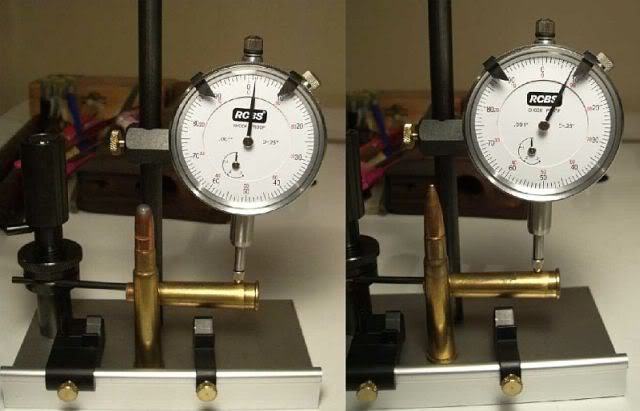 The Military specification for 303 brass Rim thickness was 0.058 min to 0.064 max the brass shown below would be a 'reject'. SAAMI specification is 0.054 min. 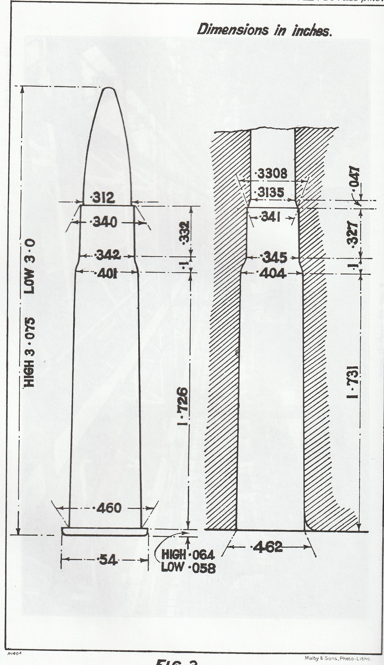 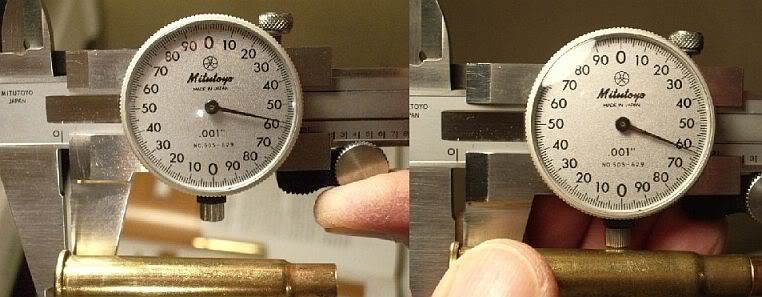 |
Posted By: Goosic
Date Posted: November 10 2022 at 9:52am
Are you FULL LENGTH resizing your brass? If you answered yes, discontinue the FL and NECKSIZE only. How many times has the brass been resized? Invest in a Forster FIELD gauge and see if the bolt closes on it. If it does close, find another bolt head that is between 0.635" and 0.638" If you are still experiencing a case rupture after a larger sized head bolt replacement and you are neck sizing only, you could possibly have a worn chamber. Remember, you have a 80 year old rifle with an unknown amount of ammunition pushed through it prior to you claiming ownership...
|
Posted By: Zed
Date Posted: November 10 2022 at 11:52am
|
The SB brass is crap. Shoot it once and bin it! A friend gave me a bag of 200 SB fired cases; it's been sitting in my workshop for 2 years. It'll be a waste of powder to load it. Best thing to do would be set them up at 50 metres and plink away with a .22! ------------- It's nice to be important, but it's more important to be nice! |