
|
No. 4 "Compensation" Tests |
Post Reply 
|
Page 123 10> |
| Author | |
britrifles 
Senior Member 

Joined: February 03 2018 Location: Georgia, USA Status: Offline Points: 8404 |
 Post Options Post Options
 Thanks(0) Thanks(0)
 Quote Reply Quote Reply
 Topic: No. 4 "Compensation" Tests Topic: No. 4 "Compensation" TestsPosted: July 28 2025 at 5:51am |
|
Thought I would start a new post on fore-end fitting. I'll start by abbreviating "fore-end" to "forend". I'm lazy I guess.
I've begun some experiments with the No. 4 T on forend fit and barrel bedding in order to see if I can induce what Maj Reynolds called "Positive Compensation". Per Reynolds book "The Lee Enfield Rifle", compensation trials done by RSAF Enfield during development of the No. 4 were inconclusive. The No. 1 SMLE was well known for possessing positive compensation, at around 800 yards, and it was favored for many years in the final stages of the Kings/Queens Prize (900/1000 yards) for this reason. A simple definition of "Positive Compensation" is that the point of impact in the vertical (elevation) plane on the target is independent of muzzle velocity at the compensation range. This obviously cannot be true for a very large velocity spread, but it can, and is true, for as much as 75 fps, perhaps 100 fps. Here is how Maj E.G.B Reynolds illustrated “Positive Compensation”: 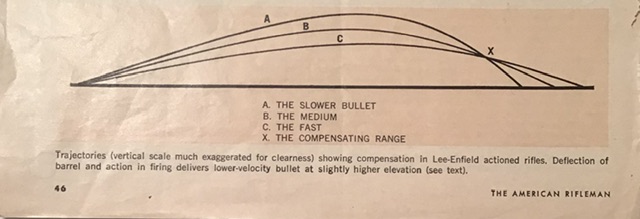 At 600 yds, my No. 4 T is not showing any sign of positive compensation, in fact, it may even be "negative" compensation. Fast bullets are impacting much higher, and slow bullets much lower, than a simple bullet drop trajectory predicts. In an effort to induce positive compensation, I'll be trying various barrel packing methods and will post the results here. My interest is strictly at 600 yards where I'm seeing significant vertical stringing as a function of muzzle velocity. If I could produce ammunition that gives less than 30 fps extreme spread in muzzle velocity, this would not be an issue. While my loads do get down to the 25-30 fps ES range, at times is exceeds 50 fps and result in vertical fliers into the 8 and 9 ring. Regarding the ES values of 50 fps and higher, I intend to start to cull cartridge cases giving very low or very high muzzle velocities and set them aside. I'm weighing each powder charge, prepping cases all the same way, so this seems to be the only way to potentially reduce ES. |
|
 |
|
|
Zed
Special Member 

Donating Member Joined: May 01 2012 Location: France Status: Offline Points: 6460 |
Post Options
Thanks(0)
Quote Reply
Posted: July 28 2025 at 9:16am |
|
I look forward to seeing your results.
In fact I am looking at my latest Maltby No4mk1, and considering making it an accuracy project. The reason being that it's not as original as I first thought. This rifle came with the deal for the 1907Mk1*. So only got a quick check at the time of purchase. Having now had time to remove the fore end, it is evident that the barrel has been replaced. It is a 1943 dated barrel, but the parkerizing is much better than the receiver. Which has marks on it from the tooling to remove the old barrel. This one gauge's well, it is a two groove barrel. But it's in good shape, so should be ok. The Knox form area of the wood doesn't have much contact with the barrel, and the up pressure at the muzzle is low. To address the Knox form problem, I have cut a sliver of oak, along the grain, about 1 mm thick. I then form it to the curvature, by placing it in boiling water for about 20 minutes, then pressing it between two semi circular pieces of metal pipe. The inner diameter of the exterior pipe is equivalent to the curve of the Knox form in the wood. The inner pipe has enough clearance to allow the wood to flex into shape. It's now sitting in a vice while it dries out into shape. I will then glue a 3/4" square at the knox form wood and adjust to get good contact with the barrel. Once that is done, I will see if I go to centre bedding. Ideally, I will test it prior to any modifications, then note the changes at each stage.
|
|
|
It's nice to be important, but it's more important to be nice!
|
|
|
|
|
britrifles
Senior Member
Joined: February 03 2018 Location: Georgia, USA Status: Offline Points: 8404 |
Post Options
Thanks(0)
Quote Reply
Posted: July 28 2025 at 10:27am |
|
Shaun, you lucked out, this rifle could well be a good shooter with a 1943 barrel. Do you have a Hornady OAL gage? This is a good way to assess erosion of the throat.
On my next installment, I'll discuss the various barrel bearing locations, some of which are discussed in Reynolds book. Of the four common locations of forend barrel bearing, I have at least one of each of them along with one that a full length forend bearing! |
|
|
|
|
Shamu
Admin Group

Logo Designer / Donating Member Joined: April 25 2007 Location: MD, USA. Status: Offline Points: 20510 |
Post Options
Thanks(0)
Quote Reply
Posted: July 28 2025 at 12:38pm |
|
I'd find that interesting too. My No4 Mk2 seems to be compensated at least out to 650 yds, which is the longest range I can get to round here. It does have a slight,1.5 MOA or so Left<>Right difference though, but that may be because I'm getting the higher velocities with the lighter 150Gr bullets it seems to like. Vertical dispersion is minimal. But again that may be bullet weight & BC as much as velocity.
|
|
|
Don't shoot till you see the whites of their thighs. (Unofficial motto of the Royal Air Force)
|
|
|
|
|
britrifles
Senior Member
Joined: February 03 2018 Location: Georgia, USA Status: Offline Points: 8404 |
Post Options
Thanks(0)
Quote Reply
Posted: July 29 2025 at 7:39am |
|
To really determine if the rifle has "positive compensation" you need to record both muzzle velocity and bullet POI on the target. A rifle that gives consistent tight vertical spreads of say 1 to 1.5 MOA for 10 shots at all ranges out to 1000 yds would indicate no compensation exists and you have very good loads with tight velocity extreme spreads (less than 30 fps).
What I'm referring to is vertical stringing of the group, 2 MOA or more, where individual shot vertical POI at the target is strongly correlated to muzzle velocity and is not just a random placement of shots. With "positive compensation" these two variables are inversely related (i.e. fast bullets impact low and slow bullets impact high) at short range and show no correlation at all at the compensating range. That is "Positive Compensation". I've been digging thru my plot sheets (score book) results on my No. 4 T where I've recorded the muzzle velocity of each shot, plotted the POI on the target diagram and calculated the elevation spread per fps change in velocity. That value is about 3 times more than the bullet drop trajectory accounts for. On a rifle that compensates (at the compensating range), you would see no correlation at all with elevation POI at the target and muzzle velocity. |
|
|
|
|
Zed
Special Member
Donating Member Joined: May 01 2012 Location: France Status: Offline Points: 6460 |
Post Options
Thanks(0)
Quote Reply
Posted: July 31 2025 at 9:16pm |
|
I have my Fulton's No 4 Mk1/2, to look at the bedding of the fore end
The Knox form oak shim, I used once before on the 1929 BSA No1. That made a difference, and was the last modification. Prior to that I had been experimenting with Play Doh to work out the thickness required. We are currently enjoying our vacation.
|
|
|
It's nice to be important, but it's more important to be nice!
|
|
|
|
|
britrifles
Senior Member
Joined: February 03 2018 Location: Georgia, USA Status: Offline Points: 8404 |
Post Options
Thanks(0)
Quote Reply
Posted: August 02 2025 at 7:39am |
|
I’ve ran some Strelok bullet trajectory calculations to establish a baseline of expected vertical (elevation) spread on the target as a function of range and muzzle velocity extreme spreads. With this, we can judge if a given rifle shows signs of positive compensation or not.
First, the ballistic absolute bullet drop (in inches) from the muzzle. These were based on two different loads as follows: Case PPU Primer WLR Powder Varget, 40.0 gr and 41.5 gr Bullet 174 gr Sierra MatchKing, G7 BC = 0.249 OAL 3.07” 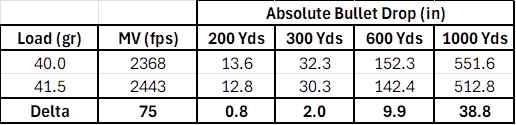 From this, we can see that the 200 yard delta drop is really not much to be concerned with even with extreme velocity spreads of 75 fps, but is quite significant at 1000 yds. I then calculated the delta bullet drop in Minutes of Angle (MOA) for various muzzle velocity Extreme Spreads (fps). Note these are not true minutes of angle, as I am using 1 inch per 100 yds, close enough. 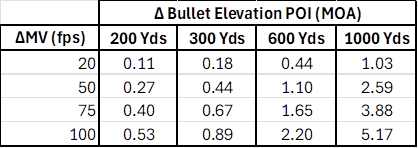 A 20 fps Extreme Spread is about the best handloads I can produce, but it’s typically 30 to 50 fps ES. I had two 10 shot groups yesterday with a whopping 100 fps ES, and I don’t know why. Even with a 100 fps ES, we would be hard pressed to notice a 1/2 MOA elevation difference at 200 yards as this is well within our shooting ability. This is why we don’t concern ourselves with muzzle velocity variation in short range service rifle shooting. But at 600 yards, it becomes quite significant. This would easily push the bullet out of the 2 MOA 10 ring, possibly into the 8 ring on the US NRA Mid Range Target. To these elevation variations, we have to add our own hold and aim errors, although sometimes they can cancel out these velocity deviations. You can see why positive compensation in a rifle was so important at long range (800-1000 yd) competition, otherwise, a 100 fps velocity deviation could cause a miss! Next, I’ll post on results of shooting tests with measured elevation variations as a function of velocity variation. We will see that my No. 4T is showing a “negative” compensation, exaggerating these elevation deviations and my No. 4 7.62 is showing strong Positive Compensation. |
|
|
|
|
Zed
Special Member
Donating Member Joined: May 01 2012 Location: France Status: Offline Points: 6460 |
Post Options
Thanks(0)
Quote Reply
Posted: August 02 2025 at 10:32am |
|
An interesting thread Geoff, I look forward to seeing your results.
|
|
|
It's nice to be important, but it's more important to be nice!
|
|
|
|
|
Sapper740
Senior Member

Joined: July 15 2021 Location: Texas Status: Offline Points: 1737 |
Post Options
Thanks(0)
Quote Reply
Posted: August 02 2025 at 10:57am |
|
Thank you for this very informative thread Geoff, I had never heard of Positive or Negative Compensation before. I have heard throughout the decades of this effect with revolvers and pistols whereby the heavier and thereby slower bullets tend to hit high due to being in the barrel longer and thus subject to more muzzle flip before being free of the bore.
On a related issue, I have a Fulton regulated No1 Mk III but I've been loathe to take it apart for fear of undoing what Fulton and Son did during the accurizing process....that, and I've heard they may have used asbestos matting in the process. The rifle is wonderfully accurate so I plan on leaving well enough alone.
|
|
|
|
|
britrifles
Senior Member
Joined: February 03 2018 Location: Georgia, USA Status: Offline Points: 8404 |
Post Options
Thanks(0)
Quote Reply
Posted: August 03 2025 at 2:07pm |
|
Derek, as my Dad would say, “leave well enough alone”. I wouldn’t take the forend off either if the rifle shoots good. I can be done in a way to not cause harm, but it can also be done in several ways to destroy the good fit at the draws.
|
|
|
|
|
britrifles
Senior Member
Joined: February 03 2018 Location: Georgia, USA Status: Offline Points: 8404 |
Post Options
Thanks(0)
Quote Reply
Posted: August 03 2025 at 2:30pm |
|
Through a lot of testing and data collection/analysis, a picture is emerging on the No. 4T that suggests there may not have been anything wrong with the CMk4 Long Branch six groove barrel and the new CBI five groove barrel previously installed. In fact, I will write CBI back and offer to buy the barrel back from them if they still have it.
This rifle most definitely shows a “Negative Compensation” at 600 yds. To illustrate this, I’ve plotted up the bullet elevation POI on the target at 600 yds vs Muzzle Velocity. In my previous post, you will see that the expected elevation change for a 100 fps muzzle velocity extreme spread would result is just over 2 MOA. But, I’m getting considerably more than that, 4 to 5 MOA elevation spread:  These were all the same loads, 40.3 gr Varget with 174 gr SMK, PPU case. Why I’m occasionally getting velocity spreads of 100 fps is still a mystery. I’m weighing out all the charges on my RCBS digital scale. The only thing I can think of is the cartridge case, so I’ve been putting cases that give very low (or high) velocities aside. Note the slopes of the trend lines, all about the same for the four 10 shot groups. I have many more groups that have shown this with the three different barrels I had installed over the past 5 months. So why is it that this rifle strings shots vertically about 2-3 times more than the velocity variations alone would account for? The bedding method? Loose butt stock, forend not fitting well? Numerous possibilities perhaps, some of which I have investigated already with no success. The plot below shows what “Positive Compensation” looks like. This is my No. 4 Mk 2 DCRA 7.62 at 800 yards. Note that there is no correlation at all between muzzle velocity and bullet elevation POI at the target despite a 100 fps velocity variation.  My next step is to experiment with the forend on the No. 4 T to see if I can get Positive Compensation as I do with the DCRA 7.62. |
|
|
|
|
britrifles
Senior Member
Joined: February 03 2018 Location: Georgia, USA Status: Offline Points: 8404 |
Post Options
Thanks(0)
Quote Reply
Posted: August 03 2025 at 4:02pm |
|
I have some suspicion that the scope affects how the action deflects under the thrust load from the bolt. It would seem that the added stiffness from the scope and bracket mounted above the bolt/bore axis would result in a muzzle down bending deflection under the bolt thrust load. The No. 32 scope and mount is obviously very stiff/rigid! This might explain why fast bullets exiting the muzzle sooner before the full downward deflection is reached result in shots going higher than the trajectory would account for.
If this is true, there is not likely anything I can do to alter the compensation characteristics with different bedding methods. I’ll need to shoot the rifle without the scope at 600 yds to see what the compensating behavior is compared to with the scope attached. More to do in this. |
|
|
|
|
Canuck
Special Member

Donating Member Joined: January 17 2012 Location: Cochrane, AB Status: Offline Points: 4021 |
Post Options
Thanks(0)
Quote Reply
Posted: August 03 2025 at 4:08pm |
|
That is an interesting thought. It makes sense.
|
|
|
Castles made of sand slip into the sea.....eventually
|
|
|
|
|
britrifles
Senior Member
Joined: February 03 2018 Location: Georgia, USA Status: Offline Points: 8404 |
Post Options
Thanks(0)
Quote Reply
Posted: August 03 2025 at 4:35pm |
|
A clue to this appears in page 172 of Reynolds book. Trials carried out at Enfield in 1945 with 26 No. 4 T rifles determined that the scope and mount had the effect to lower the angle of “jump” by 6.5 minutes of angle (on average). On some rifles, the “jump” was found to be as much as negative 2 minutes. Could well be that a slow bullet gives a negative angle of jump and a fast bullet a positive angle of jump.
Unfortunately, it’s very difficult to verify any of my results with other No. 4T rifles. The issue I have with vertical stringing at 600 yards may well have been considered acceptable, particularly since it is effectively mitigated with selected ammunition that gives consistent velocity. For the sniper, a shot that drops 18” low at 600 yds (3 minutes) would still do its job, and that would only occur should that shot fall below about 2370 fps from the nominal 2440 fps based on the slopes of the POI vs MV lines in the above plot. At least based on how my T shoots. If I could produce a load with a muzzle velocity ES of less than 20 fps, the rifle would stack shots on top of each other, within the 1 MOA X ring. I may not be able to solve the compensation issue, but hopefully I can find out why I’m getting velocity spreads as much as 100 fps! Mick’s email on the other thread on the book about Furness may also be another clue. The T may well be more sensitive to poor quality ammunition for the reasons I’ve explained above. Where is Reynolds when you need him! Some days I wish I could travel back in time… |
|
|
|
|
Doco Overboard
Senior Member
Joined: January 26 2020 Location: USA Status: Offline Points: 279 |
Post Options
Thanks(0)
Quote Reply
Posted: August 03 2025 at 4:54pm |
I would think the additional weight added to the rifle would have more effect than stiffness. Like a fly rod, the center section will bend faster and move before the tip when more weight is added to the butt once stressed. (I think I have that right). But more importantly, the weight is added to the end of the barrel at the receiver which has an effect on the harmonics produced in the barrel and technically should, have a profound effect on barrel "whip" at the other end. I think Whelen goes into this in the second edition of the two volume design and ballistics works. However with a slightly different take from what he extracted and acknowledged/credited from the British small arms textbook. Also more weight means less recoil so that could have an effect as well the more I think about it. How much for a few fps one way or the other I'm not smart enough to figure out. Maybe that could be a factor Im not sure. I seem to recall also that there was a short range test using site height above the bore and measuring the distance from point of aim to bullet strike at like 10 or 12 yards that was used to determine positive or negative compensation in either volume one or two I would have to look to refresh my memory its getting cloudy anymore all of the sudden.
|
|
|
|
|
britrifles
Senior Member
Joined: February 03 2018 Location: Georgia, USA Status: Offline Points: 8404 |
Post Options
Thanks(0)
Quote Reply
Posted: August 04 2025 at 5:27am |
|
No doubt, the additional weight would alter the vibratory response as well. Both weight and stiffness
play a big role in dynamic response to impact loads on structures and mechanisms in both amplitude and frequency. I think it was in Reynolds book where experiments were made hanging a weight off the muzzle with wire and it didn't change the angle of jump, but a fixed mass, like the bayonet, did change it significantly. Reynolds and Robin Fulton's book, Target Rifle Shooting, (many thanks to Mick for this recommended reading) has a good explanation of "jump" and "compensation". Unfortunately, they don't discuss the No. 4T at all. They describe a test procedure to determine if the rifle has positive or negative compensation by shooting groups at 25 yards with handloads having -1.0 gr and +1.0 gr below/above the standard powder charge (to generate mean velocity differences). But, I don't see any reason why this could not be done at 100 or 200 yds since the bullet drop differences due to velocity variations are quite small at that range and could be accounted for analytically. In Reynolds book, The Lee Enfield Rifle, he does refer to trials conducted that determined some of the T's showed a negative angle of jump; and this indicates the muzzle is moving downward when the bullet exits the barrel, whereas the No. 4 with standard service metallic sights, the muzzle is moving upward (positive angle of jump). I estimate the source of Elevation spreads at 600 yards that I experience with the T with the No. 32 Scope fitted for muzzle velocity extreme spread of 100 fps consist of the following contributions: Bullet Drop/Trajectory + 2.2 MOA Negative Compensation + 2.5 MOA Aiming/Holding Errors + 1.0 MOA TOTAL ERROR + 5.7 MOA Whereas a rifle that gives positive compensation like my No. 4 7.62 DCRA with iron sights looks like this: Bullet Drop/Trajectory + 2.2 MOA Positive Compensation - 2.0 MOA Aiming/Holding Errors + 1.5 MOA TOTAL ERROR + 1.7 MOA This clearly illustrates the significance of "positive compensation", although this only occurs at one fixed distance where it cancels out the bullet drop effect. At 200 yards, I'd estimate the T would perform as follows for 100 fps muzzle velocity spread: Bullet Drop/Trajectory + 0.5 MOA Negative Compensation + 2.5 MOA Aiming/Holding Errors + 1.0 MOA TOTAL ERROR + 4.0 MOA With muzzle velocity variations of zero, the Bullet Drop/Trajectory and Compensation values are zero and we are left with a 1 MOA shooting rifle dependent on shooter ability. Of course, the aiming/holding errors do not always add to the other errors, which is why the group sizes vary somewhat, they can cancel out the trajectory and compensation errors. What I don't know for certain is if the compensation is a fixed MOA value independent of range. If the angle of jump is constant as a function of muzzle velocity, then I suspect it is independent of range. But, the vertical movement of the muzzle would impart a vertical velocity component on the bullet that would result in increasing vertical deflection of the bullet (either up or down, depending on the direction the muzzle moves when the bullet leaves the barrel) as a function of distance travelled. Vertical deflection at the muzzle must be fairly small (perhaps on the order of 0.1 inches) but it is moving quickly, perhaps at 100 hz (cycles per second) and could well be much higher. If the bullet leaves the muzzle at the middle of the sinusoidal response, it would impart a vertical velocity component on the bullet on the order of 20 inches per second (upward or downward, depending on the direction the muzzle moves when the bullet leaves the barrel). That's not an insignificant amount of vertical travel of the bullet at 600 yds. Need a ballistics expert to confirm this, but seems intuitive. Now for the big question, can we alter the angle of jump and direction of muzzle movement when the bullet leaves the barrel by different barrel bearing locations in the fore-end? Sounds like a good retirement project! |
|
|
|
|
Post Reply
|
Page 123 10> |
| Tweet |
| Forum Jump | Forum Permissions You cannot post new topics in this forum You cannot reply to topics in this forum You cannot delete your posts in this forum You cannot edit your posts in this forum You cannot create polls in this forum You cannot vote in polls in this forum |


 Topic Options
 britrifles wrote: