
|
Case Neck Concentricity |
Post Reply 
|
Page <1234> |
| Author | |
britrifles 
Senior Member 

Joined: February 03 2018 Location: Georgia, USA Status: Offline Points: 8404 |
 Post Options Post Options
 Thanks(0) Thanks(0)
 Quote Reply Quote Reply
 Posted: June 20 2023 at 12:14pm Posted: June 20 2023 at 12:14pm |
|
Yes, I have polished the expander on the FL die.
I use a spray on lube that I make from Isopropyl Alcohol and liquid lanolin. I set up the cases in a loading block and spray them such that the insides of the neck get lube as well.
I've also tried a separate application of sizing wax to the inside of the neck with a Q-Tip, didn't make any difference in resulting neck concentricity. I might try dry lube next. I do think that it's the neck expanding where things can go wrong and pull the neck out of alignment. This is one of the advantages of a bushing sizer, no neck expanding after its run into the die. Shamu, have you checked your cases for run-out? If so, what do you typically get? After I wrote the last post, I FL sized another 50 .30-06 cases, these were S&B. I could feel significantly less resistance to withdraw the cases from the die (the Lapua case necks are substantially stiffer than the S&B). All but one of those 50 cases measured neck concentricities of less than 0.002 inches. |
|
 |
|
|
A square 10
Special Member 

Donating Member Joined: December 12 2006 Location: MN , USA Status: Offline Points: 16998 |
Post Options
Thanks(0)
Quote Reply
Posted: June 20 2023 at 4:16pm |
|
ive never checked such , but then i dont shoot bullseye like yall do , i tend to aim at a close 19" square target at close range and am pleased when i dont liss with my single action revolvers - smile its fun , when on the clock you can miss something like that with a 12ga coach gun if your not really in the game , i missed one last weekend , picked it up on the reload but lost that time reloading , thankfully the shotgun targets dont count as a liss - just shoot till they are down , its all time ,
|
|
|
|
|
Shamu
Admin Group

Logo Designer / Donating Member Joined: April 25 2007 Location: MD, USA. Status: Offline Points: 20510 |
Post Options
Thanks(0)
Quote Reply
Posted: June 20 2023 at 4:24pm |
|
If I can't get it under 3 thou (average for a batch) then I start looking for troubles. That was actually how I discovered my New (to me) RL550 was out of alignment!
|
|
|
Don't shoot till you see the whites of their thighs. (Unofficial motto of the Royal Air Force)
|
|
|
|
|
britrifles
Senior Member
Joined: February 03 2018 Location: Georgia, USA Status: Offline Points: 8404 |
Post Options
Thanks(0)
Quote Reply
Posted: June 21 2023 at 4:27am |
|
Hummm, might be my press. It’s a Lee Classic single stage heavy “O” press. I got it to take the large 1 1/4 dies for the Snider and Martini. It uses a threaded reducer to step it down to use the standard 7/8 dies. That’s a potential source of misalignment.
.223 Cases FL sized in my new Wilson bushing type die in this press have a max neck runout of .002. Most are .001. But, I found that bullet runout is typically more than that, sometimes as much as another .006 to .008 more when bullets are seated in this press with my Dillon seater. I’m measuring bullet runout 1/8 inch forward of the case mouth. Bullets seated on my arbor press with the new Wilson In-Line seater die are typically .002 max. In checking 100 loaded cartridges, I found 10 that had bullet run out of .003 to .005, and this is maximum. Certainly much better than I get using the Lee press with my Dillon dies, but still some variability. Wilson does not make an In-Line Seater die in .303, so I will need to find another solution. That might mean measuring and sorting cartridges for a match. I’ll need to do some test firing to see how much runout results in fliers. I’ll also need to measure more loaded .303 rounds to confirm that bullet runout is acceptable when seated in cases neck sized with the Lee Collet die, so far, that seems to be the case. |
|
|
|
|
Shamu
Admin Group
Logo Designer / Donating Member Joined: April 25 2007 Location: MD, USA. Status: Offline Points: 20510 |
Post Options
Thanks(0)
Quote Reply
Posted: June 21 2023 at 10:38am |
|
That's neck run out, bullet is sometimes more because of uneven neck thickness.
|
|
|
Don't shoot till you see the whites of their thighs. (Unofficial motto of the Royal Air Force)
|
|
|
|
|
britrifles
Senior Member
Joined: February 03 2018 Location: Georgia, USA Status: Offline Points: 8404 |
Post Options
Thanks(0)
Quote Reply
Posted: June 21 2023 at 10:47am |
Some of my loaded .223 cartridges have a neck runout of 0.002 (mid point in the neck) and a bullet runout of 0.008 (0.125 in fwd of case mouth). If this is due to differences in neck thickness, that is an awful lot of neck thickness variation for match grade brass (.223 Lapua). Using the neck thickness measuring tool on the RCBS Casemaster, I'm only seeing about 0.001 difference in neck thickness for this brass; most is less than 0.001. I think the bullets are going into the case at an angle and perhaps deforming the necks at an angle; seems odd, but I don't know how else this can happen. |
|
|
|
|
britrifles
Senior Member
Joined: February 03 2018 Location: Georgia, USA Status: Offline Points: 8404 |
Post Options
Thanks(0)
Quote Reply
Posted: June 21 2023 at 4:24pm |
|
I just finished checking some additional .303 rounds I had loaded this year. I found one that had a neck runout of .010 inches and a bullet runout of .020. That’s the highest I’ve seen so far, it looked like I was rolling a banana on the concentricity gage. I’m not even sure this round will chamber.
This was a partial length resized PPU case. I can’t explain how it got so crooked, it’s plainly visible. The average of ten rounds from that box was a case neck runout of .0057 and a bullet runout of .0117. I’ve identified these and it will be interesting to see where they land up on the target. Suffice it to say, I won’t be using these in a match.
My Lee collet die sized PPU cases give me an average neck runout of .0017 and bullet run out of .0030. Clearly much better. I got to figure out what is causing this issue. I’m hoping the new Forester Sizing die will be better and i won’t have to worry about this any longer. It seems the trouble must be in the sizing process since the same bullet seating die is used with the collet sized cases with good results. The average runout for the 1952 DCRA match ammunition is .0014 for the neck and .0026 for the bullet. Many bullets had only .001 runout, but a few were as high as .005 which pulled the average up. The measurements are repeatable, so no issues with the gage or procedure used. |
|
|
|
|
Shamu
Admin Group
Logo Designer / Donating Member Joined: April 25 2007 Location: MD, USA. Status: Offline Points: 20510 |
Post Options
Thanks(0)
Quote Reply
Posted: June 21 2023 at 7:12pm |
|
You have a case neck thickness gauge on the Case-master. I'd pull those bad boys & check that just in case. Otherwise I'd be looking at the seating die?
|
|
|
Don't shoot till you see the whites of their thighs. (Unofficial motto of the Royal Air Force)
|
|
|
|
|
britrifles
Senior Member
Joined: February 03 2018 Location: Georgia, USA Status: Offline Points: 8404 |
Post Options
Thanks(0)
Quote Reply
Posted: June 22 2023 at 3:33am |
|
Seems very unlikely the case neck thickness could vary by .010 inches, I’ll pull the bullet to confirm. Also, the seating die works fine with cases that are neck sized giving an average bullet runout of .003 vs an average of .012 with cases that are PL resized. That’s a very large difference.
|
|
|
|
|
britrifles
Senior Member
Joined: February 03 2018 Location: Georgia, USA Status: Offline Points: 8404 |
Post Options
Thanks(0)
Quote Reply
Posted: June 22 2023 at 5:13am |
|
OK, I pulled the bullet on the cartridge that had the whopping 0.020 bullet runout and 0.010 neck runout. The neck variation in thickness was .003 inches, which is quite a lot, but not enough to account for this high runout.
I resized the case in my new Forster Bench Rest Sizing die. That dropped the neck concentricity down from 0.010 to 0.003 inches (which matches the neck thickness variation). I reseated the bullet, and the bullet runout dropped from 0.020 to 0.007. Still a fair amount of runout, but much lower than it was. |
|
|
|
|
Goosic
Senior Member

Joined: September 12 2017 Location: Phoenix Arizona Status: Offline Points: 8842 |
Post Options
Thanks(0)
Quote Reply
Posted: June 22 2023 at 8:07am |
|
I am actually surprised that you are not Neck Turning your cases britrifles. It has been shown by various BR and Target shooters to improve overall accuracy by keeping the variables of an uneven neck wall thickness to a minimum...
|
|
|
|
|
britrifles
Senior Member
Joined: February 03 2018 Location: Georgia, USA Status: Offline Points: 8404 |
Post Options
Thanks(0)
Quote Reply
Posted: June 22 2023 at 9:51am |
|
Looks like I have identified the cause and have a solution.
I resized a batch of 50 cases this morning using the new .303 Forster Bench Rest FL sizing die. The resulting case neck concentricity is much better than my old (circa 1960) RCBS FL sizer.
PPU cases sized in the new die have an average neck runout of .0028 inches, which is less than half what it was with the old die. Many cases showed a runout of less than .002 inches. I’ve not seated bullets yet, but I’m expecting bullet runout to also drop in half, and hopefully eliminate those that had very high runout (above 0.010). Why exactly the RCBS die creates eccentric case necks is anyone’s guess, but most likely reason is the decapping rod is bent. I’ve not tried to determine this yet, but since the new die is doing a good job, the fix is easy. How much runout is considered acceptable? As for all reloading variables, there is much debate on the subject with little evidence to back up opinions. But, the consensus is that for best accuracy, 1% of bullet diameter is the goal for high precision shooting. That’s not what I’m doing in Service Rifle matches, particularly with the .303 which is 200 yard position shooting with original service sight. There is some empirical data that shows bullet runout values of .010 and up does spell trouble, even with iron sighted Service Rifles. This was demonstrated with some poor lots of 7.62 M118 ammunition that had considerable bullet runout. I’ll attempt to quantify this affect in my No. 4, which I have a significant number of loaded rounds with a bullet runout exceeding .010 inches. I’ve marked these cases with the amount of runout so it will be easy to correlate results on the target. |
|
|
|
|
Shamu
Admin Group
Logo Designer / Donating Member Joined: April 25 2007 Location: MD, USA. Status: Offline Points: 20510 |
Post Options
Thanks(0)
Quote Reply
Posted: June 22 2023 at 1:22pm |
|
It sounds like you have a handle on it. Daft thought, what happens if you take the old die, unlock the locking screw, run it down into the primer hole of a known good case then re-tighten the lock ring? I learned to do this years back as it acts a tail-stock center , for lack of a better term, aligning the decapping stem & rod? I also only tighten the die body lock ring with pressure from a ram on the bottom (mouth) of the die! I use a washer if I'm seating backed off at all.
|
|
|
Don't shoot till you see the whites of their thighs. (Unofficial motto of the Royal Air Force)
|
|
|
|
|
britrifles
Senior Member
Joined: February 03 2018 Location: Georgia, USA Status: Offline Points: 8404 |
Post Options
Thanks(0)
Quote Reply
Posted: June 22 2023 at 4:27pm |
|
I’ll try messing with the die and see if I can get things into better alignment. I’m also going to remove the decapping rod and size some cases and see what the runout is before neck expanding.
I loaded up 30 rounds this afternoon using the cases that were PL resized this AM in the new Forster die. Bullet runout was much improved, not as good as it is with cases sized in the Lee Collet die, but much better than the old RCBS FL die. The average bullet runout was .005 inches which I think will prove to be perfectly fine. I might have to dig out my Dad’s old Pacific C press and see if it makes any difference. |
|
|
|
|
Shamu
Admin Group
Logo Designer / Donating Member Joined: April 25 2007 Location: MD, USA. Status: Offline Points: 20510 |
Post Options
Thanks(0)
Quote Reply
Posted: June 23 2023 at 11:52am |
|
Yeah, substitution testing frequently shows up gnarly stuff.
|
|
|
Don't shoot till you see the whites of their thighs. (Unofficial motto of the Royal Air Force)
|
|
|
|
|
britrifles
Senior Member
Joined: February 03 2018 Location: Georgia, USA Status: Offline Points: 8404 |
Post Options
Thanks(0)
Quote Reply
Posted: June 23 2023 at 2:00pm |
|
Got out to the range today to test the bullet runout saga. I must say, I did not expect this result. It seems that the No. 4 and the 174 gr Sierra MatchKing can tolerate a LOT of bullet runout with no detrimental effects. I tested various loads, with cases sized in three different dies: 1) Lee Collet Die, Avg bullet Runout .003 2) RCBS FL Sizer, Avg bullet Runout .012 3) Forster FL Sizer, Avg bullet Runout .005 Discarding one flier, 1) gave the best group as I expected. Then 3), then 2). Also as I expected. BUT, the shots fired from cases I had marked that had the most runout in Group 2) (.012, .015, .016 and .016) all landed in the center of the group! No evidence at all that bullet runout is at all an accuracy factor in this rifle. At least up to around .015-.016. All shooting was at 200 yards, prone slung up. No attempt was made to adjust sights to move shots into the target center, I was shooting for groups. First, Group 1) the Lee Collet Die sized cases. These were not my regular match load, it is 38.5 gr N140 behind 174 gr SMK. I have no explanation for the one flier, out in the 8 ring. I thought it might have been a case head separation, but nope.  Next, Group 2) my regular Match Load with cases partial length sized in the RCBS FL die: 40.0 gr Varget behind 174 SMK. This group has the cartridges with the large amount of runout. Shots # 6, 7, 8 and 10 have runouts from .012 to .016. And these all landed in the cluster of shots in the group center. 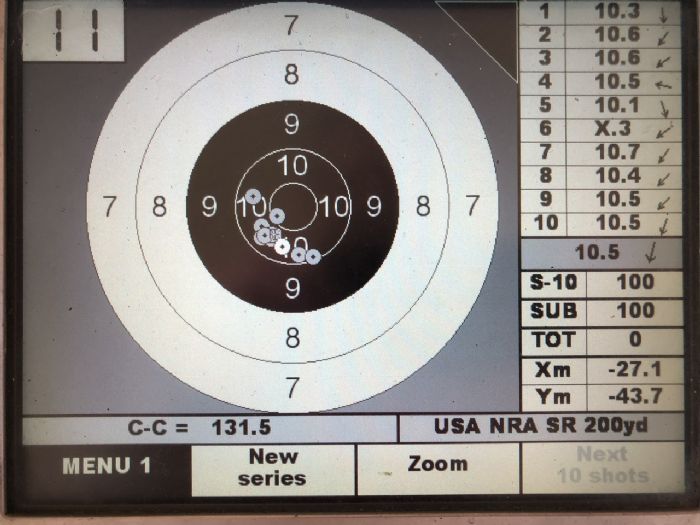 And finally, Group 3) cases partial length sized in the new Forster Bench Rest FL die: 40.0 gr Varget behind 174 SMK. I moved the front sight to the left and the rear sight up one click before I shot this group. It’s a bit more scattered than Group 2). 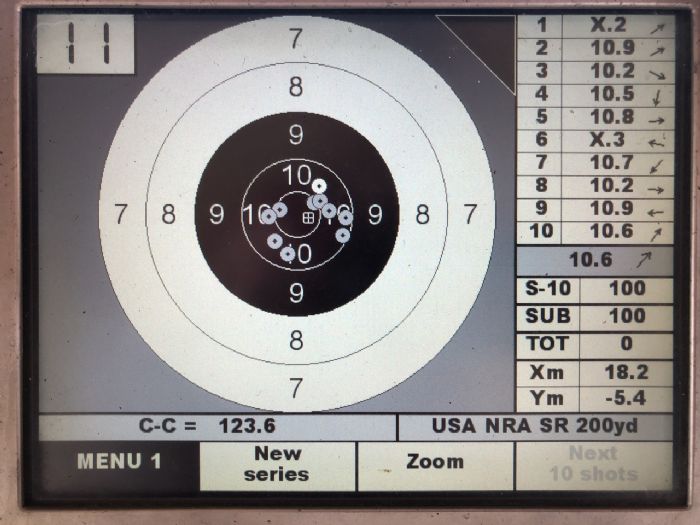 Here is another target with Group 3) loads, same as above. Note another flier at 10:00. But, a nice five shot cluster in the X ring.  Conclusion: I will no longer worry about bullet runout in the No. 4. It seems that the nose profile of the 174 SMK and the very long throat mitigate issues with bullet runout. Bullet runout most certainly made a big difference in my AR 600 yard line load with long pointy bullets (80 gr SMK) that are seated close to the lands. But, on this shot out barrel on my No. 4 with a whopping 1/2 inch jump to the lands, bullet runout does not seem to be a factor in 200 yard Service Rifle shooting accuracy. |
|
|
|
|
Post Reply
|
Page <1234> |
| Tweet |
| Forum Jump | Forum Permissions You cannot post new topics in this forum You cannot reply to topics in this forum You cannot delete your posts in this forum You cannot edit your posts in this forum You cannot create polls in this forum You cannot vote in polls in this forum |


 Topic Options
 Shamu wrote: